
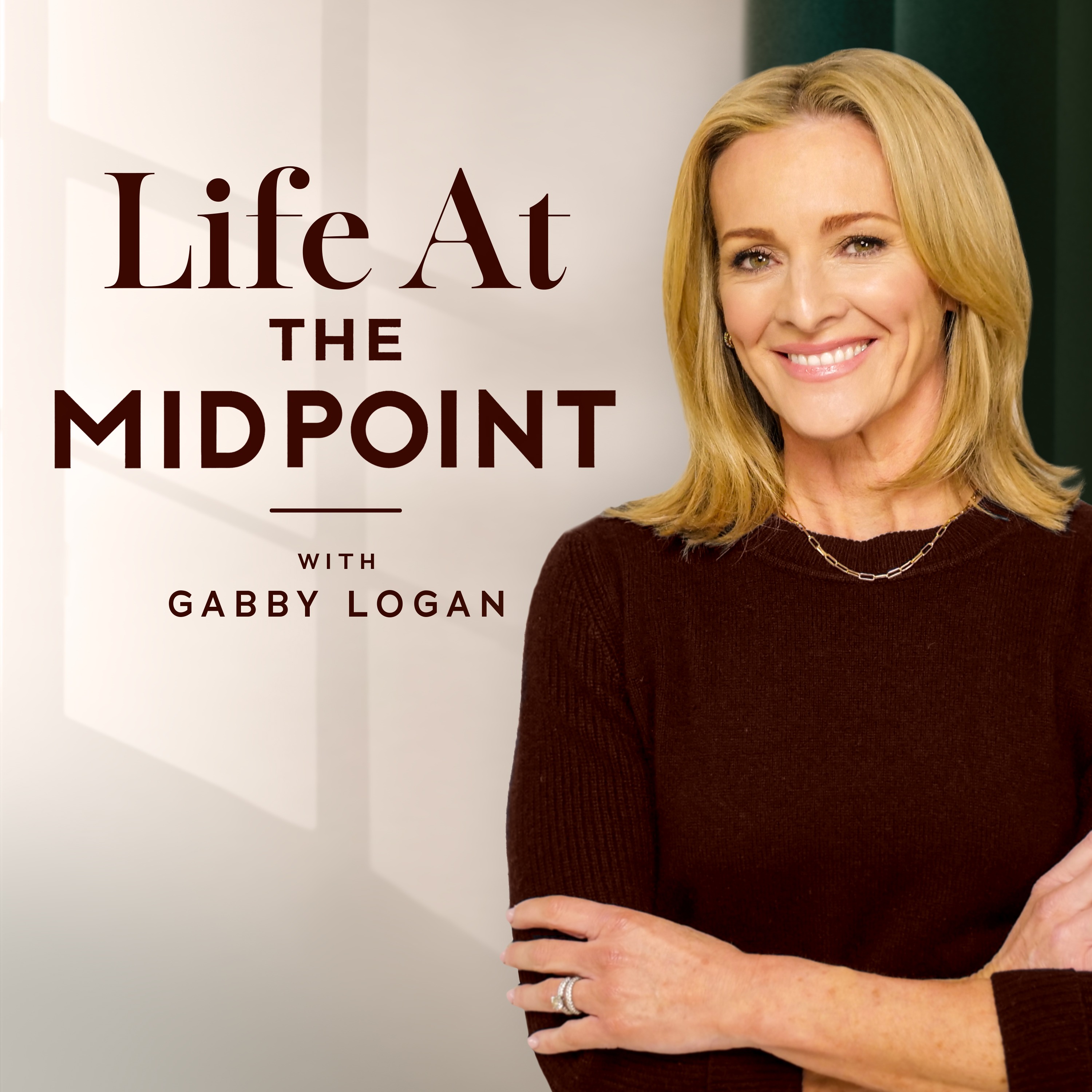
Gabby Logan talks to beauty journalist Sarah Jossel on Life At The Midpoint, drawing on listener questions to cover skincare ingredients, menopausal skin, pigmentation, treatments such as microneedling and LED masks, and makeup tips for midlife. Sarah also discusses her newly published book, The Diary of a Beauty Editor, which covers skin, makeup, hair and cosmetic treatments for all ages.
Topics menopausal skincare, pigmentation treatment, retinol and retinoids, microneedling advice, LED face masks, foundation and concealer tips, beauty industry careers, budget skincare products
Mentioned in this episode Sarah Jossel, India Knight, Hannah Betts, Bear Grylls, Joan Collins, Laura Mercier
Chapters
- 0:01:47 Sarah Jossel joins Gabby
- 0:02:22 Why beauty journalism matters
- 0:06:43 Listener Q&A begins
- 0:07:15 Pigmentation and SPF
- 0:09:11 Anti-ageing products and skin boosters
- 0:12:55 Menopausal skin, spots and rosacea
- 0:22:16 Microneedling, neck care and LED masks
- 0:31:13 Budget buys and book recommendations
Partner with Life At The Midpoint
Life At The Midpoint is produced by Audio Always. We work with brands on sponsorship, advertising and partnerships across our network of podcasts, reaching engaged listeners and viewers.
Advertising categories Skin Care, Makeup And Accessories, Skin And Dermatology
Show notes
Sarah Jossel is one of the most respected names in beauty journalism — a woman who has built a brilliant career helping people look and feel their best while navigating all the twists and turns that come with life in a fast moving industry.
In this episode of Midpoint, Gabby sits down with Sarah for a conversation that is part career deep dive, part listener Q&A — because you had questions and Sarah had answers. From the secrets of the beauty world to the bigger questions about confidence, ageing and how we feel about ourselves as we reach our own midpoints, this is a really open and honest conversation.
Sarah is warm, knowledgeable and refreshingly straight talking — and your questions made it even better. This one is for anyone who has ever wanted to know what really is behind the beauty myths and what actually works!
Hosted on Acast. See acast.com/privacy for more information.
Full transcript
Gabby Logan 0:01:02 Hello and welcome to The Midpoint. My guest today is someone who is much loved and trusted in the beauty industry. Sarah Jostle has been a must-read in the Sunday Times Style section for over a decade, a straight-talking woman on This Morning, and she has thrived on social media where she gives absolutely brilliant advice, a go-to for so many women and men when it comes to product and treatment recommendations. Her book, The Diary of a Beauty Editor, is out very soon, so it seems like a perfect time to tap into her expertise. And you have been sending in the most brilliant questions. Let's go meet Sarah. Sarah Jossel, welcome to The Midpoint.
Sarah Jossel 0:01:47 Thank you for having me.
Gabby Logan 0:01:49 Very exciting day I meet you on because today is book day. The Diary of a Beauty Editor is officially out today. So I've only seen it in PDF form.
Sarah Jossel 0:01:57 I am mortified. that you haven't actually had a copy, so I'm going to send you a copy straight after this. But yes, I've had a typical me day where I was so excited, I went off to the bookshops. I haven't been able to see it yet. Do you know, it's that, like, Instagram versus reality moment where it all looks so glossy, but the book hasn't arrived in any of the bookshops. So we'll get there, though.
Gabby Logan 0:02:17 But congratulations, because I know you say this in the foreword, I think it is, that it's taken a while to get off the ground, this book.
Sarah Jossel 0:02:22 Only 5 years.
Gabby Logan 0:02:24 Um, and, and it prompted a few questions when I was reading the first few chapters. Um, you, you're quite kind of almost, um, apologetic, first of all, about the— you say, look, being a beauty editor is really important. It's not apologetic, that's the wrong word. You're, you're kind of explaining why beauty is important. And I think that's important to establish now as well, how big an industry beauty is. It's not fickle, it's not shallow, it's worth a lot of money to this country.
Sarah Jossel 0:02:46 Of course. So beauty is a business. We talk a lot about the incredible work that the British Beauty Council do. You know, they are campaigning at Number 10 all the time about whether it is looking at the cosmetic treatments world and how we can be far more careful with what's going on there. It's It's the high street, you know, how we contribute to the high street.
Sarah Jossel 0:03:05 There is just so much business in beauty, and yet it is still massively looked at as just a silly little frivolous world by so many people, men and women. And so that is something that I, I really wanted to kick the book off with, to just say, yes, I'm a beauty editor. And it's this sort of phrase that I used to always say, which was, I'm a beauty editor, but I did study politics at university. Like, I always felt I really needed to say that. And I was talking to another friend who, said she used to say, I'm a journalist, but, you know, not a real one because it's beauty.
Sarah Jossel 0:03:37 And it's so sad that we feel that. That's obviously how we've always felt. But I, I would say after 16 years, I am now so proud.
Gabby Logan 0:03:46 A motoring journalist wouldn't do that.
Sarah Jossel 0:03:48 No, that's exactly what I said. I referenced, um, a journalist called Hannah Betts who said she got given this— well, she got offered this beauty column, and she said that her colleagues who are sports journalists, but, you know, wine journalists, car journalists, all was it career suicide. Don't do it. You will not be taken seriously anymore. And she said, you are literally writing about wine and cars and you're saying that beauty is nonsense. You know, they're, they're all— they all play its part.
Gabby Logan 0:04:17 Absolutely. They are all valid. And, and as you know, it is so important to people that they— you know, it's not about necessarily having treatments and plastic surgery and treatments, whatever. It's about presenting your best self. And for some people, that's having a hair blow dry. For some people, it's making sure that they're contoured, you know, to the max in the mornings. It's just about what makes you feel good.
Sarah Jossel 0:04:41 Each and every one of us have such a different relationship with our reflections, and we all are after different things. And that's what I try and say in the book. This is not about looking pretty for society.
Sarah Jossel 0:04:52 This is not about you know, looking great for anyone else. It's just how you feel when you look in the mirror. And 90% of us do this with our hair. And what I'm doing right now is fluffing it in front of as much of our faces as we possibly can because we don't like what we see. And we've been told from a very young age, doesn't— that's not important.
Sarah Jossel 0:05:09 Grades are important. What we do in society is important. But what we look like is not important. And I am here to change that, Gabby.
Gabby Logan 0:05:17 We all know that's nonsense as well, don't we? Because people will, whether they do it subliminally or they do it very overtly, they will decide something about you the minute they look at you. And whether it's because they've seen your fingernails are well kept, they might decide that you, you know, that you look after yourself. They might decide that you've got, you know, dirty fingernails, therefore you're, you know, you don't care about yourself. So
Sarah Jossel 0:05:39 it could be so much about—
Gabby Logan 0:05:40 yeah, and it's tiny micro things that we're all taking in all the time. Exactly. Right. And I think we need to go on with the questions because, Sarah Jossel, I have never had a response.
Sarah Jossel 0:05:49 I love how you say my name. I've just been telling Gaby, I love your voice so much. You need to present Desert Island Discs. That is the show for you, without question.
Gabby Logan 0:05:58 Okay, the campaign starts here. Lauren Burns, you're wonderful, but you do need a break at some point in your life, and when you are, I'll be ready. Um, you, you've had an incredible, um, response from our listeners. They, they love you, and they've sent in a wide range of questions, so I really need to get on with them. Okay. I think you'll be able to answer many of them.
Sarah Jossel 0:06:14 So I'm turning into an agony aunt for you today.
Gabby Logan 0:06:17 Well, you're— and I've spoken to a couple of makeup artists in the build-up to speaking to you who you know and you've contacted over the years regarding products, and they all say what they love about your recommendations is that it's not just you on your own at home going, oh, I like this mascara. Yeah, you contact other people within the industry and you want to know how it's working for them and how long they've been using it. And so, you know, your opinions are incredibly well researched. So here we go. Here we go.
Gabby Logan 0:06:43 There's a wide range of stuff. Showtime. And a lot of it does pertain to this period of life. Obviously, we haven't got too many teenagers emailing in.
Sarah Jossel 0:06:50 Funny that for the midpoint. Yes.
Gabby Logan 0:06:52 So I could give the weird Instagram handles, but I don't think I will actually. But @lelwise44 says— Well, I think you just did.
Sarah Jossel 0:07:00 We have called her out, or him. Let's
Gabby Logan 0:07:02 see, what are the best treatments for pigmentation which is caused by hormones? Um, pigmentation actually often occurs for women first time during pregnancy, doesn't it? That's when they sometimes get those weird brown kind of marks that start.
Sarah Jossel 0:07:15 Yes, so that would often be melasma, which most famously will come up on your upper lip or on your forehead, basically areas also that catch the sun. So I really— I'm gonna— we've started on a hard one, Gabby, because pigmentation is one of those subjects that I could tell you everything that you could do and ultimately it's still going to come back. So pigmentation never goes away for good. So what you're doing with pigmentation is you're maintaining it for as long as you possibly can and keeping it at bay, right? So that's the main thing.
Sarah Jossel 0:07:43 So any product you're buying that says gets rid of pigmentation, it can't, because once you've got pigmentation, that's your skin. And the second you go back in the sun it's very likely it's going to come back. So the number one thing you can do if— with pigmentation, and this is a very boring answer, is SPF. SPF is going to help protect it from not getting worse. A hat is actually before SPF.
Sarah Jossel 0:08:08 If you are someone who doesn't wear a hat when you are on holiday in broad sunlight, then your pigmentation is going to come back. So we're talking Joan Collins—
Gabby Logan 0:08:16 Wide-brimmed.
Sarah Jossel 0:08:17 Wide-brimmed hat. That's number one. Number 2 is SPF. Number 3, you're looking at a product— I always say something like the Skin Rocks. I want to say it's anti-pigmentation, hyperpigmentation. Correct me if I'm wrong on screen or somewhere. Um, but that is an excellent product for tackling pigmentation. And when I say that, it's going to help lighten it, but you want to be using that through the winter to help lighten it. It's not going to take it away completely.
Gabby Logan 0:08:44 Okay, that's excellent advice. Um, quite a lot of these questions Sum up what Fran424 says. I don't want— it just shows you how long Instagram's been going, that the names have got quite so ridiculous, doesn't it? Um, although that could be her birth name. Um, I don't want Botox or fillers. What are the best 2 products? I love it when I can keep you down to a very distinct answer. Um, distinctive even. Uh, one of the best 2 products to keep me looking youthful.
Sarah Jossel 0:09:11 Right, so the first thing to say is there is no such thing as Botox in a bottle. So any product that is promising you Botox in a bottle ban them, unfollow them, write to them and say Sarah Dossal said this is nonsense. That's my first request. Um, in terms of treatment, so what should we say, in clinic or at home?
Gabby Logan 0:09:31 Well, I think products. It sounds like products. It sounds like something you can buy off the shelf.
Sarah Jossel 0:09:35 Fine. Okay, so I'll quickly just say, because if you're saying I don't want Botox or fillers but I'm interested in something, skin boosters is the world to look into if you're in clinic.
Gabby Logan 0:09:42 Is that okay?
Sarah Jossel 0:09:44 Skin boosters? No, no. So skin boosters are injectables, but they are not going to plump your face or freeze your face. They are working on the collagen underneath your skin to help with the texture of your skin and what it looks like.
Sarah Jossel 0:09:56 So skin boosters are things like Julene polynucleotides, and they're a really, really interesting time for them because what they're not doing is they're not changing your face. They're helping the texture and essentially what your skin looks like rather than distorting your face shape in any way. So skin boosters are really interesting. It's what a lot of news presenters and, um, celebrities are doing because no one would know. You just look fresher.
Sarah Jossel 0:10:21 Okay. And I do think we're in that.
Gabby Logan 0:10:22 Is this the one that sometimes is called salmon sperm?
Sarah Jossel 0:10:24 Yes, right, that's polynucleotide. So it sounds worse than it is in that sense.
Sarah Jossel 0:10:28 Um, in terms of products, retinoids. So you will probably have heard of them as retinol. Um, like, you know, you should use retinol, and everyone's like, how, how, or what? Um, but that would be the number one step proven. Any consultant dermatologist who I talk a lot about in the book, they are the fairy godmothers of the skincare world.
Sarah Jossel 0:10:48 They have studied the science of skin for decades. They will tell you after SPF, retinoids is the number one step for improving your texture, fine lines, pigmentation, acne-prone, etc. And for that, the number one you could ever use if you want to look at toleration is a prescription retinoid. called tretinoin. So I'm going to say that as your, your number one.
Gabby Logan 0:11:15 You have to get a prescription.
Sarah Jossel 0:11:16 So that is, that is if you're, if you're going for like, I want this to be the most hardworking level of it. But if you're like, I'm not going to go and get a prescription now, then I would look at a brand like Medik8, M-E-D-I-K, then the number 8. They have a range called Crystal Retinol and it starts at number 1. That is the gentlest. And you can work your way up, I think, to number 10 now. And that is the product that I would work into your routine. And may I just say, before you tell me it doesn't work, please use it for at least a month.
Gabby Logan 0:11:48 Right, okay.
Sarah Jossel 0:11:49 For instant gratification, if you are thinking, I've got a big event, I want fresh skin, and you look in the mirror and you're thinking, my makeup's not sitting that well on my skin, it's a bit dull, it's a bit textured, it's a bit dry, then you want to use an AHA. So that's an alpha hydroxy acid. And I would do something like the Dr. Dennis Gross Peel Pads, which So easy, you just swipe them over your face and it's just gonna give you that glow like that.
Gabby Logan 0:12:14 What brilliant trio of advice there, different levels.
Sarah Jossel 0:12:18 Sometimes I think, are you— is this face of, Sarah, this is too complicated?
Gabby Logan 0:12:22 No, there's 3 entry levels almost there, isn't there? From kind of like a slightly more expensive, long-term thing to something you can literally go into a shop right now and just take off the shelf, and I like that. Okay, fear. So, Can you— and there's a lot of questions pertaining to this— Mrs. Beaumont says, uh, can you recommend a simple regime for menopausal skin? Now this opens up a bit of a can of worms for me because I get quite agitated when I see products describing themselves as middle-aged kind of product.
Sarah Jossel 0:12:55 Meno serum.
Gabby Logan 0:12:56 Yes, because I don't know what that really means, because surely everybody's skin in midlife is going to be different depending on what they've been doing for the previous 40 years to their skin?
Sarah Jossel 0:13:06 I say this in capitals in the books, that menopause is not a skin type. It's a time of your life. It's a phase. So my best friend is going through early menopause because she's on medication post-breast cancer at 30-something.
Sarah Jossel 0:13:22 Someone will not have any symptoms till 50-something. So there is no perfect skincare regime for someone going through menopause. So Mrs. Beaumont is not going to get the answer that she wants. What, what I needed to know from Mrs. Beaumont is what are her skin symptoms essentially from going through menopause? Is she finding that she's getting, uh, you know, more flushed red cheeks or dry skin, or suddenly she's getting acne for the first time in her life?
Sarah Jossel 0:13:50 Completely different things happen to people.
Gabby Logan 0:13:51 Let's attack all of those because there's another question that actually talks about middle-aged spots, and I wondered whether that was because of— obviously it is because of changing hormones often, but sometimes when you're topically and/or however else you're applying your HRT, that is then distorting your hormones. So often this is to do with fluctuating hormones, right?
Sarah Jossel 0:14:10 It's all to do with, right, with hormones and lifestyle and, you know, emotional, what you're going through, etc. All of that affects your skin.
Sarah Jossel 0:14:18 Gut health is a huge one. I mean, gut health is through your life though, so as in, it probably isn't something that will massively change when you, when you hit menopause. But I would say, so let's go through them. So if it is acne. You suddenly— you've never had acne before, or the last time you had it was a teenager, and suddenly you, you're faced with it again.
Sarah Jossel 0:14:38 So the first thing you want to do is look at your skincare regime. What oils are you using in it? Because oils are the number one problem for acne-prone skin. So have you been having a lovely life with your face oil, doing gua sha and massage, and suddenly you're getting all these red angry spots? Cut the oils.
Sarah Jossel 0:14:55 Go to an oil-free cleanser. oil-free moisturiser and watch what happens to your skin. So the key word that I always say to people when you're suddenly getting flare-ups is research non-comedogenic. That means non-pore clogging. That's— your foundation could be clogging your pores, your skincare could be clogging your pores.
Sarah Jossel 0:15:15 There is a whole world of non-comedogenic skincare and makeup.
Gabby Logan 0:15:19 Non-comedogenic?
Sarah Jossel 0:15:20 Yes, it means non-pore clogging.
Gabby Logan 0:15:22 Wow. Yeah, so it will say that On the product?
Sarah Jossel 0:15:24 Lots of them say it on the product. Lots of them will say oil-free, but really now you can type it into Google, give me a non-comedogenic cleanser, non-comedogenic moisturiser, and it will give you a full comprehensive list.
Gabby Logan 0:15:39 Wow. Yeah, okay, so we've got the spots sorted out.
Sarah Jossel 0:15:42 Yes.
Gabby Logan 0:15:43 And then, and then would you say to that person who's, who's messaged about spots, treat them in the same way they would have done as a teenager? Are there certain products that are better for later life spots than there are for
Sarah Jossel 0:15:53 No, it's all the same. You know, I think people try and
Gabby Logan 0:15:57 market it,
Sarah Jossel 0:15:57 market them into different categories. Maybe you don't want to put a Hailey and Justin Bieber road sticker on your face when you're slightly older. And they're fun, though. They do work. But you could easily say, you know, say you've got a big meeting and you've suddenly seen a huge spot there and you want to put a spot patch on.
Sarah Jossel 0:16:15 There are so many invisible ones now. CeraVe, La Roche-Posay, they all do those clear hydrocolloid patches, which essentially calms them. stops you picking them, and they're just really helpful. But the, the ingredient that if you really want to be like, right, I've got the spot, it needs to go, it's called benzoyl peroxide. And you can get that over the counter.
Sarah Jossel 0:16:37 It's something a lot of teenagers will know all about. But you're going to pop that on the spot before bed, and it is going to take it down.
Gabby Logan 0:16:43 Popping the spot before bed?
Sarah Jossel 0:16:44 Yes, don't pop the spots ideally. I do teach you how to pop the spot if you are someone who, who is going to pop the spot, whether I tell you to do it or not to do it. Um, but no, you're going to pop that on before bed and it's going to calm inflammation, help clear out the bacteria, etc. Okay. Um, and then salicylic acid is your friend. Sorry, there's lots of different things, but what I say with this is you don't need it all. Listen to the advice, research yourself, and pick the step that you feel speaks to you the most.
Gabby Logan 0:17:12 So then the dry skin that comes— that was a symptom that I definitely noticed when I first realised that my body and my, my face was changing. Actually, it was body body skin rather than face skin almost at first. Do you need anything different in midlife for your dry skin?
Sarah Jossel 0:17:26 So I think it's looking at your, your skincare regime and thinking, I've always loved that foam cleanser, move to a cream cleanser or move to a cleansing oil. So I, I mentioned Medik8, they do an incredible— I think it's called lipid cleansing oil, but it just feels like, you know, like silky on your skin.
Sarah Jossel 0:17:45 It's so delectable, which is, which is a mad thing to say for a cleanser, but it just, you know, it will really hydrate the skin while cleansing the skin. Have you always used, say, a lotion? Like, I've always used the CeraVe lotion and facial moisturising lotion, but if suddenly my skin was very dry, I would turn to the Drunk Elephant— I think it's called the Protini Cream— which is much richer. It's packed with ceramides, um, and glycerin, and it's got ingredients in there that's going to really amp up the dehydration and the dryness in my skin. So amp it up.
Sarah Jossel 0:18:18 Like, if suddenly you're faced with dryness and your moisturiser isn't cutting it, go up one. Look for the rich moisturiser, you know, in that way. Okay, you amp it all up.
Gabby Logan 0:18:28 There's, um, you mentioned redness, and there is a question actually from somebody about rosacea. So I think that— is that the same thing? Um,
Sarah Jossel 0:18:37 not necessarily. Right, okay. So rosacea, a very, very common symptom is redness, probably the most common. The reason why I'm very careful with telling people what products to use is often the best thing you can do with rosacea is use a lot less than you're using.
Sarah Jossel 0:18:52 You're probably panicked and upset about the flushed skin and you're using too many products. So strip it all back, go very, very, very gentle. What I always say, look at brands like La Roche-Posay, look at brands that are quite literally made for sensitive skin. Mm-hmm. So that is La Roche-Posay, that can often be CeraVe, things that are things that are fragrance-free is your number one tip.
Sarah Jossel 0:19:16 You would be surprised how much skincare has fragrance in it. And when you've got rosacea-prone skin, something like— I'm going to stick with La Roche-Posay. Go there because they are, they are absolutely made for sensitive, allergy-prone skin. And that is essentially what is happening. Your skin is flushed, it is allergy-prone, and it is red.
Sarah Jossel 0:19:35 So you want to calm it all down. Avène is another brilliant brand for rosacea-prone skin.
Gabby Logan 0:19:39 They're the kind of more medical-looking products or the ones—
Sarah Jossel 0:19:42 I'm afraid, yeah, because rosacea in that sense does fall under that category. I think people forget, you know, they think, oh, skincare is all lovely.
Sarah Jossel 0:19:49 Skincare isn't trend-led, and it isn't. I know it looks it, and I know Instagram and social media makes you feel that way, but actually this is the kind of stuff you, you want to— rather than spending your money on lovely packaging, spend your money on a consultant dermatologist appointment who will say to you, use this, use that. You actually do need prescription. And I talk a lot about prescription strength because it sounds far away from what you're going to use, but actually it could be the step you're missing in your skincare regime. And it's probably worth me saying now, in the whole world of rosacea and redness, azelaic acid.
Sarah Jossel 0:20:23 So that is the name. Have you heard of azelaic acid? No. Okay, so everyone's heard of hyaluronic acid for hydration, or, um, you know, AHAs for exfoliation, but azelaic acid is the most unsung hero skincare ingredient for redness, for post-acne marks, for uneven skin tone. It is so excellent.
Sarah Jossel 0:20:43 And you would find that in products like Dr. Sam's Flawless Brightly Serum. Dr. Sam is an incredible dermatologist who started in clinic, was always seeing people. She is the woman who I actually say is responsible for helping me with my skin journey. So I've had acne-prone skin my whole life, and people meet me now and they're like, are you sure?
Gabby Logan 0:21:01 Yeah, I'm one of those.
Sarah Jossel 0:21:02 I will— you sure? I will send— I will show you a picture after after this podcast, riddled with spots. And she said to me, we need to switch off the acne, and we're going to do that with azelaic acid. So brilliant for that, brilliant for post-acne marks as well. You know, when you get those little marks that you want to fade.
Sarah Jossel 0:21:19 Mm-hmm. Um, also 2 recommendations: Klira, K-L-I-R-A. So that was started by a woman called Dr. Emma Craythorne, and with her you get to do an online consultation with a top dermatologist. You will say to her, I'm struggling with rosacea, nothing is working. and she will make you a product based on your needs, and it gets sent to you.
Sarah Jossel 0:21:41 So now what's happening is we're democratising that whole dermatology world because not everyone can afford to go and see a dermatologist. So now you could go to a company like Cleara, and another one is called Skin and Me. So you would sign up, you would say, I'm struggling with redness, I'm struggling with acne, I'm struck— I hate my, uh, pigmentation and fine lines, and they will help create the serum step for you to use every day.
Gabby Logan 0:22:05 Wow, um, so many advances. It's incredible.
Sarah Jossel 0:22:08 So many.
Gabby Logan 0:22:08 Um, Annie says, um, and now we're kind of getting into slightly more the treatment area, and thoughts on microneedles. I hear such mixed—
Sarah Jossel 0:22:16 Have you had it? Yes.
Gabby Logan 0:22:17 And what do you think? I, I definitely see a massive difference. Yeah. When I, you know, I usually tend to do it more in wintertime because of the redness. Exactly. And it gets a little bit— if it's hot, it's not comfortable, is it, for a couple of days?
Sarah Jossel 0:22:28 No, microneedling is brilliant. I think people have to have realistic expectations, so you have to have it more than once sometimes. Wouldn't have it if you've got very sensitive skin, if you've got eczema-prone skin, if you're about to go in the sun. Wouldn't have it too close to an event.
Sarah Jossel 0:22:45 But generally, it is brilliant for helping with the collagen, helping with the glow. So all in all, I would say yes, but please don't cut corners with where you go, because what I do notice is suddenly you'll go to the hairdressers and they'll say, oh, you know, we, we started— we've got the skin pen and we can do that for you downstairs afterwards. It should never be that. Those sorts of treatments, you need to go to a reputable practitioner who you can— you have seen peer-to-peer reviews, you know that everything is hygienic. I know it sounds obvious, but you would be surprised how easy it is to go, oh, I saw that person do that on social media, I want to do that too.
Sarah Jossel 0:23:19 Go to— go ask people who you know love treatments, where did you go, what was your, you know, what was the downtime? Know what you're getting into before you do something like microneedling.
Gabby Logan 0:23:29 I said we're getting into treatments, but actually there's an area that keeps cropping up. Um, so we've got, um, Linda has asked this question. Linda Briceyland, she's 72, and she says she's just beginning to see wrinkly skin on her neck. Um, which, I mean, lucky Linda at 72 because I'm seeing it at 53. Um, and there's a few others who are talking about neck and neck cream. And is there such a thing as neck cream? Surely that's just a cream that's from somewhere else. And I mean, is it?
Sarah Jossel 0:23:55 I know, I always really want to help the brands out. No, I don't want to help them, but I always feel bad for the brands because they try so hard with this. I, I would always say treat your— I start your face routine from the nipples up. That's the best way to think about it.
Gabby Logan 0:24:09 No matter where your nipples are.
Sarah Jossel 0:24:10 Wherever your nipples are, start there and work the way up, because skin is skin. And yes, you know, people— this is also— this also affects the eye area. People always say about eye creams, do you really need an eye cream?
Sarah Jossel 0:25:02 The— yes, the skin on the neck and the skin around the eyes are slightly different, but if you are time poor, if you are on a budget, if you are thinking, I want to, you know, just get the best products in the right areas— it's also same to the back of your hands— use all the same products. So that would be a cleanser, that would be a serum, and that would be an SPF and a moisturiser if needed. Those 4 steps, you're doing it on your face anyway, just do it on the neck. So,
Gabby Logan 0:25:29 so amazing neck, Sarah Jossel. Well, thank you.
Sarah Jossel 0:25:31 I'm turning 40 in 2 weeks, so— So you're getting ready for the big day? I'm getting ready.
Gabby Logan 0:25:36 Yeah, well, you're looking great. Um, so we've got the neck covered, we've got teenage—
Sarah Jossel 0:25:41 Yes, I would say just very quickly on the neck in terms of treatments, um, because people always ask me about this, you can do great things with tightening with lasers around the neck area. Um, so I would say radio frequency, lasers. Um, some people can do Botox to do the— yeah, almost like the vertical lines that people might have Botox in it, in it, in the neck. Um, but again, it goes back to where it was. So unless you're going to be able to do it regularly, it's quite an expensive route to start if you're going to need to stop.
Sarah Jossel 0:26:14 What you could do is say it's before a big birthday or something like that, you could do it as a one-off, but just know treatments like Botox, they're not helping what's going on behind the scenes. It's just almost like a mask, and the mask will drop. Yeah, sorry, that sounds quite depressing.
Gabby Logan 0:26:29 Um, so, um, Claudia Mahoney said—
Sarah Jossel 0:26:31 Claudia, we love you! Claudia and I worked together at Glamour magazine.
Gabby Logan 0:26:35 You certainly did, and she loves you, and she sent about 3 different messages for you, but this is the one I've picked out. She said, as we head to our 50s, am I right to use Hourglass, or should I be looking at heavier foundation? coverage. I mean, I still love my tinted moisturiser by Laura Mercier as my day-to-day go-to kind of moisture, um, foundation. What's your take on whether we're going heavier, we should be going lighter?
Sarah Jossel 0:26:58 Yeah, so this is a bit similar to another question that you asked me in the sense of it's not really by your age because we've all got different skin types through life. So it's hard for me to say at 50 use this because you've all got different concerns. But I know Claudia and I know her, she's got gorgeous skin I would say the main thing is obviously as we get older and we have fine lines, or we might have slightly crepier skin or slightly drier skin, firstly think about what you're doing underneath your foundation. That is step number one, because if your skin is dry underneath, it doesn't really matter what foundation you use, it is going to look dry and cakey.
Sarah Jossel 0:27:39 Mm-hmm. Number 2, as we get older, I would say don't use your foundation to conceal. It's the biggest mistake people make. They put it all over trying to conceal that little mark of pigmentation or that red spot. Use a tinted moisturiser.
Sarah Jossel 0:27:55 So for example, one that I think is brilliant at the moment is the Milk Tinted Hydrogel Tinted Moisturiser or something like that. It's by— It's blue. Milk is the brand, Milk Makeup. It is so dewy and light and creamy, but it covers. So I would say use something like that and then go in with a concealer stick.
Sarah Jossel 0:28:14 like the— like the Hourglass Foundation Stick exactly where it's needed. If Claudia is using her Hourglass Foundation Stick everywhere and she looks great, I do remind people, you don't have to change. I think because they're seeing me talk about products all the time— me and everyone else, I'm not taking full blame for that— but, you know, because they're seeing that, they think I need to update. If it's working, stick with what you're doing.
Gabby Logan 0:28:40 That is great advice. You're right, there's that feeling of pressure that, oh gosh, I'm approaching a landmark age, should I be doing things differently? Well, you look great. You look great.
Sarah Jossel 0:28:48 But there are so many incredible tinted moisturisers out there now to play around with. Bare Minerals is a great brand. They've just brought out this foundation stick. If you're time poor and you're just doing it on the go, you're about to start filming here today, Gabby, you could take something like that and just put it on exactly where's needed. Pat, pat, pat, buff, buff, buff, and you're done.
Gabby Logan 0:29:05 There's an amazing concealer, um, as you were talking about concealers there, that disappeared off the market. And I hate it when this happens with products. one. All the makeup artists that I work with love it.
Sarah Jossel 0:29:15 Was it the banana?
Gabby Logan 0:29:16 It was the one that was in the little compact and it was hard. It was like— so as opposed to a liquidy one. Yes. And I had 2 and I left my makeup purse on the back seat of a cab. I know. And both were in the makeup purse and that was it.
Sarah Jossel 0:29:30 Gone.
Gabby Logan 0:29:31 I went on eBay, I went everywhere thinking there must be an end of line. But when a product is so beloved by the industry, why do they disappear?
Sarah Jossel 0:29:38 It happens all the time. And I wish I knew. Sometimes there's a few things that could be happening in the background.
Sarah Jossel 0:29:44 They could be updating the formulas. They could be seeing that it's not selling as well as something else. So they're going to merge it into something if it's within a bigger brand. So what you'll sometimes— and by that I mean one of the big houses. So a lot of the time people don't know that L'Oréal owns YSL, Giorgio Armani, L'Oréal Paris, Maybelline, Garnier.
Sarah Jossel 0:30:03 It's all under one roof who owns it. So they might think, Right. Well, that's gone. That whole brand is gone, for example. So let's bring that one hero product into an Armani.
Gabby Logan 0:30:14 Right.
Sarah Jossel 0:30:14 So there is a lot of that going on as well. But that does not help you on your mission.
Gabby Logan 0:30:19 You'd have to really know about the industry to know where that product's going, wouldn't you? Oh, yeah. So it's— so, yes. Yeah, it's a matter of kind of—
Sarah Jossel 0:30:25 but if you want your replacement, the Dior foundation, the Dior Forever Foundation Stick is basically that. It's a stick, but it's solid and you can take it and just whack it on anywhere. And it's a bit like a Photoshop for the face. There's a video of me doing it on my Instagram in the car, to which someone replied saying, why do you always have to do your makeup in the car? And I was like, because I have a 3-year-old and a 1-year-old, and where else would you like me to do my makeup? But it— you'll see in this video, it Photoshops
Gabby Logan 0:30:51 the face,
Sarah Jossel 0:30:51 the face in quite an incredible way.
Gabby Logan 0:30:53 We've referred to a lot of brands that, um, are quite pricey at one end of the spectrum. You've also done some kind of in the middle. There are good products. You go into Boots and you can find some really good products that make— to put into your makeup bag, I think, aren't there? So there's some— so, so give us a couple of those hero products for you that are at the lower end of the market.
Sarah Jossel 0:31:13 For sure. So I've got a section in the book called the High Street Hit List, and I basically say that that was one of the hardest sections to do because you're actually spoiled for choice now. So that edit is really, really hard. So Maybelline mascaras, I, I would probably choose them over anything expensive to this day. Makeup brushes, there are so many expensive makeup brushes out there And I would still pick a brand called Morphe, M-O-R-P-H-E.
Sarah Jossel 0:31:38 They, they are the most stunning quality. They work so well. They just blend everything. And most of them are around the £10 mark, which is brilliant. Um, I love Revolution, which is in Superdrug.
Sarah Jossel 0:31:53 Again, you would just never ever know that price point. Rimmel eyeliners, probably some of the best out there. Lipsticks, again, really hard, I think, because longevity is hard. When, when you're looking at high street lipsticks, they tend to look great, but then they tend to start gathering around the sides, except Kiko. K-I-K-O.
Sarah Jossel 0:32:15 It's the Smart Fusion range is the one I always rave about. So if you love neutral nudes, Smart Fusion have the most brilliant lipsticks.
Gabby Logan 0:32:25 Do you still use, or would you use, lip coat to keep a lipstick on?
Sarah Jossel 0:32:29 I, I mean, I don't use it because I think lipsticks in today's market last exceptionally well. But, um, India Knight, who I do— who also writes for Sunday Times Style, we, we did a talk the other night and somebody asked, you know, why did— why— where's Lipcoat? Lipcoat's still there. Yeah. And it's still doing its thing and people still love it. Um,
Gabby Logan 0:32:47 my mum used to use it.
Sarah Jossel 0:32:48 Yeah, no, people still absolutely love it. But now with technology today, there's just lipsticks last.
Gabby Logan 0:32:55 Yeah.
Sarah Jossel 0:32:55 Amen. Hallelujah.
Gabby Logan 0:32:57 They don't all end up on your face.
Sarah Jossel 0:32:58 Yeah, exactly.
Gabby Logan 0:32:58 Um, people talk about night creams. Uh, HFK82 says, what is the best night cream? What is a night cream?
Sarah Jossel 0:33:07 So this is something I, I upset a lot of brands with, especially in the book, because I don't use a night cream. You can use the same moisturiser in the morning and the evening as long as it hasn't got SPF. They should be absolutely fine to use day and night. The only thing that separates a night cream from other creams is it definitely won't have SPF in it because you're going to sleep in it. Mm-hmm.
Sarah Jossel 0:33:31 And the only other thing you might consider is if your night cream is very rich, you might find it doesn't sit that well under makeup and you might want to use something lighter. But otherwise, you do not need a separate day and night cream. It's quite an old-fashioned marketing concept that brands still have because people still want a night cream, but you don't need it.
Gabby Logan 0:33:53 And also, I think back to like my granny. They didn't really have a morning regime, did they? I know. So what they put on at night— remember Astral? Um, yeah, of course. That would be the night cream, and then in the morning it would be a wash and go, wouldn't it?
Sarah Jossel 0:34:08 Totally.
Sarah Jossel 0:34:08 I mean, I read my comments every Sunday in my column, and there is always one person who's like, you can just use Pond's cream and leave it there, or just use soap and water. And I always say to people, if you're happy with your skin and that's working for you, you use soap and water. But how great that in today's world, if you have— if you have got pigmentation or you are dealing with acne, you can now treat it yourself. You can now, yeah. You don't need to spend fortunes, you know, trying to get the answer, and you don't need to guess.
Sarah Jossel 0:34:37 That's what I always say. My book is there to help people not guess. Growing up, for a lot of women, it would be firming cream, youth in a jar, lifting cream, and no one knew what the ingredients were. But this, this generation, we call it skin-telectuals, and I quite like that. Now you'll say, well, what's in it that's going to firm and what's in it that's going to lift?
Sarah Jossel 0:34:58 And now we'll say, well, that's vitamin C and that's your retinoid and that's tranexamic acid. And you now understand those words to know what's actually working in your skincare. And it's not a filtered, lovely world of adverts going, use me, you know. Yeah. There's, there's more science behind it and ingredients.
Gabby Logan 0:35:15 And people have a thirst for that, I think, as well. Um, a few questions have come through about LEDs and those masks. Um, my husband bought me one at Christmas. Okay, my husband's Christmas kind of bounty for me this year was suspiciously anti-age— anti-aging. I don't like that expression. You don't like that expression, I know. But you know, those kind of—
Sarah Jossel 0:35:35 I don't— I mean, I get why it exists. Yeah, I always say that.
Gabby Logan 0:35:39 And I have had red light therapy in facials, right? So I was kind of— and so I did use it quite religiously in the first few months of the year, and I don't know if it was psychosomatic, I felt my skin was really good. We've been moving around the place at the moment and I've not been using it. Um, do they work? Should I keep using it?
Sarah Jossel 0:35:54 I think you are pretty much the same as the rest of the nation. You use it a bit in the beginning and then it falls out of your routine. So number one, I would say on behalf of all skin experts, never choose a mask over your skincare products. Because there is a lot of that. It's like, well, I'm using this now. Still cleanse, still treat, still moisturise, still SPF. This is very much a nice-to-have. So an LED mask, there'll be— there will often be different colours. You'll see red, you'll see blue. Blue is my favourite of them all, and that is for acne-prone skin.
Gabby Logan 0:36:27 And that really works?
Sarah Jossel 0:36:28 When I say it really works, you still have to be careful with that because it can— it can work and it can help with inflammation and redness. On, you know, with acne-prone skin, but you are still better off using skincare. So here's the thing with an LED mask: if you are someone that's going to use it every day, it's going to commit to 15 minutes, not 1 minute. If you have bought a mask that is very close to the skin, because there are so many out there that are almost too hard and they're here and they're not even getting to your skin.
Gabby Logan 0:37:00 Mine's rubbery and it sits right on.
Sarah Jossel 0:37:02 Yeah, if it's quite literally sitting on the skin. If you know you are going to be that person who is consistent— and consistent is quite—
Gabby Logan 0:37:11 3 times a week.
Sarah Jossel 0:37:12 Literally the theme throughout my book— I would go in more, like 4 to 5 times a week. And you're willing to be patient enough, you know, that's 2 months, a month, 2 months, 3 months to see any difference, then I'd say go for it and use it. But if, like me, you've forgotten to put your Invisalign in for like, you know, you, you wear that just about here and there, or you never check like expiration dates of products and you're rubbish at doing Ocado or your shop or whatever it is, then it might not
Gabby Logan 0:37:42 be—
Sarah Jossel 0:37:42 it might not be for you. That's my thing. And also remember, when you do your red light in facials, they are using a far higher strength red light than what they can legally put in your at-home LED.
Gabby Logan 0:37:54 So what is the best on the market?
Sarah Jossel 0:37:57 I would say there is a brand called Z Skin, and the woman behind it is Dr. Ifeoma Ejikemi, and she's made it. She's got an incredible clinic where she's known for her face peels, her, um, in-clinic face peels. I really trust her, and she has brought out an LED mask, and I would say that is probably the best. But we are— we're talking hundreds of pounds. They're not cheap. No. And if you are spending under £100, it's not going to have a strong enough light.
Gabby Logan 0:38:23 Yeah, if you're not going to be using it as well as regularly as you say, then really it probably is something that you'd be better off having some good facials.
Sarah Jossel 0:38:30 Um, you're way better off doing facials and skincare, and then research brands like CurrentBody and Shark Beauty.
Gabby Logan 0:38:37 Okay, I think mine's CurrentBody.
Sarah Jossel 0:38:39 There you go. Yeah, yeah.
Gabby Logan 0:38:41 Um, there, there are more questions and there are more areas we could go into, but our time is just about up. But I, I think it's fair to say, Sarah, that you can read your book and get even more information, and that everything we've covered pretty much is within the book as well, isn't it? There's a lot of those— a lot of those questions are answered within the book.
Sarah Jossel 0:38:57 Yeah, so the whole premise of the book is there is skin, makeup, hair, fake tan, hair removal, fragrance, cosmetic treatments. And I very much know that most people I meet apologise before they ask me, I'm so sorry to ask, but they're so embarrassed to ask about beauty that I hope this answers all your questions. And I talk to teenagers, I talk to new moms, I talk through— talk to women going through menopause, I talk to men, hair, um, with receding hairlines.
Gabby Logan 0:39:22 Oh, I love that you've done men because somebody asked me what's Kenny, my husband's Do you know what he swears by? Beef tallow. He loves a bit of beef tallow on his skin.
Sarah Jossel 0:39:29 Bear Grylls. Bear Grylls and I had a real head-to-head on this. He was like, SPF is terrible and we should all just be using beef tallow.
Gabby Logan 0:39:36 He uses SPF as well.
Sarah Jossel 0:39:37 Yeah, beef tallow is a real movement, and it's a very particular type of person. I mean, if you're happy to stink of—
Gabby Logan 0:39:43 Oh no, he's got a fragrance.
Sarah Jossel 0:39:44 Has he got a fragrance?
Gabby Logan 0:39:45 Yeah, he doesn't smell of beef.
Sarah Jossel 0:39:46 Well, a lot, but you'd be surprised. It is now, it is now a movement where it's like just like smelling of
Gabby Logan 0:39:51 the beef.
Sarah Jossel 0:39:51 I don't know if they like it, they just believe it's excellent for the skin. I'm, I'm gonna, I'm gonna do a bit more research in this world of beef tallow because it is a movement and I know it's there. Um, but men can use what women use, and that's the truth. He uses all my products. Yeah, men's skin and women's skin are completely the same. The only difference would be facial hair and not the odd chin hair, you know. If you have got, you might be dealing with ingrown hairs and things like that.
Gabby Logan 0:40:15 Yeah, we haven't really got into facial hair. No. I feel like you need to come back. Maybe when you've sold a million copies of the book, you'll come back.
Gabby Logan 0:40:22 That is a tall ask. And we could do another area, because honestly, it has been such a popular shout-out. I had so many brilliant questions, and you are so loved. So thank you for writing the book. I think it's going to be one of those books that people have on their shelves and they can pass it through the generations, and everybody can use it as a reference over the years.
Gabby Logan 0:40:40 You know, like when we were growing up, there was a cookery book— I've forgotten what it's called now— and it was It was before everybody had millions of cookery books and everybody used to— it was like the Nigella, the original Nigella book, you know?
Sarah Jossel 0:40:49 Yes, yes, yes, yes, yes.
Gabby Logan 0:40:50 It's gonna be that kind of book.
Sarah Jossel 0:40:51 Well, I can only pray and hope that that is the future of the book. So yes, and I'll just say very quickly, because there will be people listening to this, that anyone who has recently gone through a cancer diagnosis, that is, that is the person who comes to me the most, which I hate, and I wish it wasn't like that.
Sarah Jossel 0:41:08 And they are so apologetic to say they wish they didn't care about their brows or their hair loss, but that is the thing that they are struggling with, and can I help them? There is a whole section of that in the book as well. So anyone who is going through that, buy this book for them, and I hope that they find it useful.
Gabby Logan 0:41:22 They sure will, as will everybody else who comes to you for advice and wisdom. Thank you so much, Sarah Jossel, for coming on.
Sarah Jossel 0:41:28 Thank you, Gabby Logan.
This transcript was generated automatically and may contain errors.