
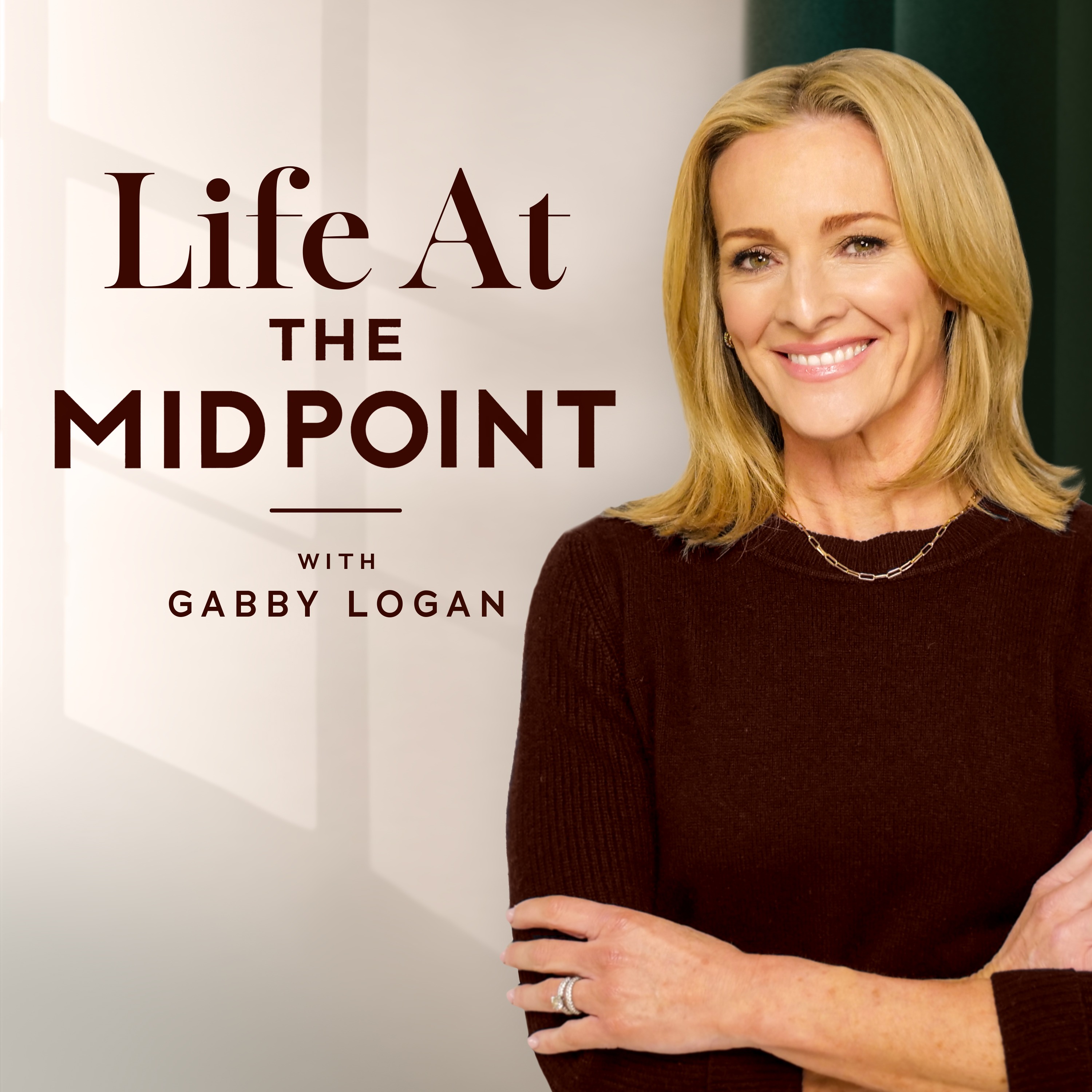
In this episode of Life At The Midpoint, Gabby Logan speaks with bestselling psychological thriller writer Lesley Kara about reinventing herself in her mid-fifties after years working in education and dealing with ill health. They discuss grief, ambition in later life, the confidence that comes with age, and the pressures facing women at midlife. Lesley also reflects on the television adaptation of her debut novel The Rumour and her latest book Troublemaker.
Topics second careers midlife, women's ambition ageing, grief and loss, psychological thriller writing, confidence and self-doubt, reinventing yourself fifties, late bloomer success
Mentioned in this episode Lesley Kara, Nuala McGovern, Harlan Coben, Richard Osman, Margaret Atwood, Ruth Rendell
Chapters
- 0:01:13 Introducing Lesley Kara
- 0:02:14 Grief and loss at midlife
- 0:04:24 Reinventing a career in the fifties
- 0:09:45 The writing life and creative process
- 0:16:52 Inspiring others through social media
- 0:22:04 Representation of older women in fiction
- 0:28:33 Troublemaker and finding confidence with age
Partner with Life At The Midpoint
Life At The Midpoint is produced by Audio Always. We work with brands on sponsorship, advertising and partnerships across our network of podcasts, reaching engaged listeners and viewers.
Advertising categories Freelance Writing, Young Adult Literature, Screenwriting
Show notes
Welcome to The Midpoint with Gabby Logan — the podcast where we pause at life’s crossroads and talk honestly about the shifts, challenges and opportunities that come with being in the middle of it all.
Today, Gabby is joined by bestselling psychological thriller writer Lesley Kara, whose gripping novels have captivated readers across the UK and beyond. After years working in education, Lesley took a leap of faith and turned to writing — and her debut novel The Rumour became an instant sensation, proving that it’s never too late to change direction and chase something new.
In this conversation, Lesley reflects on the courage it takes to reinvent yourself, the realities of launching a creative career later in life, and how self-doubt can coexist with ambition. She shares what she’s learned about resilience, success, and the surprising pressures that come after a breakthrough moment.
Expect a thoughtful and candid discussion about second acts, creative risk-taking, and what it really means to find your stride at midlife.
Hosted on Acast. See acast.com/privacy for more information.
Full transcript
Gabby Logan 0:01:13 Hello and welcome to The Midpoint. My guest today is a woman who found that her 50s truly were the beginning of the time of her life, caring less about what other people think, getting her first book deal for her book Rumour. And as the title of her latest book might suggest, she's enjoying being something of a troublemaker. We also have something in common which may well come up today. This week we buried my dad, and last week Leslie Cara wrote a post about the recent death of her mum on Instagram.
Gabby Logan 0:01:40 She talked about how women in their 50s and 60s are often rebuilding after loss, but this can happen, of course, much younger and to men too. So I hope we
Gabby Logan 0:01:48 get a chance to talk about that and a very pertinent line in her post, which was, it isn't only the physical fact of ageing that wears us down, it's everything that comes with this stage of life. So there's that to talk about, but also something else she's passionate about, which is keeping doing the things we want and carrying on fulfilling our ambitions, whatever decade we're in. Let's go chat to Lesley. Lesley, thank you so much for coming on The Midpoint.
Lesley Kara 0:02:14 Oh, thank you for inviting me, Gabby.
Gabby Logan 0:02:16 First of all, can I say I'm so sorry for your loss? And you recently posted about your mum dying.
Lesley Kara 0:02:22 Thank you, yes.
Gabby Logan 0:02:24 Very recently.
Lesley Kara 0:02:25 Yes. We're both grieving, aren't we, at the moment?
Gabby Logan 0:02:28 Yeah, I spoke to you in the week that we had my dad's funeral. So a lot of what you said actually really resonated and will do for a lot of our listeners because, as you pointed out, women in particular, I think, and it affects men as well, but women in their 40s, 50s, 60s are often dealing with loss and change at the same time. And it's a really powerful kind of period of life in one sense, but also it can be a period of life that's filled with a lot of grief.
Lesley Kara 0:02:57 Absolutely. And the journey we've had with my mum, you know, it's been several years of very ill health and my dad as well. My dad died in 2024. So yeah, it's taken a real emotional toll, I think, on myself and my siblings. But yeah, it's a sad time, but it was the right time for mum. You know, she was very old. She had dementia, she was bedbound, quality of life wasn't great. So really, it was— it's a relief, but it's still very sad and it's a lot to process. It churns up all sorts of memories and emotions, as I'm sure you're well aware.
Gabby Logan 0:03:29 And it's all about being human, isn't it? It's all the stuff that you talk about when you lose somebody kind of reconnects you with what it is to be human. Even the process of a funeral and hearing about a life. I think we just don't pause and take stock until we get into those situations sometimes.
Lesley Kara 0:03:46 And this is actually the the 3rd funeral I've arranged in 2 years because my dad, as I say, my dad died and then my stepson died. So it's, yeah, it's been a lot. Yeah.
Gabby Logan 0:03:58 And on happier notes, the last few years for you has been quite remarkable. And since your first book was published in your mid-50s, life has taken a very different kind of trajectory, hasn't it? And you've become a a kind of powerful spokeswoman, I think, for not forgetting your dreams and not getting rid of ambition just because you hit a certain age.
Lesley Kara 0:04:24 Absolutely. I really do believe that. I mean, the last sort of decade for me has been one of the most creatively and professionally fulfilling. I've wanted to be a writer all my life, but life, work, family, ill health all seemed to conspire against me. And it wasn't really until my mid-40s, my midpoint, that that changed.
Lesley Kara 0:04:46 I mean, I can talk about why that changed. I'd been working in education for a long while. I was a nurse to start off with, and then I went into teaching. And I, like in many jobs, you're good at what you do and you get promoted. And I ended up in a management position, Head of Education and Training.
Lesley Kara 0:05:07 And then I became Director of Quality for my sins. I'm not sure whether quality might have dipped under my aegis. I'm not sure. But all through that time, I was suffering suffering from undiagnosed endometriosis. And so I tried various treatments and, you know, different alternative therapies, acupressure, acupuncture, and dairy-free diet, and all sorts of things.
Lesley Kara 0:05:32 But what I'm trying to say is I had a long period of time where I was juggling ill health, depression, and trying to hold down a really high-powered, but it was a very important job. You know, I was Director of Quality in a large college of further education where I was dealing with Ofsted. And yeah, it was a lot. And so my writing, I always had this writing dream. And it wasn't really until I became clinically depressed after I'd had various operations that my husband, my second husband, my now husband, said to me, look, you've always wanted to write.
Lesley Kara 0:06:10 Why don't you prioritise that? And I thought, yes, he's right. I've always put my work first and my family first. And it was time to prioritise my own ambitions. And that's something I strongly believe in, that ambition doesn't fade as we get older.
Lesley Kara 0:06:29 With me, it's increased. I've become more confident, more capable.
Gabby Logan 0:06:33 You said something wonderful, actually, on one of your posts about confidence, that people think they have to be confident before they act. But it's the opposite almost.
Lesley Kara 0:06:42 It really is the opposite. You have to show up and do something and the confidence comes. I mean, I'm nervous before I do things. I'm nervous now. I was nervous before I arrived here today. I was nervous before I did the Woman's Hour interview going out live. Very nervous. But I thought, you know, I have to do it because we have to move out of our comfort zone sometimes if we want to succeed. And I always enjoy these things so much more retrospectively because I think, yes, I did it. Yeah.
Gabby Logan 0:07:09 And you know you can do it the next time. Exactly. the first time really that is ever the time you're not sure. And then after that, it's just all experience, isn't it? Yes. But you didn't have the experience of being a writer at this point when your husband said— you were a writer inside and you'd always enjoyed writing. So why do you think that moment— because I'm sure over the years people must have tried to nudge you into writing more. So what was it at that moment that made you receptive, do you think?
Lesley Kara 0:07:37 I think it was It was a combination of having that period of ill health, having time off work, a prolonged time off work, and realising that although I loved teaching and I loved my job, and I wanted to do the best job I could do, I needed more. Mm. And I needed to prioritise that ambition that I'd always, always had.
Lesley Kara 0:07:59 You know, from a young child, I used to write stories. I used to submit to agents all throughout my 20s and 30s. I would be submitting short stories to magazines. That was a time when there was no social media. And you had to research everything by going and getting the Writers' and Artists' Yearbook out of the library.
Lesley Kara 0:08:18 And you had to send submissions. You had to type out your manuscript and put it in an envelope and stick a stamp on it. And I didn't really know any other people who had the same ambition as me. And I think now, if I was doing it now, there'd be a whole tribe. It's hard to communicate.
Lesley Kara 0:08:32 I'd find my tribe so easily. But yeah, I didn't. And also, you know, having 2 young children, a marriage that was sort of— I mean, it was fine for a long while, but then, you know— Then it wasn't. Then it wasn't. As these things happen.
Lesley Kara 0:08:47 Nobody's fault. But that's what happened. So, you know, I think women particularly, we put our— we often put our own interests and needs to one side. And we, yeah, we prioritise everybody else but ourselves. And I think when you hit that sort of midpoint, when you hit your 40s, you realise that there's possibly more time behind you than in front.
Lesley Kara 0:09:09 And if you don't do it now, you're not going to do it. You're never going to do it. And I think I'd reached the stage with my writing where I had accepted the fact that if I never got an agent or I never got a publishing deal, I would still continue to write. You know, we don't say to our—
Gabby Logan 0:09:29 So you're a true artist. I think so. Because that's— you're not doing it because of validation from elsewhere. You're doing it because you have to. The stories were there.
Lesley Kara 0:09:36 Yeah, I'm doing it because I have to.
Lesley Kara 0:09:38 I mean, I wanted validation. I think we all need validation. We all have egos, don't we? However, we might pretend we don't. I did need that validation.
Lesley Kara 0:09:45 But I also realised that I wanted to write. I mean, we don't say to someone who paints or sculpts, oh, well, if you're not going to be, you know, if you're not going to do an exhibition at the National, what's the point? We don't say that, do we? And writing can be very cathartic. And I love the process of writing.
Lesley Kara 0:10:03 I mean, obviously, I love the success. And I love the fact that my books are now published. And I get to do things like this and get to go to festivals. But ultimately, my real enjoyment, my real pleasure comes from sitting down at my desk on my own, talking to myself like a madwoman, and creating stories and characters.
Gabby Logan 0:10:22 And the characters have always been with you, I imagine. The stories have always been there. Even the days when you were too busy or not feeling mentally like you could do it, the stories were there. So how did you— I mean, how did you suppress them? When they wanted to come out?
Lesley Kara 0:10:36 I dabbled. I sort of did. I often started novels and wrote about 3 chapters and then gave up. And that's very common with aspiring writers because it gets hard. I mean, it's hard writing a novel. And it's all very easy and wonderful when you've got this fantastic shiny new idea and you set off writing. But it's sustaining that over 80,000, 90,000 words. It's a marathon.
Gabby Logan 0:11:00 Well, your success has come with Crime writing. So where was it always solving mysteries and kind of looking at the reasons why people get into trouble?
Lesley Kara 0:11:10 No, no, I think I started off wanting to write literary fiction. And I got some advice from an editor once. This was before I got my agent. And she said, I mean, I'd been trying to write a gentle comedy. And the feedback that came back was quite brutal. She said, well, it's not funny. I thought, oh.
Gabby Logan 0:11:30 It's a bit too gentle.
Lesley Kara 0:11:34 I mean, I made myself laugh, but there you go. But she did say— Have
Gabby Logan 0:11:38 you had a look back at that manuscript now that you've had—
Lesley Kara 0:11:40 No, I haven't. She did say that there was one paragraph, a couple of paragraphs where it was quite suspenseful. And she said, I wonder, have you thought of writing domestic noir or psychological thrillers? And I hadn't up to that point, which is surprising because I loved reading them. You know, I grew up on Ruth Rendell and P.D. James.
Gabby Logan 0:11:58 Right. I was about to ask that. Was that your preferred genre or your go-to genre in terms of your own reading?
Lesley Kara 0:12:03 I'm quite an eclectic reader. So I read a lot of different genres. I love literary fiction. I love— I used to, as a child and a young woman, I used to read a lot of romantic fiction. I don't now.
Gabby Logan 0:12:15 Do you go anywhere near writing about romance? Is that somewhere that you kind of feel—
Lesley Kara 0:12:19 Not really. Although my second novel, Who Did You Tell, did— although it's a psychological thriller, it did have a romance in it. And it did have a little bit of sex in it as well, which appalled my sons, you know, because of course, they read my books. And they say, oh, Mum, I didn't like that. I had to read that very quickly. I mean, if you can't embarrass your teenage children, you know, you're failing, aren't you?
Gabby Logan 0:12:41 So your second husband pushes you kind of into action and says, this is what you've always wanted to do. How quickly then did you notice the way you were, that your mental state, your physical state starting to improve?
Lesley Kara 0:12:54 Oh, 100%. I mean, by this time I had had a hysterectomy as well. I'd had a total hysterectomy and I was feeling healthy. And I continued to work for a couple more years. But then when I made that decision to stop and to do the Faber Academy writing a novel course, yes, it was like, I felt like I'd come home. I thought, this is what I should have been doing all the time, you know, right from the beginning. And I kind of berated myself for a little while for sort of leaving it so long.
Lesley Kara 0:14:38 But then I thought, well, we can't beat ourselves up for decisions we've made in the past because at the time we made them—
Gabby Logan 0:14:45 Also, everything you've done to date informs the person that you are now.
Lesley Kara 0:14:49 Exactly. And we made those decisions at the time based on the circumstances we were in. So yeah, so I really— that was the time. It was the time. And I did feel that if I hadn't, prioritised my writing, and if I hadn't given it my best shot, even if I'd never succeeded, you know, in a sort of traditionally published way, I think I would have regretted it. And I would have become even more depressed, I think. And I haven't been depressed since. I've had low periods. Obviously, life throws those at us. But yeah, it was the right thing to do. I feel like I am a writer.
Gabby Logan 0:15:22 Yeah. And what you're talking about now, especially the way you use your social media, I think is brilliant in terms what's been picked up on, the comments that you've made about women getting to an age where it's not just the ageing process, the physical ageing process, there's a heavy load that women have. So to be able to then go on and achieve our dreams or try and kind of realise ambitions we had when we were younger, it's just even harder, isn't it? It's much harder to access that younger kind of spirit that we had.
Lesley Kara 0:15:52 Yes. And I think as we get older, we often sort of recapture our adolescence almost. And those, not in all the bad parts of the adolescence, but the sort of the thoughts and feelings and ambitions and desires.
Lesley Kara 0:16:04 Yeah, I mean, the ageing thing that I've been doing on Instagram, that's relatively recent because I think when I first started off, I didn't bang on about my age because I was published— my first novel, The Rumour, was published when I was 55. Yeah. And I thought, if I don't bang on about my— it was that sort of thing where we sort of glorify youth, don't we? And I didn't want to be thought of as the older writer. So I thought, well, if I don't mention it, people might think I'm still in my late 40s.
Lesley Kara 0:16:30 Ridiculous, ludicrous, vain, you know. So it's only really in the last few years years, as I'm now 62, I thought, I can't really pretend I'm not 62. And I've leant into the ageing and been trying to say, well, look, you know, it isn't too late. You can achieve whatever you want. Well, maybe you can't achieve whatever you want, but you can achieve things and you have ambition still at this age.
Lesley Kara 0:16:52 And that's when I've been getting an influx of new followers and amazing comments. I mean, some of them quite heartbreaking, actually. Yeah. people who feel washed up. And they're 20 years younger than me.
Gabby Logan 0:17:02 Yeah. And you're obviously inspiring those who perhaps had just put all their ambitions to one side and thought that was it, to just have a little look back in, you know, in their kind of youthful selves and say, right, this is the time now.
Lesley Kara 0:17:16 I hope so. I hope so.
Gabby Logan 0:17:18 It would appear so from the comments that you get underneath your posts. I
Lesley Kara 0:17:21 mean, women, you know, women have been writing to me saying they've, you know, they've started new businesses. They've gone back to— or not gone back necessarily, but gone to university for the first time and I myself was a mature student. I didn't go to university until I was in my mid-30s.
Gabby Logan 0:17:35 So you've always left things a little bit late.
Lesley Kara 0:17:38 I have, I have, yes. There's obviously a pattern here.
Gabby Logan 0:17:41 But not a procrastinator.
Lesley Kara 0:17:45 Absolutely not.
Gabby Logan 0:17:46 And really a doer from the, well, you know, what you were going through in your life and doing in your life. A hard worker.
Lesley Kara 0:17:51 I think definitely. I mean, I've always wanted to do the job well. I think that's probably why I didn't prioritise my writing earlier because I had this very sort of stressful job I lived and breathed that job. You know, I brought it home with me.
Lesley Kara 0:18:05 I wanted to be seen as competent and capable. In fact, I also wrote recently in one of the posts where I was— I remember a time when I was probably going through the perimenopause and having all those various symptoms of brain fog and being in a meeting with 2 other male directors from a different college and forgetting what I was going to say mid-sentence and feeling terrible about it, feeling really— Awful. incompetent and ridiculous, really. I, I, I, letting one moment destabilise me like that. But, uh,
Gabby Logan 0:18:38 well, I mean, the confidence that, you know, can ebb and flow anyway as a woman in terms of the, the cycle. If you're a younger one with your cycle, you meet— we all know, don't we, how that changes. But what's come out just in the last week is, is how our grey matter is affected as well in menopause. And so I think there's got to be greater understanding. Yes. What women are going through.
Lesley Kara 0:18:57 Oh, absolutely. I mean, I, I feel very motivated to, to make up for lost time now, you know. My 6th novel's just come out. And that's in sort of 6 novels in 7 years or what have you. You're a machine. Well, I wouldn't go that far.
Gabby Logan 0:19:10 And this is Troublemaker. This is Troublemaker, yeah. And do you see your style now really kind of finding its feet in terms of what you're writing?
Lesley Kara 0:19:21 I think so. And I think I would like to start writing with older protagonists. Because in fact, I was on the Woman's Hour interview recently and Nuala McGovern sort of picked me up. And because I was talking about the sort of lack of representation for older women in in books, on the screen, in the arts generally, and in marketing, you know, it's all skewed to the younger generation. And she said, well, why don't you write an older character?
Lesley Kara 0:19:44 And I thought, my God, she's quite right. And I said, yes, I need to up my game. I mean, the main character in Troublemaker is 39, 40, on the cusp. So yes, she's kind of midpoint, but still quite a bit younger than me. Yeah.
Lesley Kara 0:19:56 So I think that's what I need to put my money where my mouth is now and write an older
Gabby Logan 0:20:00 And do you see a recurring character in terms of this subject?
Lesley Kara 0:20:04 Well, I mean, I think I would love to write a series. But I think publishers are quite wary about commissioning series until they know how well the book is going to do. I quite like writing standalones for now because—
Gabby Logan 0:20:19 When you finish, is that it? Have they gone, those characters? Are you quite—
Lesley Kara 0:20:22 Well, they have and they haven't. I mean, with The Rumour coming out on TV last year, then obviously, I was I was thrown back into that world.
Gabby Logan 0:20:32 And what was that like?
Lesley Kara 0:20:33 Oh, that was amazing. I mean, a long time coming because it was optioned back in 2018 and it came to the television. These things take time. Yeah, it was glacial. And
Gabby Logan 0:20:43 of course, you've probably shared it with a few people and they're going, when's that thing coming out? When's it coming out?
Lesley Kara 0:20:48 Well, at one point I thought it would never happen. There were lots of sort of ups and downs where it was greenlit and then it wasn't. So when Channel 5 took it on with Cuba Pictures and Clapperboard Studios, that was absolutely wonderful. And of course, I insisted on being an extra. in episode 1, because why not? You know, if it's good enough for Harlan Coben, then really.
Gabby Logan 0:21:08 Harlan Coben's in every single one, isn't he?
Lesley Kara 0:21:10 He is.
Gabby Logan 0:21:11 Somewhere.
Lesley Kara 0:21:11 Yes.
Gabby Logan 0:21:12 I don't know if Richard Osman's done that, has he?
Lesley Kara 0:21:14 I don't know. Did he appear in the film? I'm not quite sure.
Gabby Logan 0:21:18 No, I'm not sure. His partner was in, but he maintains cast completely separately and nothing to do with him. But yeah, I mean, they're older people, obviously, that he's writing about, but they're much older people, aren't they? So I guess if you're writing about your peer group. That's a different kind of life experience again, isn't it?
Lesley Kara 0:21:37 Yeah. But just going back, you were asking me about whether any of my characters come back. But there is a character in Troublemaker, Lena, the police officer, who is also a character in a previous novel. So there's like little biscuits. I do sort of like to— is that the word? Little crumbs? Easter eggs, I think they call it, where you sprinkle them in.
Gabby Logan 0:21:56 Right. Okay. And have your readers Now, do you think, kind of cemented? Do you feel like they're a group that you could recognise? Are you gathering a
Lesley Kara 0:22:04 tribe?
Lesley Kara 0:22:04 I think so. Yes. I think so. And a lot of— this is the sort of interesting thing because often marketing of novels is aimed at younger readers, you know, 20s and 30s. But the bulk of the readership, I think, and the people who support books and go to book festivals and come to events are predominantly, not exclusively, obviously, older women.
Lesley Kara 0:22:27 And there's no— I think older women tend to be portrayed more perhaps in literary fiction. But with psychological thrillers, they tend to be younger, maybe mothers. But there's no reason why women over 50 can't be put into a thrilling situation because we lead thrilling lives. You know, many of us are leaving relationships and travelling and reinventing ourselves. I'm not leaving my relationship, by the way, just in case my husband's listening and thinking, what's she talking about?
Gabby Logan 0:22:56 But not necessarily the prime relationship, there are other relationships in your life, aren't there, that you might decide you're— you talk about women in their 50s and 60s rebuilding after loss. And that loss can be other things, can't it? It can feel like you've lost something of yourself or you've lost a relationship with a longstanding friend or, you know, even taking yourself out of a job that you felt was defining you. You know, if you had a 10, 20, 30-year career in some kind of high-powered environment, that can feel like a loss.
Lesley Kara 0:23:25 Yes. And retirement. I mean, I hate that word retirement. Me too. It's not a good word. is it? We're not retiring, are we? We're just leaving one job and going on to pastures new. But yeah, it's—
Gabby Logan 0:23:37 Well, I mean, every Blue Zone study in the world talks about purpose. And if you retire, that sounds like you've— where's your purpose?
Lesley Kara 0:23:45 It sounds like you're declining, doesn't it? Whereas I see it as a period of expansion and growth and the time finally to focus on your own needs. But of course, that's problematic because for many women, my age, they are still working full-time and have to work, and perhaps in jobs they don't like. They're also caring for elderly parents, looking after grandchildren. So it's the one time in our life when we maybe have the time, and hopefully some of us the extra money, to indulge our passions. But for many women, they're pulled, still being pulled in all these different directions.
Gabby Logan 0:24:22 So what's your advice for women listening to this? this who want to fulfil those ambitions that they felt perhaps time had gone, they weren't going to do that?
Lesley Kara 0:24:30 Are you talking writing ambitions or any ambitions?
Gabby Logan 0:24:34 Any ambitions, yeah.
Lesley Kara 0:24:35 I think, you know, we can't all go big, can we? We can't all sort of take a year off and write a novel or climb a mountain. We can do one small thing. We can take small steps and carve out time within our week that is just for us. You know, if you've always wanted to write, You can find half an hour in your day.
Lesley Kara 0:24:53 You can join a writing group. If you want to get fit, you know, you can do an exercise class. That's my mission for this year, to regain my fitness because I've kind of let that go a little bit in the last year or so. Yeah, I think just prioritising your own needs and carving out time, even if it's something small. Small steps build habits, don't they?
Gabby Logan 0:25:15 What is your writing routine now? Because I imagine the small steps have become A different routine in terms of the professional side of things.
Lesley Kara 0:25:22 Well, I write full-time now. And so that means I obviously treat it like a job. It is my job.
Lesley Kara 0:25:30 At the moment, I'm not writing a novel. I'm coming up with ideas for the next one. But when I've started a novel, when I'm in the thick of it, then I work probably— I get up early in the morning. I work for a few hours, have breakfast, go back to it. So you work before breakfast?
Lesley Kara 0:25:44 I do work for— well, I mean, I might have a banana and a cup of tea or something. I can't keep going on an empty stomach. But I'm then have breakfast. Then I will work probably till about the early afternoon. So I do work for about 5 to 6 hours each day.
Lesley Kara 0:25:59 And when I'm editing and it's really, you know, coming towards the time when it's going to be published and I'm working on the last sort of stages of it, then I work all hours. All night? I might work— not necessarily an all-nighter. I don't think I've got the stamina for that. But—
Gabby Logan 0:26:15 You work into the night?
Lesley Kara 0:26:16 Work into the night sometimes, yes.
Gabby Logan 0:26:17 So when you write your first draft, without doing any editing?
Lesley Kara 0:26:20 Well, you know, they always say you should edit as you go. But I'm afraid— sorry, they always say you shouldn't edit as you go and that you should just get the draft out.
Gabby Logan 0:26:31 Get the story out.
Lesley Kara 0:26:32 Get the story out. But I am an editor. I do go back and obsess over things and take quite a long while writing. But if I get the first few chapters right, then that's a sort of springboard. But I do spend quite a lot of
Gabby Logan 0:26:47 time
Lesley Kara 0:26:48 And
Gabby Logan 0:26:48 do you discuss these ideas that you're currently thinking about with anybody? Or are they all—
Lesley Kara 0:26:53 Not when they're in the very early stage. I mean, I might— I'll discuss them with my agent because she's a really good sounding board. I'm meeting her after this, actually. She's taking me for a cup of tea and a cake. And we're going to be talking about the next book and what I'm going to be doing.
Gabby Logan 0:27:06 So you've got some ideas that are forming at the moment?
Lesley Kara 0:27:08 I've got some ideas. They're quite nebulous at the moment. But
Gabby Logan 0:27:11 it's so exciting, though, isn't it? To, you know, to begin going through that process. This must be one of the joys of, you know, of now being being able to do this for a living, that this is your work. Yes, absolutely. And discussing what you want to write, which is something you probably just did anyway before. Absolutely, yeah. What do your friends think about this?
Lesley Kara 0:27:29 Oh, they're very pleased for me, obviously. You know, I've been talking about writing a novel all my life. So, you know, it was that question, how's the novel coming on? You know, so now I am actually a published writer. That's great, you know.
Gabby Logan 0:27:41 And in terms of your social media profile, which we discussed, the brilliant things that you talk about in terms of ambition, I imagine your publishers really love that as well. They do.
Lesley Kara 0:27:50 Yes.
Gabby Logan 0:27:51 It's rare that even you see somebody in their 60s being so proactive on social media as you are.
Lesley Kara 0:27:57 A lot of writers don't like social media. They feel that they should just be allowed to write. And that's— I have a lot of sympathy for that. You know, we're not marketers, we are creatives. But I tend to view it as a creative act in itself, coming up with ideas for posts.
Lesley Kara 0:28:14 I don't want to be ruled by it. It is a time suck. I have to be quite disciplined and regulated. I'm not going to look at my phone all day long. But obviously when you've got a book out, you know, you are looking.
Lesley Kara 0:28:26 If readers contact me with a message or a story, I don't want to ignore them. So I am probably always looking at my phone at the moment.
Gabby Logan 0:28:33 And who do you like to follow on social media in terms of inspiration?
Lesley Kara 0:28:38 Oh, lots of different people. I mean, I love art, so I love following artists. artists' accounts and interior design and anything that's creative and that's lovely to look at visually. I do follow other writers, but I tend to have quite a broad base of accounts I follow.
Gabby Logan 0:28:55 And do those art accounts and the interior design, does that give you inspiration?
Lesley Kara 0:28:58 Absolutely, yeah. And I like to look at accounts in different sort of spheres and see what they're doing that works and see how I can adapt that to my niche. Because it's all about niche apparently now in social media. Yes. Although I would argue that ageing isn't a niche, is it? We're a huge part of the population. So I think that was it. I wrote— prompted to write an article for The Bookseller, which was sort of, you know, older women are not a gentle niche. You know, we don't want to just be confined to cosy crime and grandmother roles, you know.
Gabby Logan 0:29:31 And how marvellous as well that there is no age limit. to doing what you do. You can carry on now that you have this career. You can carry on for as long as your books are being published and your agent wants to keep representing you.
Lesley Kara 0:29:44 I think that's the key, the latter statement there.
Gabby Logan 0:29:48 That's not age dependent, is it?
Lesley Kara 0:29:49 No, absolutely not. No, it isn't. No, it is a profession you can carry on. I mean, look at Margaret Atwood. I mean, she's in her 80s. And Ruth Rendell, I think, died in the middle of writing her book. And, you know, she'd practically finished her book when she passed away. So yeah, it's something that you can continue to do. And I do love writing. I love writing psychological thrillers. I love being a troublemaker myself. And I think even more so now that I'm older. So it's probably an apt title.
Gabby Logan 0:30:18 So yeah, you've said that, that you quite like this age, that you don't have to care as much. Is that what a troublemaker is, do you think?
Lesley Kara 0:30:26 I think so. Well, I mean, in the book Troublemaker, she's just— the main character Storm is dismissed as a troublemaker because she keeps calling the police out for incidents that only she has seen. She's the sole witness. So the sort of question is, you know, is she telling the truth? Or is somebody— So I think, in a sense, although she's younger than I am, that notion of being dismissed or being written off and not taken seriously is a message that sort of correlates to, you know, older age.
Gabby Logan 0:30:57 So you are something of a troublemaker.
Lesley Kara 0:30:59 I am. And increasingly so.
Gabby Logan 0:31:02 But in terms of that idea of not caring, which I think sometimes gets misrepresented. It's not that we don't care what people think because we're going around, you know, kind of through life just disregarding social norms or anything, but not being as bothered about other people's opinions.
Lesley Kara 0:31:17 I think that's it. It isn't not caring. You do have to care what people think. You don't want to go around hurting people, do you, and offending them. But if somebody doesn't like me now, I just accept it. Before, I would be worried. Why don't they like me? What am I doing wrong? Now I I just think, well, that's their right not to like me and I'm going to carry on regardless. I'm also much more assertive. I used to put up with things that I perhaps would not put up with now. And I think that's one of the real positive things about getting older, finding your confidence and speaking up for yourself.
Gabby Logan 0:31:54 Saying no to something but not feeling you have to explain it.
Lesley Kara 0:31:57 No, not explaining, not giving— I mean, I still have a tendency to sort of give it lots of reason. And then I think, no, I write an email and then I think, no, I can just say I can just say, no, I'm sorry, I'm not available on that date. I don't have to go into all these ridiculous details. I
Gabby Logan 0:32:09 realised I was doing that way too much when I once took a screengrab of my diary to explain to somebody who kept asking me to host the same event all the time. And I was saying it was clashing with work. And I was like, why am I showing him my diary? It should be enough that I'm just saying, no, I can't do it.
Lesley Kara 0:32:28 Absolutely, yeah.
Gabby Logan 0:32:29 So yeah, I gave myself a bit of a talking to then. And following in your lead, I'm trying not to over-explain on a no now. So it's a good feeling.
Lesley Kara 0:32:38 It is a good feeling. And we're constantly learning, aren't we? And constantly evolving as people and how to be and how to, you know, we never have it sorted.
Gabby Logan 0:32:47 No. That's the other thing I think you've talked about brilliantly is that if we wait for a period that's going to be perfect, it will never come.
Lesley Kara 0:32:53 It never arrives. And we never feel grown up. I mean, I don't, I certainly don't feel 62. I mean, I still, in my head, I'm, what, 32? I think I am. I mean, nothing changes, does it? You're still the same person. So yeah.
Gabby Logan 0:33:09 I bumped into 2 of my really good friends from school who came to my dad's funeral the other day. And so I don't see them very often. They live in Leeds. And we were best mates around the age of 13 to 17, 18.
Gabby Logan 0:33:21 And immediately kind of, I'd say it's 20 years, 25 years since we've had a natural conversation apart from just messages and how are you? And, you know, see you've had a baby, that kind of thing. And we were talking again, like we were 16-year-olds. I don't mean in terms of the content, but just that energy that we had. In my mind, we were at school, you know, just stood at the edge of, you know, the gate, about to go into school.
Gabby Logan 0:33:44 And it really made me kind of go, oh my gosh, we, you know, what happens that you suddenly, you know, the world might see you differently, but that same energy is there.
Lesley Kara 0:33:54 Yes. It's funny, actually, that reminds me, I got a message this morning from someone who's done a She's doing a garden design course. And she's, I think she's in her 60s. And she said that when she tells people, if they ask her how old she is, and when she tells them her age, they seem to be treating her differently now, even though she was one of them sort of a little while ago, because she looks younger than her age. And so it's, yeah, it's that weird sort of, we don't change, we don't become a different person just because we're in our 50s or 60s, do we? No, no. We're still exactly the same inside.
Gabby Logan 0:34:29 Yeah, I'm a little bit more life experience.
Lesley Kara 0:34:30 More wisdom, perhaps.
Gabby Logan 0:34:31 A bit more wisdom. Hope so. Yeah, well, clearly, um, you're garnering lots of that and ideas, and I wonder if anything of this studio will enter your, your next book.
Lesley Kara 0:34:41 Oh, well, it might well.
Gabby Logan 0:34:42 In the world of media or podcasting.
Lesley Kara 0:34:45 Are you casting yourself as a key character here, Gabby?
Gabby Logan 0:34:49 I think, I think it needs to be around Woman's Hour because that's iconic, isn't it? And I think that will resonate with your—
Lesley Kara 0:34:54 You've given me some good ideas to, to chat with my agent about in a little while.
Gabby Logan 0:34:58 You're guaranteed to go back onto one of those shows to promote the book. So, you know, see me Friday.
Lesley Kara 0:35:04 That's very good advice, Gabby. Will you be my mentor?
Gabby Logan 0:35:06 Thank you so much, Lesley, for coming on. Once I'd seen some of your clips and started to kind of learn about your story, I was so keen that the Midpoint community learnt more about you. So now they can all go and buy all of your books. Oh, that would be lovely. Yeah, and keep being prolific. Thank you so much.
Lesley Kara 0:35:21 I shall try. Thank you very much.
Gabby Logan 0:35:23 Thank you.
This transcript was generated automatically and may contain errors.