
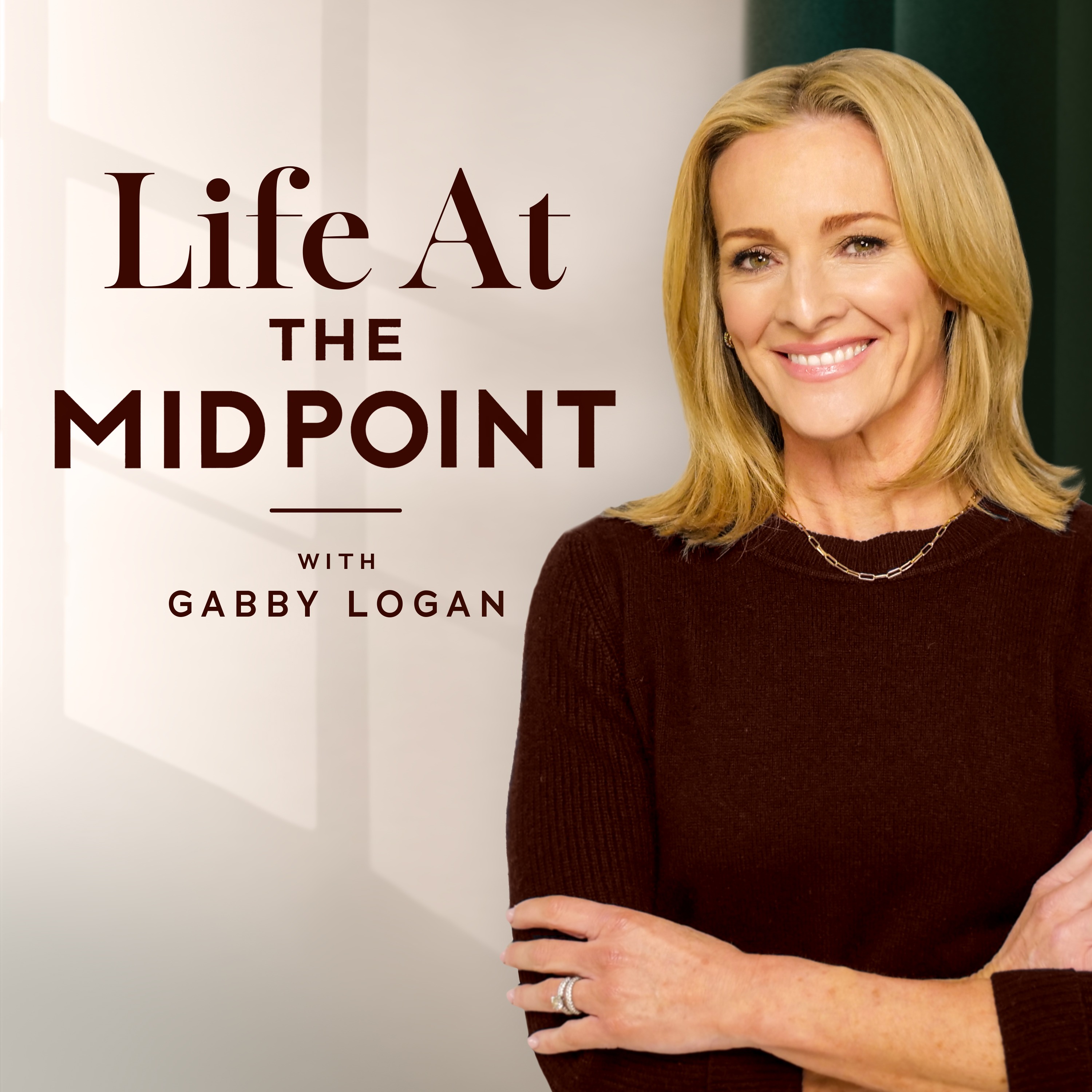
In this episode of Life At The Midpoint, Gabby Logan speaks with author Catherine Gray about her book Little Addictions, which explores the small compulsions — from phone use and gossip to ultra-processed food — that quietly shape everyday behaviour. Together they discuss the science behind habit formation, dopamine, early drinking age and addiction risk, and practical tools for reclaiming agency over ingrained patterns.
Topics habit change, phone addiction, dopamine and behaviour, alcohol and young people, little addictions, people pleasing, equine therapy, behaviour change tools
Mentioned in this episode Catherine Gray, James Clear, Paul Dolan, Brooklyn Beckham
Chapters
- 0:03:04 Introducing Little Addictions
- 0:04:37 The Sticky 8 and the 15 addictions
- 0:08:12 Managing phone use
- 0:14:48 Gossip and judgement as addictions
- 0:18:41 Nature, animals and recovery
- 0:24:06 Language, habits and timeboxing
- 0:27:01 Early drinking age and addiction risk
- 0:34:59 Slow dopamine and healthy habits
Partner with Life At The Midpoint
Life At The Midpoint is produced by Audio Always. We work with brands on sponsorship, advertising and partnerships across our network of podcasts, reaching engaged listeners and viewers.
Advertising categories Substance Abuse
Show notes
For this episode, Gabby sits down with author and speaker Catherine Gray for an honest, curious conversation about the habits that shape our lives — and the tiny patterns that quietly run the show.
Best known for her writing on behaviour change and sobriety, Catherine joins us to explore the ideas behind her book Little Addictions, unpacking how small compulsions — from scrolling and sugar to work and worry — can subtly steer our choices, moods, and identities. Together, we look at why humans cling to rituals, what it really takes to shift ingrained habits, and how self-awareness can open the door to something more intentional.
This episode marks a reflective pause in the journey: a chance to examine the everyday dependencies we often overlook, and to ask what freedom might look like — not in dramatic transformations, but in small, meaningful changes.
A thoughtful Midpoint conversation about awareness, agency, and the stories we tell ourselves about control.
- More than 40 percent of respondents who began drinking before age 15 were classified with alcohol dependence at some time in their lives, the researchers found: https://www.niaaa.nih.gov/news-events/news-releases/age-drinking-onset-predicts-future-alcohol-abuse-and-dependence
Hosted on Acast. See acast.com/privacy for more information.
Full transcript
Gabby Logan 0:01:49 Hello and welcome to The Midpoint. Today we're talking about addictions. Now you might think, Oh, well, this is not for me. But hang on a second, because Katherine Grey, my guest today, has written Little Addictions. Not about the breakfast gin drinker or the 50-a-day smoker or the gambler who's in thousands of pounds worth of debt, although plenty of what she has learnt relates to them.
Gabby Logan 0:02:08 This book, and hopefully the chat you're about to hear, will almost certainly relate to you. It certainly did to me. I first became aware of Katherine when I read her brilliant book, The Unexpected Joy of Being Sober, which more than one friend has confided in me changed their life. In Little Addictions, Catherine has identified 15 addictions, including gossip, procrastination, dating, and shopping. Within the 15, there is this sticky 8, which includes things like alcohol, gambling, and phones.
Gabby Logan 0:02:35 Now, you might have half nodded at one or maybe two of those. And as Catherine says, many of these, including the phone, might not be your fault, but it is your responsibility. It's more than a self-help book, and it looks at how we got here as a society, And we're going to explore that in our chat. But if you want to do something about one of your little addictions and free up some time and headspace in your life, then buckle up. Let's get some tools to make a change.
Gabby Logan 0:03:04 Katherine, welcome to The Midpoint.
Catherine Gray 0:03:06 Thank you. Lovely to be here.
Gabby Logan 0:03:07 I mentioned in your introduction that I read your book, The Unexpected Joys of Being Sober, and, and then when this book kind of landed in my inbox, I was very excited because you have such a great way of writing that makes it so easy to kind of dive in and be part of your journey. And I'm delighted to say this book has that similar feel that, you know, I think it's so accessible for people because, as the title says, you know, this is something— and I said in the introduction— that I think most people will connect with in some way, even if they don't think they have Yeah.
Gabby Logan 0:03:44 So where did you get the idea that actually there's probably a lot of people who've got things they just either want to quit or cut down on?
Catherine Gray 0:03:51 Well, it was a combination really of social observation. So I think that, and I am willing to die on this hill of a statement, I think that everyone has or has had a little addiction, if not a medium or large addiction. And I think, you know, even if you haven't experienced clinical addiction, which I have to alcohol, you know, it's Diet Coke, it's candy, It's vaping, it's TikTok, it's Vinted. And the really interesting thing about this book is whenever I mention the premise to people, they're like, they know instantly what their little addictions are and they can reel them off.
Catherine Gray 0:04:26 But oftentimes, there are more than they think. So they— the top 3, and then once they dive into the book, they're like, oh, actually, I've got 7. And I personally, no judgement, because I've got 10.
Gabby Logan 0:04:37 Right. And you talk— so there's 15 in the book.
Catherine Gray 0:04:40 Yeah.
Gabby Logan 0:04:41 And then there's the Sticky 8, which reminded me a bit of— I've been on safari a couple of times, you know, There's the ugly 5, and then there's obviously the 5 that everybody wants to see when they go on safari, the Big 5. So the Sticky 8, would you say they're the kind of the more insidious ones almost that you—
Catherine Gray 0:04:58 Yeah, they're definitely the stickiest ones. And by stickiest, I mean, you know, the most addictive. So I worked with a neuroscientist and addiction specialist to draw them out. And they are alcohol, nicotine, cannabis, Gambling, gaming, and porn, and our phones, and ultra-processed food. But then there's 7 more in the book. There's, you know, shopping, caffeine, dating and sex, people pleasing, procrastinating, judgement, and gossip. I think I've hit them all. So yeah, there's— I mean, those are the most common little addictions. So that's what I really wanted to get into. And those are the things I've struggled with myself many a time. Not all of them, but many of them.
Gabby Logan 0:05:40 And then you have a kind of formula through the book, don't you, of kind of almost like there's a checklist of ways of asking yourself the questions about these things. How did you come up with that formula?
Catherine Gray 0:05:51 So that table of how to tell whether something's a little addiction or a big addiction, I worked with an addiction psychiatrist to pull that out. So it's things like if someone were to tease you about this. So say, for instance, I love tea. I drink way too much tea.
Catherine Gray 0:06:07 But if someone teases me about it, I don't get very defensive and feel very ashamed. Whereas back in the day with my relationship hopping, because I believe I was a love addict, and also my alcohol use, I would have pretended to laugh but really had a visceral reaction to that and felt very emotional. And afterwards maybe thought, who are they to talk? They drink too. Yeah.
Catherine Gray 0:06:32 So things like that. And also the lengths that you'll go to to get this thing. love chewing gum. It's one of my little addictions, but I wouldn't walk a mile at 1 AM like I used to walk for wine or cigarettes.
Gabby Logan 0:06:44 And you talk about how much money is in, you know, left in your account, and would you spend that on this thing? I seem to remember, it's been a while since I read your book about The Joy of Being Sober, that was something that was really apparent with your alcohol addiction. Oh, yeah. That you would spend literally the last pound of your bank account on alcohol.
Catherine Gray 0:07:00 100%. And, you know, I would go and buy a bottle of Sauvignon Blanc and buy a pot noodle for dinner. And that, you know, I don't like pot noodles. So that is a real sign when you're willing to redirect your funds mainly into that thing. But I think most people who are reading the book will find that their addictions are little. It was just in there to do my due diligence because obviously the book isn't for people who have medium or large addictions. It's about moderation. It's not about quitting. And if you do have a larger addiction, then abstinence is probably the best option.
Gabby Logan 0:07:32 Yeah. So there's a way— so that's the beauty, I guess, of This book, that there's a way of dealing with those things, that you don't have to get rid of them completely in your life. And as you say about people pleasing, that has a purpose.
Catherine Gray 0:07:43 It does have a purpose. I mean, if you're really gonna go hard on the people displeasing, which I did when I started trying to stop it. So people pleasing is otherwise known as fawning. And I read a lot about it a few years ago and really started trying to stop fawning and saying yes to things I didn't wanna do and all that sort of thing. But I went too far. And then people were actively displeased. So I think, yeah, there's a balance to be found when it comes to ceasing people-pleasing.
Gabby Logan 0:08:12 Phone will be something I think that resonates with a lot of people. It's highly likely they're listening to this on a phone. And they have great, great advantages to our life. We know that. And they also have enormous disadvantages. And a lot of the advice around the phone comes down to being disciplined in terms of how we use it, doesn't it? And it's putting it away, having days off the phone, having hours off the phone. How do you manage your own phone use?
Catherine Gray 0:08:40 I do a few things. So I have an 8 PM cutoff, and I put it underneath a cuddly toy of my daughter's, so that if I pick it up, I have to move this cute seal, because I'm then prioritising my phone over family time. So that for me has really worked. That's cut it down to 2 or 3 hours. But I also do other things.
Catherine Gray 0:09:02 I mean, I will literally go to the lengths of deleting So I'll redownload Instagram every day if I'm using it a lot for work or what have you, and then I'll delete it so that I don't look until the next day. So it's all about reducing friction and also installing friction if you want to do something less. So there's lots of apps that you can use, like 1 Sec is really good. It makes you take 3 deep breaths before you open an app. Right.
Catherine Gray 0:09:27 And that engages your prefrontal cortex. I'm not a neuroscientist, but I spoke to many who told me about this. Installing a delay really helps us think about what we're doing and if we actually want to do it.
Gabby Logan 0:09:40 So what is OneSec then?
Catherine Gray 0:09:42 It's an app that you can download and you can attach it to different— To everything? Yeah, to any apps that you find to be sticky. So say, for instance, people have talked about Ocado and Rightmove and Vinci.
Gabby Logan 0:09:55 I get Rightmove.
Catherine Gray 0:09:56 I get Rightmove. And I mean, one of the things, one of the reasons Rightmove is—
Gabby Logan 0:10:00 I can't believe they're not sponsoring this. I mention them all the time.
Catherine Gray 0:10:04 They should. And one of the reasons, so I spoke with some evolutionary psychologist for the book as well, because I was really interested in how apps that are the most addictive often tap into ancestral urges that we can't turn off. So the Rightmove thing is, you know, you can't turn off the urge to get a better cave.
Catherine Gray 0:10:21 So even if you have no intention of moving, which I don't at the minute, and yet why am I still looking at Rightmove? So that's one of the things that you'll find any app like Instagram, it taps into wanting to stay in the community and the tribe. Mm-hmm. You know, that's really important for survival. It was back in the day.
Catherine Gray 0:10:39 So you'll find that they often, even if they have a very modern design, they tap something very ancient.
Gabby Logan 0:10:46 And that's what you say at the beginning of the book. You talk about the fact that a lot of these things have been kind of put on us as opposed to us going out and seeking them. But then we have a responsibility in how we use them. And I guess that's the same when you think about kids and when they grow up from teenage years, it's the responsibility to treat alcohol with respect or the responsibility to kind of treat that when they start driving, to drive in a way that is careful and sensible.
Gabby Logan 0:11:11 It's not that you're saying, I mean, with alcohol, obviously, your journey was different. It's not you're saying, you know, get rid of all these things. But we have to learn how to deal with them. And they've just been thrust on us, so many of these things, haven't they? Without, as we're hearing now, without much research, because as the government's about to debate for the next 3 months whether or not to ban social media for under-16s, I've been listening to so many interesting conversations about kind of how we, you know, we let this out, we let this out there without really knowing what we were doing.
Gabby Logan 0:11:37 Yeah.
Catherine Gray 0:11:39 what impact it's gonna have on our mental health and our children's mental health. And that's it. I mean, we are living in the most addictive modern landscape that has ever been. And it's about— so the book is seeking to really tool people up in terms of what we can do, practical things that we can do. I love a tool.
Catherine Gray 0:11:58 So there's 130 in the book that just seek to empower us. Mm-hmm. Because, yeah, it's not our fault that these algorithms are manipulated until they're ultra-addictive and they hide the exits. And, you know, screenwriters write irresistible cliffhangers, and vapes are designed so that they hit neuroeconomic nudges. And, you know, there's just so many things against us, but it is our responsibility to monitor how we use it and to choose what we use and reclaim that agency.
Gabby Logan 0:12:27 You talk about GLP-1s as well, potentially being an effective tool in dealing with, well, alcohol for one. Obviously, there are other contraindicators. If you use a GLP-1, it's going to then sate your appetite in other areas that you might not want satiating. Do you see more medical interventions coming into kind of the addictions that you're talking about? Or do you think you're hoping that it's just these small micro kind of changes can prevent that?
Catherine Gray 0:12:58 I mean, I definitely think there is going to be more pharmaceutical intervention as people become addicted to these things. And with GLP-1s, obviously, Obviously, they are now developing it so that people can use it for alcohol use. But what does that really do? Then they have to go for a jab every week in order to drink 3 glasses of wine a week rather than 7 bottles. That's true.
Catherine Gray 0:13:20 Yeah, exactly. So, you know, it doesn't actually cure anything. It's just holding back a tide. So, yeah, I mean, I don't think— for me, pharmaceutical interventions, yeah, they're really great if somebody is at the end of the road and you need to pull them back. But it's not a long-term solution.
Gabby Logan 0:13:37 No, but it is when you hear about young people on the phone or phone usage of being 7, 8 hours a day, and that's with going to school as well. That has to be a problem, doesn't it? Because of what they're not— you know, I'm not talking about homework. I'm not even talking about being outside and being in nature and being with their friends and communicating, all those things that are not being done because of that phone usage.
Catherine Gray 0:14:00 Yeah, I mean, it's really scary. I feel it in my mental health if my phone use tips over 4 hours. I feel miserable if I have a 5-hour day. So imagine what our kids are feeling. You know, we need to protect them from that. I really believe that. And I think of my childhood riding bikes and playing with animals and, you know, I don't know, making mud pies or whatever. But it was all outside and all, you know, self-play, you know, making up games and universes. And I just, yeah, feel sad.
Gabby Logan 0:14:30 I would describe the kind of smaller, less I, you know, I don't want to diminish any of these addictions, but the smaller addictions you talk about, things like gossiping. And then when I read that chapter, I think, yeah, if it makes you feel bad afterwards, then it probably isn't a healthy level of consumption, whatever the thing is.
Catherine Gray 0:14:48 Yeah.
Gabby Logan 0:14:48 If you're not feeling great about yourself when you've done it, whether it's vaping, whether it's gossiping, or whether it's taking drugs, then it's pretty much going to be a problem to you. So while people might think that's a bit kind of trivial gossiping. And you frame it in a, in a way I think that's very relatable to people. Why, why did you specifically include that chapter?
Catherine Gray 0:15:10 Because I used to be a real gossip. That was one of the things I loved to do, and judge people as well, because it made me feel superior. And then I read in Professor Paul Dolan's book, Happy Ever After, about how judgement is addictive. It gives you you know, a neuroscientific buzz. And I thought, that's really interesting. And once I started digging into gossip, there's lots of amazing stuff in Sapiens about how gossip's how we created communities, you know, 'cause we needed a shared consciousness of what was right and wrong. And gossip and judgement is one of the ways that we created it. So—
Gabby Logan 0:15:45 So we're speaking just days after possibly the biggest piece of gossip that ever kind of landed on, you know, the Earth happened 2 days ago when Brooklyn Beckham posted his bombshell of a post. And I don't even think I need to explain what's in it because I think most people, unless you're living under a rock, kind of knew what was going on because it infiltrated mainstream news.
Gabby Logan 0:16:04 This wasn't just a social media thing. And I just started to get uncomfortable quite quickly with that because there was the side of it that people were saying, oh, well, it's given us a bit of respite from the end of World War III that's imminent. And this was days before President Trump was still about to have military intervention in Greenland and everything else that's going on in the world. take people's minds away, doesn't it? So that on the one hand, you kind of go, yeah, people have had a laugh, they've posted some memes.
Gabby Logan 0:16:32 But it also felt really voyeuristic.
Catherine Gray 0:16:35 Icky. Yeah, it does. And that sort of shuddering crowd of a family that's now estranged, it's really sad. And one of the experts I spoke to, he said one of the reasons we latch on to stuff like that, especially when it comes to celebrities, and, you know, the sidebar of shame and all of those awful things that used to happen, like red circles around pictures of celebs in bikinis.
Catherine Gray 0:16:56 You know, I grew up through that. And one of the reasons we like that is because it shows us that celebrities are human too. And that's why we like to, you know, we get onto it. Dive into all that. Yeah.
Catherine Gray 0:17:07 But for me, I just don't click on anything like that anymore. And I found that since I used to be really into— have you heard of Lainey? She's a—
Gabby Logan 0:17:15 Oh, you wrote about Lainey. You wrote about Lainey and the development of Lainey from being really mean. Vicious.
Catherine Gray 0:17:20 Yeah. And she would say that herself. She has said that herself. But I found that when I reduced my gossip input to nil, I became a much kinder person. Because obviously what goes in then also comes out. So when I was reading a lot of that bitchy, you know, celeb gossip, I wasn't a very nice person.
Gabby Logan 0:17:38 Yeah, you were consuming it and therefore kind of spewing it yourself in a way that— yeah. And it just leaves you feeling— the kind of darkness transcends.
Catherine Gray 0:17:46 There is.
Gabby Logan 0:17:47 Yeah, when you know it's It's gone too far, almost.
Catherine Gray 0:17:50 And it feels— there's like a sick little kick that you get out of it in the moment when you gossip about somebody in a negative way. But yeah, you always have that sort of hangover afterwards. That's a telltale sign.
Gabby Logan 0:18:03 Yeah, the old, if you can't say something nice, don't say anything at all. That's kind of— my dad used to say that to me. And I was mainly saying things like, I don't want to clean up after dinner. But yeah. So the The formula that you've kind of gone through the book is not what you went through in terms of a really serious addiction to alcohol. But you do talk about— I love the chapter, actually, about the place up north. It sounded like a really great rehab centre.
Catherine Gray 0:18:30 Oh, yeah, Delaware.
Gabby Logan 0:18:31 Yes, the rehab centre, because you went there to kind of borrow some ideas, including one was the fact that the whole place is very much in nature.
Catherine Gray 0:18:40 Yeah, absolutely.
Gabby Logan 0:18:41 And that you can apply to all of these. little addictions.
Catherine Gray 0:18:45 Yeah. One of the reasons I was so intrigued by Delamere Rehab Centre is because they took many of the things that really helped me in early recovery, like time with animals and exercise and being outside, you know, what they call forest bathing, which is just a walk in the woods. And, you know, the bottom-up processing, you know, the whole The Body Keeps the Score, you know. So you have top-down processing, which is talking therapy.
Catherine Gray 0:19:11 But you also have bottom-up processing, which is meditation, sound baths, yoga, anything that's body-based. Walking barefoot. Yeah, walking barefoot, breathwork, anything like that that relaxes the body. And this rehab does both in tandem. And I found that so interesting because it's the first rehab I've heard of.
Catherine Gray 0:19:27 So I was so excited to go there. And they even do equine therapy. I had a real meaningful moment with some horses when I suicidal when things got really bad.
Gabby Logan 0:19:39 Well, you write about that, and that was really incredible. My daughter's a horsewoman, and she has been since she was a little girl.
Gabby Logan 0:19:45 She's 20 now and spends a lot of time around horses. And she, you know, she has really generally really great mental health. And she always says the horses are, you know, the most— the happiest she is is when one of the horses that might have been difficult kind of lies on her lap because they trust her so much. But what you described was No connection prior to this walk. And yet these horses instinctively seemed to know that you needed them.
Gabby Logan 0:20:09 I was almost in tears reading it because of, I suppose, our family connection to horses and how powerful that is. So why are horses so brilliant at getting in tune with us as humans in a way that perhaps other animals aren't?
Catherine Gray 0:20:23 Well, apparently we co-regulate with the horse when we spend time with the horse. That's why it helps us. But I do think that animals innately sense when somebody is, A, not going to hurt them, and B, having a really hard time.
Catherine Gray 0:20:39 And, you know, I've seen that with my dog and, you know, cats that I've looked after and things like that, that they just seem to know when you're upset and they come and comfort you. But I mean, that moment in the field, I just, I couldn't believe it as well because the— Yearling. Yeah, the yearling. The mother let me near the yearling. And that's so unusual.
Catherine Gray 0:21:00 But I mean, I was there for half an So I think she'd ascertained by then that I wasn't a threat.
Gabby Logan 0:21:04 In what kind of time? It's not long for them to really have that trust and that— or to see some reason that the mother could see that, you know, you needed that yearling near you. And that took you back from the edge. Yeah. Going on from there, did you— because you saw the power of equine therapy— did you look into that for the book a little bit more?
Catherine Gray 0:21:25 I did a little bit, but not to the point which I did in this book where I really looked into it. You were talking about your daughter and the horse laying on her. So an animal putting their full weight on you and making themselves really vulnerable, that is a sign of 100% trust. Mm-hmm.
Catherine Gray 0:21:42 And there's a reason why. So, you know, autistic societies worldwide will recommend, you know, time with animals, and it really helps. And it has that parasympathetic response within our bodies when an animal comes and lies on us. So I'm really intrigued by all of that— animals, nature, bodywork, anything like that— and how they can help with addiction, because I think it's been undervalued traditionally. I
Gabby Logan 0:22:08 think one of the things that comes through, and you talk about Atomic Little Habits in the book as well, the book James—
Catherine Gray 0:22:13 Yes.
Gabby Logan 0:22:14 What's his name again? Clear. Clear. James Clear. Yeah, it wasn't very clear for me there. James Clear's book, which pretty much kind of— it's a chunky book, but says, Habits are kind of basically the answer to so much good behaviour, aren't they? Right? Yeah. So a lot of what you're talking about is just keeping that routine, isn't it? Every day. So whether it's avoiding going to your phone by having a routine that is, you know, make sure your phone is out of reach or putting other things in place. So as you mentioned there, exercise and physical activity can help so much with—
Gabby Logan 0:23:59 Addictions that kind of would be contra normally to physical health.
Catherine Gray 0:24:06 Yeah. In many ways, Little Addictions is the opposite of Atomic Habits. So he's talking about building healthy habits, and I'm talking about dismantling things that we do a little bit too much. And then obviously, you could build habits in their place. But it's a similar process. And yeah, so much of it is about obstacles and friction and reframing and choosing new language. So for instance, one of the things that I discovered, because I love ice cream, and if I could, I would eat it every night, I started saying, I don't eat ice cream every night. And that feels so much more empowering to me than I can't eat ice cream every night.
Gabby Logan 0:24:44 Don't you eat ice cream every night?
Catherine Gray 0:24:46 No, I don't anymore. No. Although 4 times a week I'm in there.
Gabby Logan 0:24:50 You say this as well with drinking, saying, I don't drink.
Catherine Gray 0:24:54 Yeah.
Gabby Logan 0:24:54 Even if you actually do occasionally drink, saying, I don't drink, is very hard for somebody to try and then persuade you to have a drink if you're out.
Catherine Gray 0:25:01 Yeah. If you say, I can't have a drink, it's a weekday, there's a chink there for somebody to tap on.
Gabby Logan 0:25:07 The door's open a little bit.
Catherine Gray 0:25:08 Yeah.
Catherine Gray 0:25:08 Come on, just have one. Whereas if you say, I don't drink during the week, that's so much more powerful and people People don't tend to push on that as much. So I think, yeah, language and something called timeboxing as well is really powerful, where if you want to do something that you know isn't great for you and you box it into a certain timeframe. So say, for instance, you want to go on TikTok and you're like, okay, I'm going to go on between 5 and 5:30 and that's it. And that becomes habitual, then it will become automatic.
Catherine Gray 0:25:40 So Really, learning about all of these things has changed my life because I now find that whereas before I was having maybe 30% of my days were the kind of days that were perfect, you know, all my little addictions were tamed and boxed. Now it's more like 2/3 of my days. And then I have the odd teenage day where I'm just like, whatever, I'm going to watch 3 hours of TV and, you know, eat Haribo and do whatever I want today. And that for me is the right balance.
Gabby Logan 0:26:07 Do you think, with your experience of drinking too much and being in the grip of alcoholism, do you think, and now looking at those smaller behaviours, do you think there was always a propensity for you to have those behaviours when you look back? Or do you think everybody potentially could kind of, something could, you know, they could hack something inside them that makes them an addict of some sort?
Catherine Gray 0:26:33 So what we know is addictive personality is a myth. There's no such thing as a singular addictive personality. I've asked loads of experts about this. They all say no.
Catherine Gray 0:26:42 But there is— there are plenty of things that predispose you to addiction. One of those things is early pickup. So I'd love actually people to know about this. If you start drinking before the age of 15, you have a 40% chance of addiction. So this— that idea of, you know, we need to teach our teens to drink.
Catherine Gray 0:27:01 Mm-hmm. hold off for as long as possible because each year of delayed drinking age onset is a 14% drop in the chances of later addiction. So that's huge. So early— Does that apply to—
Gabby Logan 0:27:14 I mean, presumably applies to drugs.
Catherine Gray 0:27:16 Yeah, it applies to nicotine and cannabis as well. They haven't studied other things, but I'm sure with phones it would apply as well. I mean, it makes sense, right? And neurodivergence, there's a huge link. So if you're ADHD, you're 3 times more likely to become addicted things.
Catherine Gray 0:27:33 If you're autistic, you're less likely to use alcohol and other drugs, but you are 9 times more likely to use it in a destructive way. And there's also, obviously, we know about genes. And then there's a rocky childhood, which I definitely had. So all those things, I mean, the deck was stacked against me. But it doesn't mean that it was inevitable.
Catherine Gray 0:27:54 You know, I wasn't predestined to have a clinical addiction. Hmm. It's just the way that it unfolded. But I definitely think that if people listening relate to all of those things, then they probably are more likely to pick things up and use them in any circumstances.
Gabby Logan 0:28:09 Why had I not heard that about young drinkers?
Gabby Logan 0:28:12 Because as you say, we're sent this kind of myth of, oh, the French, they have a glass of wine with their kids when they're like, you know, 11 years old. And that has— I mean, I never really liked alcohol when I was a youngster. And I didn't go to the kinds of schools where, you know, I went to state schools where we didn't kind of hang out in boarding houses, you know, getting bored and stuff. And so maybe you Culturally, I wasn't around alcohol like that. But, you know, I spoke to friends who've— it was on the dinner table for them to have from the age of 12 and 13.
Gabby Logan 0:28:42 So why is that not out there more?
Catherine Gray 0:28:45 I don't know, but I'm going to write a bunch of pieces about it.
Gabby Logan 0:28:48 Yeah.
Catherine Gray 0:28:48 Because I really feel like now people are ready to receive that message. Now that, you know, there's a whole climate around sober curiosity and people know a lot more now about alcohol. And I think now is the time to sort of raise awareness.
Gabby Logan 0:29:02 Well, it also feeds in, I think, to what's going on in the current conversation with phones, because the debate about whether or not we ban social media for kids from 16. And there have been a few voices saying, well, no, because they're going to have to use phones at some point. But you can apply that to alcohol or, you know, cigarettes, can't you? You do have an age where you decide— it might sound arbitrary, but there is an age where you're not legally drinking alcohol.
Catherine Gray 0:29:26 Yeah.
Gabby Logan 0:29:26 So why would there not be an age where you could legally, you know, not be using or illegally be using an app?
Catherine Gray 0:29:32 Yeah, exactly. The later you can push it back, and I know it's really tough for parents, especially when they're the killjoys and the rest of their social group are all letting their teens drink at home and saying, better under my roof, or, you know, letting them all have phones from the age of 11. I know it's tough. I'm not there yet as a parent, but it is But the evidence
Gabby Logan 0:29:52 is there?
Catherine Gray 0:29:53 Yeah, the evidence really is.
Gabby Logan 0:29:54 And obviously a lot of the behaviours you're talking about are not related— I hope wouldn't be related to children. I mean, you also have a chapter on porn. Would the same thing apply there? The younger they are using it, then—
Catherine Gray 0:30:09 It makes sense because one of the experts I spoke to, Dr. Judith Grisell, she said the young mind is better at learning anything. And an addiction is Learning pointed at the wrong stuff. So I've had experts describe it to me as maladaptive learning, disordered learning, and also a hyperability to learn.
Catherine Gray 0:30:29 So it's learning plus repetition. You're just learning the wrong stuff. Instead of learning how to play an instrument, say for instance, or ride a horse, you're learning to use cannabis to feel okay, or, you know, to look at Pornhub. Mm-hmm. to release stress.
Catherine Gray 0:30:47 So the earlier people start, no matter what it is— video games, vaping, whatever— the more likely they are to really become addicted to it.
Gabby Logan 0:30:55 There are a lot of things, obviously, that people have as habit. And you talk about— it wasn't just tea, it was green tea, was it, at one point? Peppermint tea. Peppermint tea, that was it, that you were drinking a lot of, which is clearly not a problem. And you're realising that actually, if you had a glass of water, Is that cognitive dissonance? Would that be what that is, where you're disassociating? Or have I got the wrong—
Catherine Gray 0:31:17 Oh, I think you're thinking of— so this is called temptation bundling.
Gabby Logan 0:31:20 Okay, right.
Catherine Gray 0:31:21 So it's really interesting. And
Gabby Logan 0:31:23 I did write a lot of the phrases down. I'll just be clear to our listeners, my iPad went and I had lots of little catchphrases I was going to speak to you about. So I'm glad you brought that up.
Catherine Gray 0:31:31 It's a really interesting quirk. So for instance, so this professor found out about it. And what she did is she took 2 bunches of people, and they were trying to work out more, all of these people. And half of the people, she gave them a really moreish audiobook like Twilight or John Grisham or, you know, The Hunger Games trilogy. And she said, okay, we're going to lock this at the gym.
Catherine Gray 0:31:54 You can only listen to this at the gym. And then the rest of the people could listen to the audiobook whenever they wanted. And the people who could only listen to it at the gym went to the gym 50% more. So she came up with this phrase, temptation bundling. It's also called habit stacking.
Catherine Gray 0:32:08 Mm-hmm. So it's pairing something that you already do with something that you want to do. No, sorry, I've got that wrong. It's pairing something that you want to do— With something you already do. With something, yeah, that you already do that you find very tempting.
Catherine Gray 0:32:19 So now with the tea thing, because you say that it's not a problem, but I have actually burnt myself on a car journey, like pouring peppermint tea. And it is, you know, it's becoming a bit ridiculous. 8 cups a day is a bit much. And so now whenever I go to the kettle to turn it on, which I want to do, I drink a glass of water. And I just found that that very naturally dropped my use.
Gabby Logan 0:32:42 I once worked with a guy when I first started in Telly at Sky who was a neurolinguistics processing expert, but he was brought in to kind of train us all up. We were new presenters. And I remember one day saying that I needed a tablet because I felt I had a bad head. And he just said, oh, have a glass of water first. So he gave me a glass.
Gabby Logan 0:32:58 I was fine. And then later on he said to me— he was a kind of wise old sage— he said, you'll tend to find in life a glass Yeah. Before anything will sort that thing. And I always remember that because often you go and reach for an unhealthy snack and I think, I just have a glass of water and see if I still want that thing. Or a paracetamol, do I actually— I actually just need a glass of water.
Gabby Logan 0:33:20 So that would be my kind of association thing, you know, that you just go for the glass of water first.
Catherine Gray 0:33:25 Yeah, I love that.
Gabby Logan 0:33:26 Even a glass of wine or— and I know you don't drink wine, but, you know, go for a glass of water. And I actually did. I don't actually want the wine. I was just thirsty.
Catherine Gray 0:33:34 Exactly. And I think so often— so this is called interoception, where we are interpreting our body's cues, and sometimes we mishear them. And something that happened to me while I was researching the book, I went for a procedure and it was quite a stressful one. And the doctor said to me afterwards, drink loads of water because it activates your vagus nerve. Vagus nerve. Yeah, vagus nerve. Which is all to do with relaxation and parasympathetic response. And I was like, what? That doesn't sound right. And then I researched it and it's absolutely true. It really does help. So I think that's a great strategy for life.
Gabby Logan 0:34:08 I didn't know it actually affected the vagus nerve because I learned a lot about the vagus nerve when I was doing stuff with Wim Hof in cold water because as long as your cold shower hits the back of your neck, you don't need to get your head wet because it's the vagus nerve that you really need to actually get kind of cold. Oh,
Catherine Gray 0:34:24 that's interesting.
Gabby Logan 0:34:25 And stimulated. Yeah. So—
Catherine Gray 0:34:27 I'm gonna do that.
Gabby Logan 0:34:29 Do you do any of those kinds of practices at all?
Catherine Gray 0:34:32 I do, yeah. Did you in your recovery? Oh yeah, absolutely. I did a lot of meditation, breathwork, tons of yoga. But I've really gotten into, you know, wild swimming and all of that. And I'm one of those insufferable people that tells everyone every time I go in the sea. Tell everyone.
Gabby Logan 0:34:48 And do you think it's the routine of doing it or the actual physical sensation that helps you in your recovery? day-to-day kind of life of staying away from things that were no good for you?
Catherine Gray 0:34:59 Well, they know that— so things like exercise and breathwork and cold water therapy, so that releases something called slow dopamine. And slow dopamine is where it's at because it rises very slowly and it doesn't drag us into a deficit afterwards. So it makes us, you know, we feel satisfied for longer. It sustains us for longer. And one of the experts that I spoke to for the book, she said, Exercise is better than any pill I can prescribe. And I just think that's so true.
Gabby Logan 0:35:29 And you write about dopamine, actually. And I realised when I read the chapter on dopamine that I was wrong about what dopamine was. I thought it was something else.
Catherine Gray 0:35:37 Yeah. Well, many people do because it's misrepresented in the press. It's often called a pleasure chemical. And that's not what it is. Dopamine is all about wanting, not liking. So you'll often see in the press, you know, You like scrolling your phone because it gives you quick hits of dopamine. That's not right. You want to scroll your phone because of the quick hits of dopamine. That is right. So that's why— and dopamine is the fuel of all addictions. So the more dopamine something releases or triggers, the more addictive it is.
Gabby Logan 0:36:09 Because you then— the dopamine, you've got to try and correct. You're chasing it, basically.
Catherine Gray 0:36:14 Yeah, because you get dragged into— you have fast dopamine that drags you into it.
Gabby Logan 0:36:17 And slow dopamine. Absolutely. Is what we're looking for.
Catherine Gray 0:36:20 And it almost always involves some sort of discomfort. So cold water therapy, obviously. Delayed gratification, things like gardening, nurturing children and animals, doing long-term projects. You know, it's all of the stuff that you need mental grit and sustained concentration for. And, you know, trudging up a hill.
Gabby Logan 0:36:39 Which is so at odds with our quick swipe society and kind of, you know, the way technology has given us an instant hit. for things, isn't it? So it's going back to— it's Gen Z, you said. I hope I've got the right gen. We're
Catherine Gray 0:36:53 Gen X.
Gabby Logan 0:36:53 We're Gen X. Are kind of naturally starting to want to go back to a kind of analogue age almost. And those things are becoming fashionable within their social groups.
Catherine Gray 0:37:05 I love that, that they're all, you know, listening to vinyl and, you know, they've all got Brix. Have you heard about this? That disables certain apps. I think they're much more clued up than we are. But I mean, their phone use is higher. than ours is traditionally. They're hitting 6 hours a day, many of them. So I do think we are in the middle of a revolution when it comes to phone use. And it'll look completely different in 10 years' time.
Gabby Logan 0:37:28 Well, I really love this book, as I did the first book of yours that I read. So I hope you continue connecting with people and helping people navigate, because that's what it is, isn't it? It's very hard to kind of say, get rid of everything and live like a monk. Those people that, you know, go off-grid and live in a commune somewhere on the top of a mountain in Italy, good luck to them, but it doesn't pay the bills. So, Catherine, thank you so much for coming in. Thank you. It's lovely. Best of luck with the book. Thank you.
This transcript was generated automatically and may contain errors.