
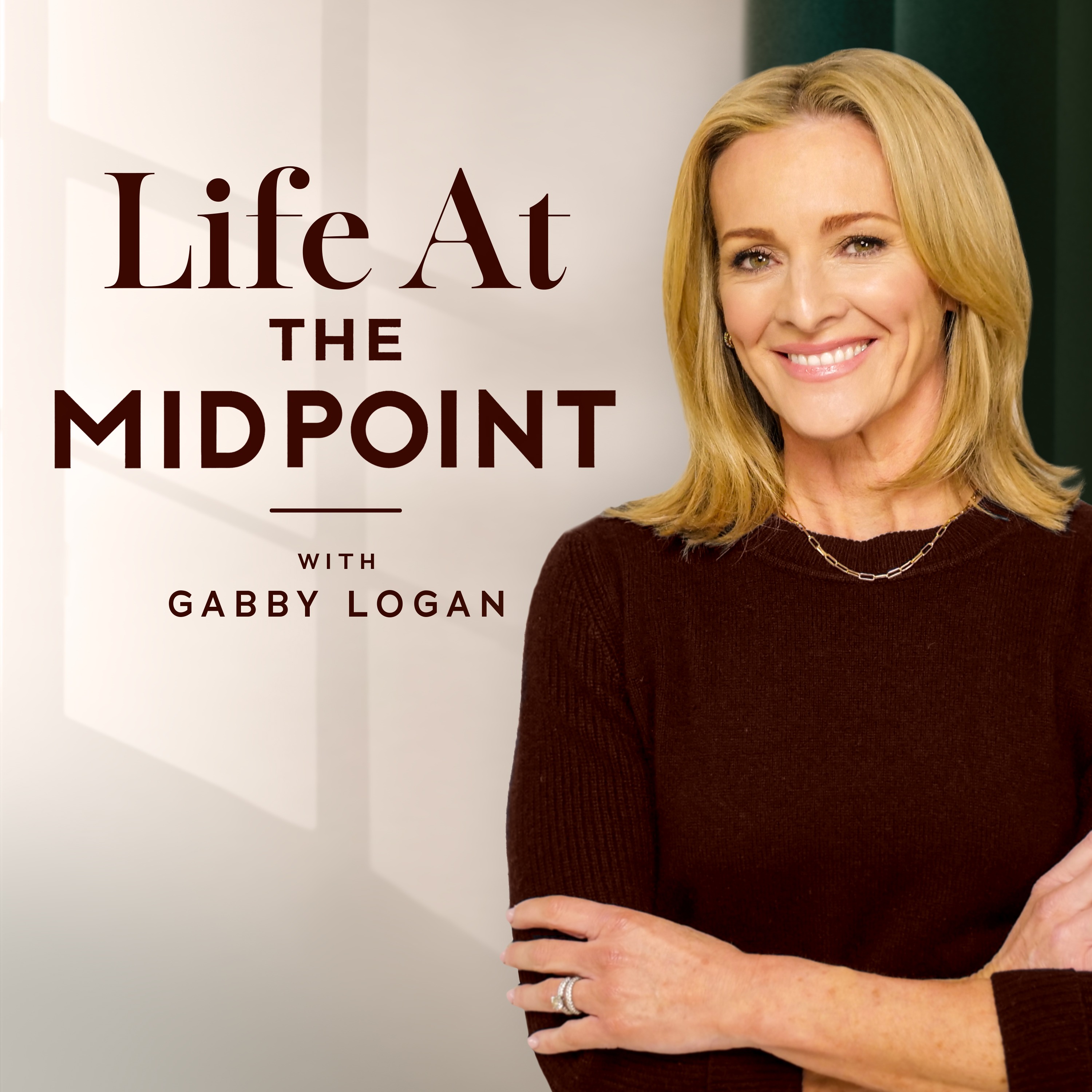
In this episode of Life at the Midpoint, Gabby Logan speaks with bestselling novelist Jodi Picoult about balancing a writing career with motherhood, and the research behind tackling complex moral subjects. They discuss Picoult's latest novel Hollow Bones, which addresses postpartum psychosis and 9/11, alongside her views on book banning in America, the authorship question around Shakespeare, and her upcoming work on AI.
Topics book banning America, postpartum psychosis, women's health, moral grey areas, balancing writing and motherhood, Shakespeare authorship, artificial intelligence, bestselling novelist
Mentioned in this episode Jodi Picoult, Melinda French Gates, Jennifer Finney Boylan, Markus Zusak, Sam Altman, Elon Musk
Chapters
- 0:02:17 Introducing Jodi Picoult
- 0:03:15 Motherhood and finding balance
- 0:07:48 Writing about gun violence and moral complexity
- 0:12:41 Hollow Bones: postpartum psychosis and 9/11
- 0:27:06 The Shakespeare authorship question
- 0:35:02 Ambition, confidence and finding your voice
- 0:44:25 Book banning in America
- 0:53:31 What drives Jodi Picoult forward
Partner with Life At The Midpoint
Life At The Midpoint is produced by Audio Always. We work with brands on sponsorship, advertising and partnerships across our network of podcasts, reaching engaged listeners and viewers.
Advertising categories Freelance Writing, Young Adult Literature, Publishing Industry
Show notes
What does it take to build a writing career while raising a family, and how do you find the confidence to keep pushing yourself? This week, Gabby is joined by bestselling author Jodi Picoult to talk about her journey from first-time novelist to one of the world's most successful writers. She reflects on a lifetime of writing about complex moral issues and the power of storytelling when it comes to challenging perspectives.
Jodi also talks about her latest novel, Hollow Bones, the research behind tackling difficult subjects and her fight against book bans in America. She shares how she approaches the subjects people might find uncomfortable and why that whatever stage of life you're at, it's never too late to find your voice.
Content warning: This episode discusses postpartum psychosis, including infanticide and suicide. Please listen with care.
If you have any questions, dilemmas or things you’d like to discuss, please get in touch email hello@midpointlife.com or you can find us on social media @midpointlife.
Hosted on Acast. See acast.com/privacy for more information.
Full transcript
Gabby Logan 0:01:48 This episode discusses postpartum psychosis, including infanticide and suicide. So please listen with care. Hello and welcome to Life at the Midpoint with me, Gabby Logan. My guest today is Jodi Picoult, one of the most successful novelists in the world with over 60 million copies of her books in print. She's written about everything from medical ethics and school shootings to racism, abortion, and the Holocaust, subjects that might seem difficult to turn into bestselling novels, but which Jodi has made millions of readers want to talk about.
Gabby Logan 0:02:17 Her books, including My Sister's Keeper and 19 Minutes, are famous for putting people in impossible situations where there isn't necessarily a right answer and where the person you think you understand can turn out to be much more complicated than you imagined. She's now written 30 novels, and her latest, Hollow Bones, explores grief, family secrets, and postpartum psychosis through the story of a woman whose mother disappeared on 9/11. It's another example of Jodi's instinct for taking a subject that can be difficult to talk about and finding the human story at its heart. But Today, I want to go beyond the books themselves. Where does her fascination with moral grey areas come from?
Gabby Logan 0:02:56 What does it take to write about subjects that can divide opinion? We're also gonna talk about motherhood, ambition, and the pressure to keep coming up with new stories. And what have 30 novels that she's written taught her about people, including the things we get wrong about one another?
Gabby Logan 0:03:15 Thank you so much for coming on the podcast.
Jodi Picoult 0:03:17 My pleasure.
Gabby Logan 0:03:18 So we start with this question. When in your life did you experience the most dramatic change?
Jodi Picoult 0:03:23 Probably when I had kids. I had my first son right after I signed my first publishing contract. And it was a really big deal to get a publishing contract. And I thought, this is it, this is my moment. And then I had a child and I was like, this is not your moment. Suddenly I was willingly at the end of someone else's life, which I think is what parenthood is And I found it very hard to balance that and to sort of strike a path between the two that allowed me to celebrate my own career, but also celebrate being a mom.
Gabby Logan 0:03:58 Because of the normal kind of conflict of feeling you're never in the right place at the right time?
Jodi Picoult 0:04:03 Yeah, and feeling like you're never doing any of it well, right? You know, like you're doing your best, but you're constantly juggling and just making it look good. But you know, it's that duck under the surface. You're paddling like crazy.
Gabby Logan 0:04:14 So that contract, did you already have the book that was going to be the kind of book that you were launching into the world? So the writing, the hard bit was done.
Jodi Picoult 0:04:22 Yes.
Gabby Logan 0:04:22 But then presumably for you, in your own mind, this is the start of a glorious career. So how am I gonna balance all these kind of things in my life and family? And which you've done incredibly well. We're sitting here as you launch your 30th book into the world.
Jodi Picoult 0:04:36 I guess I figured it out.
Gabby Logan 0:04:37 Yeah, you did figure it out. But like a lot of people, I imagine, through trial and error.
Jodi Picoult 0:04:42 Yeah. And I mean, for a while I either had a baby or a book and then I just stopped having babies. But I think that I learned that I was a better mom when I also had time to work on myself and my career and my books, and vice versa. I think being a mother really informed the things that I wrote about and the topics I chose to cover and the way I did it. So in many ways it was a symbiotic relationship, but at first I thought they were just very contentious relationships.
Gabby Logan 0:05:13 Do you think you became a better writer for being a mother?
Jodi Picoult 0:05:15 Yes, absolutely. I think there's a level of empathy that happens when you're a mom, and there's also an unparalleled dynamic of utter fear that drove many of my novels.
Gabby Logan 0:05:26 Because of what was going on in the world existentially.
Jodi Picoult 0:05:28 Yeah, and all the terrifying things that could happen to your kids, right? I mean, I have a whole string of books. There's like 10 books that are all about the scary things that can go wrong with a child. So I definitely think that part of my writing career was superstitious. If I write about it, then surely it won't affect us.
Gabby Logan 0:05:45 And because you do such incredible research and immerse yourself often in those topics and go and step into the shoes of somebody that you're going to write about, did that then kind of help to displace fears and anxieties in the sense, actually there are people who are across all this, I'll be okay because—
Jodi Picoult 0:06:01 No, never. I mean, I think I was always worried. I think it really took me getting to a point in my life where my kids were grown up, safe, healthy, contributing to society before I think I was able to, I guess, extrapolate my view a little bit. And I think at that point I started writing about what I would call bigger issues, global issues, issues like racism and reproductive rights and gay rights and the nature of good and evil, things like that.
Gabby Logan 0:06:32 And those tiny topics that you talk about there, did you take those home to the kitchen table or those moments with your kids as they're becoming young adults To gauge what their generation is thinking in the world.
Jodi Picoult 0:06:45 Yeah, many of those things I wrote about when they were already out of the house, but there were definitely times that I was writing about things that would affect teenagers that I would bring home to them and talk about. I remember talking, particularly it was when I was writing 19 Minutes, which is about school shootings and adolescence in America, and I remember very distinctly going home and talking to my kids about that at dinner.
Gabby Logan 0:07:08 And their opinions informed how the book played out, do you think?
Jodi Picoult 0:07:11 Yeah, in some ways. I mean, in more ways, their life experience contributed to why I wrote the book. It really stemmed from a place of watching all of them in different ways being bullied at some point in their school career, and wanting to look at why that continues to happen, and how an entire village can fail a child.
Gabby Logan 0:07:33 And from your research and from writing that book and talking about it, you know, as you do ad nauseam afterwards, having to go all over the place and for weeks and weeks you're on book tour, did you understand any more why A, it continues to happen and B, the gun laws remain as they are?
Jodi Picoult 0:07:48 Well, we don't have enough time on this podcast for that. But that is the gun laws.
Gabby Logan 0:07:53 Because I think that's one of the big cultural differences, I think, between both countries. And I wonder actually, did that book play as well outside of the US market? And did people—
Jodi Picoult 0:08:02 Oh, yeah, yeah, yeah, very well. I think that the real reason for gun control issues in the United States just has to do with campaign finance reform and the fact that as long as officials who run for government continue to get money from gun manufacturers, from anti-gun control lobbyists in their pocket, we're never going to see meaningful gun reform in America. We had multiple times now we've had entire elementary schools shot up and many little children die.
Jodi Picoult 0:08:33 And if that wasn't the endpoint for, or actually if that wasn't the starting point for common sense gun reform, then I don't know what could be in America at this point.
Jodi Picoult 0:08:45 But yeah, I think that for me, and when I was going out on the road for that book, and even now, many years after the book has been published, I think what astounded me the most was how isolated, particularly teenagers feel, and when they feel bullied and when they feel alone and othered, they think they're the only ones to ever feel that. And I have, at this point, I've had probably about a dozen letters from kids who wrote me to say, I was going to bring a gun to school, but I read 19 Minutes and I'm not. Wow. Which is incredibly powerful, right? You know, if you can prevent an event like that from happening through fiction, well, that's a pretty remarkable thing.
Gabby Logan 0:09:27 Well, one of the things I want to talk about is what your books do in terms of enabling a difficult topic to be discussed in a wider arena and people to then maybe understand the other side because everything is so kind of siloed and binary now in politics. It's like, you know, you sit here or you sit here. Do you set out when you are writing about difficult topics like that, thinking all the time of the other opinion and the one that maybe isn't yours naturally, to try and create a safe space to have those discussions.
Jodi Picoult 0:09:58 Yeah, I don't think it's my job as a writer to tell you what to think. In fact, I would be disappointed in myself if I was inflicting my viewpoint on you all the time.
Jodi Picoult 0:10:07 I think it's my job to make you ask why your opinion is what it is, because most of us form opinions when we're very young because our parents have them or friends or religious leaders, and we don't ever challenge them. And I think my job as an author is to take a particularly contentious subject and to make you listen to both sides' point of view in full. It might be the first time you've ever heard what the other side has to say.
Gabby Logan 0:10:33 Mm-hmm.
Jodi Picoult 0:10:33 Now, that doesn't mean I like writing about it. I mean, I of course have opinions myself, but my hope is that after you listen to both sides, you then ask yourself, why do I believe what I believe, and is that right? Which I think is the best I could ask for as an author.
Gabby Logan 0:10:50 And in doing that, have you ever moved your position on something?
Jodi Picoult 0:10:53 I have never changed my mind about a controversial issue, but I have changed my reasons for being against or for something based on the research I've done.
Gabby Logan 0:11:02 Right, so you've either kind of moved, shifted, and entrenched somewhere because of that research that you've— is there any area in particular that you feel more strongly
Jodi Picoult 0:11:12 about? I was writing about the death penalty in America in Change of Heart, And the things that I learned about the death penalty, that it actually costs more to execute someone than to keep them in jail for their lives, that the people on death row themselves think that a death sentence is actually a mercy. It's worse for them, they believe, to be in jail, in prison for their whole lives. Wow. That it doesn't reduce recidivism.
Jodi Picoult 0:11:39 I mean, all of the sort of talking points that are trotted out by people who support the death penalty are lies. And what I finally came to see doing the research was that if you can say to yourself that you do not believe change is possible, you do not believe people deserve a second chance, and that you feel that someone can be so corrupt that their DNA should be removed from the gene pool entirely, then you can say you support the death penalty. But otherwise, there's no reason to support it.
Gabby Logan 0:12:08 And I've heard you in my research and kind of building up to today, I heard you talk about you're going to write about, well, you are currently writing about AI and that book will come out in '28.
Jodi Picoult 0:12:18 Yes, we hope.
Gabby Logan 0:12:19 Which made me, well, it made me think, you look across to your publisher going, I think so. So that made me think that you write in 2-year cycles almost then.
Jodi Picoult 0:12:27 Yeah, I do.
Gabby Logan 0:12:27 So we're in '26 now as we speak. So you know what's coming out in 2 years' time. So Hollow Bones, the topics in this book was this kind of—
Jodi Picoult 0:12:36 2 years ago.
Gabby Logan 0:12:37 2 years ago. And this, partly came about because of an email that you received.
Jodi Picoult 0:12:41 Yeah, it actually, the email was almost like a boon falling into my lap. One of the topics that I cover in Hollow Bones is postpartum psychosis, and I also cover 9/11, and I very specifically wanted this book to come out in 2026 on the 25th anniversary of 9/11. I had no idea that the Lindsay Clancy trial was going to happen, right as I was launching my US book tour for Hollow Bones. So postpartum psychosis wound up being in the news much more than I expected it to be. I had done a lot of research and knew a lot of—
Gabby Logan 0:13:17 Lizzie Clancy, for anybody listening, was the woman who killed 3 children.
Jodi Picoult 0:13:21 She killed her 3 children in Massachusetts, yes, suffering from postpartum psychosis. She had gone to doctors and psychiatrists and inpatient and outpatient care, and she was on 13 different medications that all conflicted with each other, and nobody ever diagnosed her. And that is a very sadly common story for women who suffer from postpartum psychosis. When I was doing the research for this, I got a letter from a woman whose name is Solange White, and she had been a fan of my work and said, you're often a voice for the voiceless. Could you talk about what happened to me so it doesn't happen to another woman?
Jodi Picoult 0:13:56 And she was writing to me from jail where she was awaiting trial because she killed her 3-year-old daughter after having a newborn son and developing postpartum psychosis. And very much like Lindsay Clancy, Solange is white, educated, upper middle class, has a family that loves her. She too knew something was wrong right off the bat. She didn't bond with her newborn, she gave it to her in-laws to try to have them manage care, and she asked her friends to adopt her kids, she asked her husband to get a new wife. She kept hearing this command hallucination in her head that she thought was Satan.
Jodi Picoult 0:14:36 And in spite of the fact that she went to doctors, and again psychiatrists, and inpatient and outpatient care, and was on 15 medications that all interacted poorly with each other, one night before she was supposed to go to another inpatient stay, she heard this voice say, if you don't send your children to Jesus, I'm taking them. And so she smothered her 3-year-old daughter Charlotte, kissed her on the forehead, said, I'll be with you soon, tried to slit her wrists after leaving a suicide note for her husband with her wedding ring. And at the bottom of the note said, don't forget next Tuesday, Tuesday, the baby has a paediatric appointment. Please remember to take him. One of the hallmarks of this illness is moments of psychosis and moments of lucidity, like right next to each other, which is one of the reasons it's so hard to diagnose and one of the reasons prosecutors say women know what they're doing.
Jodi Picoult 0:15:23 She couldn't manage to kill herself by cutting her wrists, so she woke up her husband, begged him to take out his gun. He looked at her, said, what have you done? And it wasn't until Solange was arrested and brought to a psychiatric facility that anyone even said the words postpartum psychosis to her. And she recently pleaded guilty but mentally ill and is serving a 16 to 40 year prison sentence.
Gabby Logan 0:15:44 And we should say, and I've got this statistic actually from you, so you can kind of verify this, while this is rare, it's still 1 in 1,000?
Jodi Picoult 0:15:54 Yeah, it's 1 to 2 women per 1,000 births roughly. And it's called mood episode, It features disorganised thinking, paranoia, and these command hallucinations. Most women who experience postpartum psychosis have never had a psychotic episode, and if you don't treat it, it leads to infanticide in 4% of cases and suicide in 5% of cases. And the reason that it's so hard to diagnose is it's multifold. The first is, as I said, these moments of lucidity and psychosis that rub up against each other.
Jodi Picoult 0:16:27 The second is that the DSM-5, which is the psychiatric bible, does not listed as its own diagnostic condition. And the third is that sadly, when women go with a newborn and they say to a doctor, I'm terrified I'm gonna hurt my baby, most women are likely to hear, oh, every new mom feels that way. I mean, women are routinely dismissed.
Gabby Logan 0:16:45 And not every woman who says that will have postpartum psychosis.
Jodi Picoult 0:16:48 That is correct.
Gabby Logan 0:16:49 That is correct, yeah. And I mean, so many people have sat in that chair, not least Melinda French Gates, talking about women's health just a couple of weeks ago, about the under kind of served, under-resourced, under-financed area that is women's health, and this comes in that whole picture.
Jodi Picoult 0:17:05 Absolutely. I mean, that was really what I took away from my research, that this is not a one-off. This is one chapter in an entire book of how the healthcare system fails women, starting with puberty and endometriosis, into infertility, to perimenopause and menopause, where the healthcare community basically says, good luck with that. The statistic globally is that 1% of all non-cancer scientific research and development is targeted towards women's health. That is criminal. 1%.
Gabby Logan 0:17:34 And that, as you say, is a global figure. You know, we kind of tend to look at things through our own health system in this country. But hearing the figures that, you know, Melinda had done kind of the research or her foundation had done, America is being similarly underserved. And I've got kind of anecdotal— my sister lives in the States and her kind of visit to the doctor when she was clearly displaying perimenopause symptoms and told that she should go on antidepressants. And I was like, no, no, no, no. This is not— so by having these conversations and by writing about it in a book—
Jodi Picoult 0:18:07 You normalise it.
Gabby Logan 0:18:08 Yeah, and you obviously sell to millions and you're able to go on really big platforms to talk about this. How receptive, when you go on kind of Good Morning America and those kinds of platforms, how receptive are they to having these conversations?
Jodi Picoult 0:18:19 Very receptive. I mean, I find that the problem isn't the journalists, the problem is the administration. We're currently living in a time when you can't even have a research grant submitted with the word woman in it, it will be summarily dismissed.
Jodi Picoult 0:18:33 So that's problem number one. And I feel like that what's really important and what I've seen with this book being out in America before it was here in the UK, I have had women come through my event lines saying to me, I knew something was wrong when I had a baby, but I didn't know what to call it. We didn't have a vocabulary back then. Hmm. I've had 2 women in one line in Utah actually, where they both came through at different points and said, I'm one of the 1 to 2 in 1,000.
Jodi Picoult 0:19:07 And I had 2 women who had postpartum psychosis at one event. I mean, that's a huge statistic, right? Mm-hmm. And I do think that, like you said, not every woman is going to develop postpartum psychosis or even postpartum depression, which affects 1 in 7 women, which is actually quite high. But every new mom has had a feeling where they feel completely overwhelmed and they wanna just sit down on the floor and cry because this was not what they signed up for.
Jodi Picoult 0:19:31 The baby didn't come with a manual. Like, you don't know how to take care of one. And
Gabby Logan 0:19:35 also we increasingly live in these disjointed communities and societies where we don't have this huge kind of family or village to wrap around us.
Jodi Picoult 0:19:41 Exactly.
Jodi Picoult 0:19:42 And again, it's about that normalisation. It's about being able to say something isn't right, I need help, instead of being judged for that or instead of being punished for that. In the UK, you have different systems for women who experience some kind of postpartum illness. You actually have psychiatric facilities that allow a woman to come in with a newborn That's huge because in America, a lot of women don't want to admit anything's wrong because they don't want to be separated from their baby. You also have some kind of mitigating conditions legally so that if a woman commits a crime while she has a postpartum illness, she can't be tried on the same charges that a woman who isn't suffering from that would be.
Jodi Picoult 0:20:21 We don't have that in America, so you are much more focused on treatment than on punishment. We are the opposite in America.
Gabby Logan 0:20:26 And obviously this is such a huge topic, you mentioned that you wanted it to to coincide with the 25th anniversary of 9/11 as well. And so anybody who hasn't read the book is thinking, okay, you've got 9/11.
Jodi Picoult 0:20:37 It's a lot, yeah.
Gabby Logan 0:20:37 You've got postpartum psychosis. And so you have these huge moral grey areas sometimes, grey moral areas sometimes, these huge societal issues that you're discussing, but then it is weaved into a story that you want people to be literally turning the page every second to kind of get the next character kind of development. So there's such a kind of huge, I don't know, a lot of authors will sit down with a message they want to send But how much do you then kind of write, okay, the characters, how much time is spent developing the characters? How much time is spent researching the issue that you previously had no knowledge about, or little knowledge about?
Jodi Picoult 0:21:14 It completely depends on the story and the access I have to the research, but it does start with a story, and I think that's an important thing to talk about because no one is going to go pick up a medical treatise on postpartum psychosis and read it from COVID to cover. It's not very exciting. Even with
Gabby Logan 0:21:33 your name on the COVID
Jodi Picoult 0:21:34 Well, maybe I could make it more interesting, but the whole point of fiction is that it has a superpower. That's the way I always think about it.
Jodi Picoult 0:21:44 You think you're picking up a book to be entertained, and hopefully you will be entertained. I mean, Hollow Bones has more twists in it than I think all my other books, so that's fun for the reader, but if I've done my job right, by the time you close the book, you have learned something and you're questioning your beliefs and you're doing it in a way that has happened through empathy, a connection of empathy, by creating a character who you can at least recognise in some capacity and understand the pain they feel, the life they've lived in a way that you didn't before you opened the book. If you can't meet someone face-to-face who's experienced this, Fiction's the next best thing.
Gabby Logan 0:22:23 Mm.
Jodi Picoult 0:22:23 You know, it's a way to open up the world and to open up your mind. And that ultimately is why I like to write about controversial issues through the lives and stories that are of fictional characters. I can create something that is going to educate you without you knowing that you're getting that kind of medicine, you know?
Gabby Logan 0:23:31 also had the opportunity to do in this book was kind of recall from one of your most popular books, a character or family that came into the book very early on. Anybody who's reading it will recognise the surname.
Jodi Picoult 0:23:49 Yeah, Jesse Fitzgerald comes back in this book. Um, he first appeared in My Sister's Keeper.
Jodi Picoult 0:23:54 He was the delinquent teenage arsonist brother of the 2 sisters. I loved writing him, and I've always kind of wondered what happened to him. Always thought he became a cop. And, uh, you know, when I was writing this book and I knew it was going to be set in Rhode Island, I thought, Oh, I kind of wonder what that family's up to now. But on another level, this is my 30th book.
Jodi Picoult 0:24:14 In many ways, there are a lot of people who came to me through My Sister's Keeper. I've had several gateway books where that's the one that people start reading with. And that was a big one for me. And I kind of wanted to say thank you to the people who've been with me for all this time. And what better way than to give them back Jessie Fitzgerald all grown up, right?
Gabby Logan 0:24:33 Yeah. And one of the other things I heard you say about this book in particular, you were discussing how you thought that book clubs would find this I do. It's a really interesting book to sit down and— I haven't been in a book club for a few years, but I thought, yes, you're absolutely right. And I wondered how much that plays into also kind of when you're writing, thinking, what will they think? You know, they being the people who are your absolute fanatical kind of readers.
Jodi Picoult 0:24:55 You know, it's funny, I don't usually think about my readers when I'm writing a book, which is a terrible thing for a writer to admit. But the truth is, I'm writing the book I need to write at that moment, and hopefully that's what makes it the best book possible at that moment. But when I finish a book, I do sort of look at it and say, how did this wind up? What do I think it's going to be like? And Mad Honey was a book that I wrote with Jennifer Finney Boylan, and it became a huge book club book because there was so much to talk about.
Jodi Picoult 0:25:24 And in many ways, I feel like Hollow Bones will be the successor to that. And I'm already starting to see it in America where it's been out for a few weeks. People are dying to talk in particular about certain characters. There's not a single character in this book who is black or white. Everyone lives in a grey zone, like most of us.
Jodi Picoult 0:25:43 And I think that makes for some fantastic book club conversation when the wine's gone.
Gabby Logan 0:25:47 Do you feel then, as a writer, as you have gone through the kind of starting the perimenopause, menopause, midlife journey, and coming through kind of the other side in terms of your clarity and your conviction, bravery that you want to push the boundaries even further? And was there ever a period where you kind of retreated at all within yourself? Because a lot of women find themselves kind of, you know, especially if they experience some of the more insidious kind of symptoms of perimenopause, doubting themselves, feeling a bit like they're beige and being pushed kind of out of the picture. Did you ever have any of those moments?
Jodi Picoult 0:26:21 I didn't. I think I'm just— I don't know, maybe I'm just too opinionated for that. But I think if anything, the older I got, just the less I cared about what people thought. I guess that's, they say wisdom comes with age. Well, I think maybe so does confidence, or brutal confidence is a better way to describe it.
Gabby Logan 0:26:39 Real confidence. Yeah. I mean, it's
Jodi Picoult 0:26:40 just—
Gabby Logan 0:26:41 That only comes with doing it, can't it?
Jodi Picoult 0:26:42 I'm too old to care, honestly, what other people think at this point. So I really do believe that, I've always believed that if you are fortunate enough to have a platform, and if people are willing to listen to you, you have to think very hard about what you say at that platform. And I think I was born with a very unerring sense of justice that drives me and of sticking up for people who can't speak for themselves.
Gabby Logan 0:27:06 Well, that would certainly apply to— I think it was 2024 you wrote your book, Emilia Bassano. Yeah, exactly. The character who you talk— I mean, this opened up a whole area that I had no idea about. I didn't study Shakespeare to any degree. I did Macbeth, as a lot of people did for their GCSEs, and that was it, and seen a few plays. But I feel like that was a very brave kind of area to venture into because you knew you were going to face a kind of backlash from certain sections of the academic community.
Jodi Picoult 0:27:33 You know, the funny thing is I didn't expect that to be anywhere as controversial as it was. I mean, I've written about such politically charged topics that I'm used to hearing from people who disagree with me, but yeah, when the academics came for me, I was like, oh, okay, here we go now. It was definitely a braver book to release in the UK than it was in America.
Gabby Logan 0:27:53 Before you sat down to write the book, how much had you looked into that whole theory that— and you're not the only one, as you probably discovered— that feels that William Shakespeare might have had a bit of help?
Jodi Picoult 0:28:06 Well, I mean, that was something I heard a million years ago when I was in college. I still remember the professor who talked about that for 5 seconds in a lecture, but the candidates that he posed as alternative writers, or people who worked with Shakespeare at the time, were all male.
Gabby Logan 0:28:21 Mm-hmm.
Jodi Picoult 0:28:21 And it wasn't until I read Elizabeth Winkler's article in The Atlantic, where she talked about the authorship question, and she brought up the name Emilia Bassano, that I was really intrigued. I'd never heard of her before. And I did a deep dive, and the more I learned about this woman, the more seamlessly her life and her experience and her education fit the gaps that for 400 years academics have been falling over themselves to explain away in Shakespeare's life.
Gabby Logan 0:28:48 She fitted perfectly, didn't she? Chronologically, various cultural and her knowledge of certain countries.
Jodi Picoult 0:28:57 Yeah, her ability to speak different languages, the fact that she was Jewish and had to hide her religion, the fact that she was given a full classical and legal education like a noble male would have been given.
Gabby Logan 0:29:09 One of the things that you point to is the fact that William Shakespeare never educated his own daughters.
Jodi Picoult 0:29:13 Right. But that was what did it for me. I mean, the reason I loved Shakespeare as a student was because nobody was creating these 3-dimensional women like I saw in Shakespearean plays. And when I learned that he had never taught his daughters how to read, I just was like, I don't buy this. I just don't buy it.
Gabby Logan 0:29:30 So he was kind of savvy commercially.
Jodi Picoult 0:29:32 That's it. I think he was a great businessman. And I actually think he was probably a lot like Donald Trump. Honestly, he had people who who had restraining orders against him. He evaded taxes twice. He was not a great guy. But everything that we know about him, that we actually know about him—
Gabby Logan 0:29:51 No, that means in 400, 500 years' time, people might think Donald Trump—
Jodi Picoult 0:29:54 No, please don't. Let's not even go there. But yeah, I think that every record that we have of him is really of him as a businessman, or as an actor, or as a producer. We don't actually have proof of him as a writer. In fact, the only The only play that has his handwriting on it is a play that was written by someone else, and it's a note of his in the margins.
Gabby Logan 0:30:12 So when you enter into that area, and you then are taking on people who have very much spent their life's work entrenched to an opinion, how does that debate evolve?
Jodi Picoult 0:30:25 Well, I think what shocked me the most is I came over here and I was doing press for this book before it came out, and I had academics who hadn't read the book, they couldn't possibly, it was not on the shelves yet, already writing think pieces against the book, which was amazing to me and very funny.
Gabby Logan 0:30:42 And helping your publicity.
Jodi Picoult 0:30:44 Surely. I mean, they say all publicity is good publicity, but I don't blame them. I think when you have spent your entire life basically creating a name for yourself around a certain belief and point of view, to have some little Upstart crow, one might say, like me in the fiction world, come in with a well-researched book that says, hey, but what if we look at it from this angle? That can be very threatening. It's threatening personally and it's threatening to your livelihood. I mean, I get it, I get it. But the fact that they were mostly old white males also did not escape me.
Gabby Logan 0:31:21 Did you enjoy those debates and that discourse?
Jodi Picoult 0:31:23 No, they made me laugh because honestly, I stand by my research. We are all using the same primary documents. All of us. And so if there have been 5 points like this for 400 years and everyone has said, well, it's a circle, draw a circle around it, and I said, oh, but what if it's a star? There's nothing wrong with that interpretation. They cannot prove I'm wrong any more than I can prove that they're right.
Gabby Logan 0:31:48 So where did your inspiration come from as a— I think, what was your first book called?
Jodi Picoult 0:31:54 Songs of the Humpback Whale.
Gabby Logan 0:31:55 Oh, okay. I thought there was one about a lobster that was—
Jodi Picoult 0:31:58 Oh, well, I was 5 years old.
Gabby Logan 0:31:59 That's what I meant. I meant your very first, your very first book. I mean, I'm going right back.
Jodi Picoult 0:32:03 Yeah.
Gabby Logan 0:32:04 Because the title of that book, tell me.
Jodi Picoult 0:32:07 The Lobster That Was Misunderstood.
Gabby Logan 0:32:09 Right.
Jodi Picoult 0:32:09 Yes. Unfortunately, you can't get that at your local bookshop.
Gabby Logan 0:32:12 It did strike me. And I, by the way, haven't read the book.
Jodi Picoult 0:32:14 I don't think anyone has.
Gabby Logan 0:32:15 Don't go back. But the title caught me because I thought, oh, a misunderstood character.
Jodi Picoult 0:32:20 Yeah. Also, I was impressed that as a 5-year-old, I knew that word.
Gabby Logan 0:32:24 So why did you not become then a barrister or, I'm sorry, a litigator or—
Jodi Picoult 0:32:30 I absolutely could have. I mean, I actually think I would've been a very good detective. I would've been a very good lawyer. At this point, I really feel like someone should just give me an honorary JD degree because I've written so many trials.
Jodi Picoult 0:32:43 But yeah, I think that I loved writing. I just always loved writing. And I mean, I was doing it when I was 5. I had a lot of really spectacular individual teachers who knew I liked to write and who encouraged me to write. I mean, shout out to all of those teachers out there who were in the trenches doing hard work.
Jodi Picoult 0:33:03 And it was because of them that I really wanted to go to a college where I could work with living, breathing writers who could teach me how to do this. And then it was, I think, a combination of hard work and being in the right place, and fortitude, all those things that got me to a point where I was able to be published. And then it's funny because everyone assumes I was like an Oprah pick or something like that, and I was not. I actually had a very slow, measured growth of readership where if the book was good enough, then I knew someone would say, hey, you should read this, and would pass it to a friend, and then those people passed it to their friends, and so on and so on, and that was really That was really how I wound up at the point that I am now. It was not a magic bullet.
Gabby Logan 0:33:49 And when you started out, how much were you measuring success on sales and commercial success? How easy was it to know you were doing the right thing?
Jodi Picoult 0:33:58 My first book, I was paid $3,000, I believe, or $3,500. And I bought a piano that was my husband's Christmas present. That was what I did with it.
Jodi Picoult 0:34:07 So I would not say that I was really enjoying my massive spoils of being a writer back then. I was barely contributing. to the family income. But I was fortunate that I was married and that my husband had a job and that I was able to, like you said, figure out how to balance motherhood and writing so that I could take a few hours each week and write. And when my husband came home at 6 o'clock, I would throw the kids at him.
Jodi Picoult 0:34:36 He would do bath time and bedtime and I would write until about 11 o'clock at night. So I had my other job happened after I finished being a mom for the day. Mm-hmm. my partner in that. I wouldn't be where I am if I didn't have that kind of help.
Jodi Picoult 0:34:51 And yeah, so I just, I don't know, I think that's, I was fortunate to have someone who could pay the bills while I was still getting a foothold in this career.
Gabby Logan 0:35:02 So many authors that we've had on over the last few years have only really got going into their 40s because of the obstacles you describe, especially women, where they've not had that time and they've not necessarily had that support, or they might not even had a partner at home to take the slack. And so they've really had to be brave and kind of keep going into their 40s and 50s before they even get published. Do you think there is an age where kind of women, it's now or never? Because I kind of feel, no.
Jodi Picoult 0:35:31 I don't. In fact, I know so many writers who were older when they published their first book. And I don't think it's now or never. I almost think that the people who pose success as it's the world against me and I somehow have to jump a hurdle in order to make it into whatever it is that I want, But I think that's a fallacy. I think more often the biggest hurdle is inside yourself and believing that you can actually do it.
Gabby Logan 0:35:53 Mm.
Jodi Picoult 0:35:54 You know, I've always believed that if you write something good enough, someone is going to notice that you believe in it. And if you believe in yourself, it gives them the confidence to believe in you. And then all of a sudden maybe you have an agent and that agent believes in you so much that they sell it to a publisher. And, you know, if you doubt yourself continuously, then there's no reason anyone should ever take take a chance on you.
Gabby Logan 0:36:15 Yeah, I think the best advice to any writer is to write, right?
Jodi Picoult 0:36:18 100%. Yeah, carve out time every day to do it. Yeah.
Gabby Logan 0:36:20 And what does that look like for you now? Now that you are, you know, a multi, multi, multi-million selling author, you could pretty much down tools if you wanted to now in terms of, you know, you've achieved everything there is in the industry. That kind of, you know, that motivation to get up and go, right, I'm gonna do 6 hours today, is it still burning as brightly as ever?
Jodi Picoult 0:36:38 Yeah, and it's because of the fact that I But I have the luxury of having readers who have been willing to go anywhere I want to go when I write a book, because I don't write the same book over and over again. And I think that would bore me. But because I get to explore something and be a continuous student really of something I want to learn, I am excited to get to my desk.
Jodi Picoult 0:36:59 You said I've been researching this book on AI and I had to stop because I was coming on book tour. From previous experiences, writing on book tour is not a good thing because you come home and you go, what is this? What am I trying to do? Your brain is just too scattered. So I have a 148-page single-spaced outline.
Jodi Picoult 0:37:18 I let myself write the first chapter as a treat before I went away. And when I get home, I get to start and I can't wait.
Gabby Logan 0:37:24 Are you thinking about those characters when you're falling asleep at night? Constantly. They're kind of there with you.
Jodi Picoult 0:37:29 Yeah, absolutely.
Gabby Logan 0:37:30 The AI is such a a changing landscape. I mean, we didn't even, you know, 2 years ago, it wasn't on our lips. We weren't, and now it prevails everywhere. It's in every industry, it's in every conversation.
Jodi Picoult 0:37:41 And it's one of the reasons I will have to set this book in a time-space because by the time it comes out, things will be very, very different. But what I'm writing about is a specific era that basically happened with a particular model of what was an OpenAI model of AI. Where things went very wrong.
Gabby Logan 0:38:00 Is it scaring you what you're learning?
Jodi Picoult 0:38:01 The more I learn about it, it's both terrifying and also in some ways comforting. Because I'd say the most terrifying thing is that the people who began the AI industry began by saying, we want people who are responsible individuals to control this. We don't want it in the hands of bad actors. But they have become the bad actors.
Gabby Logan 0:38:23 And
Jodi Picoult 0:38:23 it's It's now about bottom lines and about a race to the top, or as I might say, a race to the bottom.
Jodi Picoult 0:38:30 And what we're seeing are safety protocols being compromised by companies that want their product out before a different company gets their product out. And that is not healthy for the people who are using it. So yeah, so there is a lot that's terrifying. I don't like, you know, there's a lot in the news about AI writing. Certainly there are books being written by AI.
Jodi Picoult 0:38:54 I believe, first of all, that readers are smart enough to recognise when a book is human written versus AI written. But I also don't really fear for AI coming for my job because the one thing that AI is not and never will be is human.
Gabby Logan 0:39:08 Hmm.
Jodi Picoult 0:39:09 And what an author really does is strike a chord that resonates in a reader about a specific human experience that they have felt, Or might worry about, or know someone else experienced. And it is that tension between 2 human lives that makes for the relationship between a reader and a writer, and AI will never have that.
Gabby Logan 0:39:34 No, but it can cause other, whether it's writers or musicians, it can cut an income stream, can't it?
Jodi Picoult 0:39:44 Absolutely. And I do worry about that because I do think AI is going to replace a lot of entry-level jobs based on the way that companies are embracing AI and see it there. Look, there's a lot that it can do well, but there's also a lot it does very poorly and that could be quite damaging. And I think that what I worry about is, okay, if AI takes all the entry-level jobs, how do the new college graduates ever learn anything about the their business and their career?
Jodi Picoult 0:40:14 I don't think we've figured that out yet. And I'm a little worried that it's moving too fast for anyone to ask those questions and get answers to them before it's too late.
Gabby Logan 0:40:23 Yeah. And when you layer on top of that this kind of global race as well, and how different—
Jodi Picoult 0:40:29 And a lack of safeguards. That's a real problem.
Gabby Logan 0:40:31 Well, some countries will have very different approaches than others.
Jodi Picoult 0:40:33 Right. And what we really need are federal safeguards. We need national organisations. We cannot We cannot trust these organisations to police themselves. And if my research has taught me anything, it's that. So when you get Dario and Sam Altman together and Elon Musk, and they're all like, yes, we all have to take a pause. We all have to take a breath. And don't worry, we're on top of it. Don't believe these guys.
Gabby Logan 0:40:56 Do you fear with a book like this that it's moving so fast almost that events will kind of make Your storyline almost redundant.
Jodi Picoult 0:41:07 Yeah, no, I don't worry about it, like I said, because I'm talking about a specific period of time that will basically be around 2025, and the book will be set then. And so what I'll have to do is in my author's notes say, okay, so here's what's changed.
Gabby Logan 0:41:23 But it will change. Yeah, well, we hope as well, I think humanity hopes that there'll be some kind of handle on this. It would be lovely, wouldn't it, for you to sit there and do your interviews in 2028 saying—
Jodi Picoult 0:41:33 Be like, look, we circumvented that.
Gabby Logan 0:41:35 Isn't it amazing?
Jodi Picoult 0:41:36 I don't hold out a lot of hope for that. But yeah, I certainly hope we can get to that point because—
Gabby Logan 0:41:42 You could well have a different administration in your country by then.
Jodi Picoult 0:41:45 Oh, yes. Knock on wood. Yeah.
Gabby Logan 0:41:46 I wonder how much— you talked about women's health as being one of the big issues and women's rights generally in the US have been diminished under this administration and are continuing to be eroded as well. How much hope have you got that there can be a swing in the other direction, a pendulum can swing the other way? Because historically, and you've seen this through your research of novels, that happens, doesn't it, with politics? And that there's some kind of reset needed. Are you hopeful that that can happen?
Jodi Picoult 0:42:20 I like to have hope, yes. I'd like to believe that, particularly with the midterms coming up, I mean, I wish we were having this interview a couple days from now 'cause I'd be able to say more, but I think there are a lot of progressive people in America who understand that they need to get up and get out and make their voice heard with a ballot. But also, I think there are a lot of people who voted for Donald Trump who are very disillusioned with what they received. It's only going to get worse. A lot of the cuts that were passed in his big, beautiful budget bill will actually hit in January, and we're going to see— extremely expensive healthcare in America that people aren't even figuring into their budgets yet because they're too busy trying to figure out how to pay for gas and food and rent.
Jodi Picoult 0:43:10 And that's going to hit very hard after the new year. I think a lot of those people who are starting to feel disillusioned might just stay away from the polls. And when people don't vote, traditionally the Democrats win because they're more likely to get up off their couches and cast a ballot. So I would like to say that I have hope. I will also admit that Like nothing else ever has before, this administration has turned me into a conspiracy theorist.
Jodi Picoult 0:43:34 And so I do worry about what they can get away with and what they can hide and how they will try to challenge states for control of elections and what will happen if they refuse to cede power even if the Democrats legally win. So we've seen it happen already before.
Gabby Logan 0:43:48 Yeah, and that's a genuine fear. That is a genuine fear. That you've never had those kinds of feelings before.
Jodi Picoult 0:43:53 Nope.
Gabby Logan 0:43:55 What times we are living in.
Jodi Picoult 0:43:56 Yeah, this is not the timeline I asked for.
Gabby Logan 0:43:58 No, no. So politics seeps into all of the books that you write in the sense of kind of people's positions and their standpoint. As you mentioned, you try not to go in kind of making people believe anything. But I know one thing you are very passionate about and you've spoken about publicly is the banning of certain books from— now tell us a bit more about this because obviously this is something that, you know, I kind of learned a bit more about in researching how many kind of— this started in Florida, that your campaign that I was kind of
Jodi Picoult 0:44:25 Yes. So book bans really began ramping up in 2020 in America. Since then, they've increased 1,100% at school libraries, 92% at public libraries.
Jodi Picoult 0:44:36 And when the book banners started coming for books, they were targeting BIPOC and LGBTQIA authors and stories. And then they started going after what they called mature content. That's where my books fell. Mature content is anything that they find too pornographic or explicit for a student. So my book, 19 Minutes, was the most banned book in 2024.
Jodi Picoult 0:45:04 And for the second year in a row, I've been the fourth most banned author in America. The reason that 19 Minutes in particular is banned is not because it's about a school shooting. That's okay. It's because on page 313 is the word erection. Mm-hmm.
Jodi Picoult 0:45:19 And apparently high school students don't know what that is. So also—
Gabby Logan 0:45:23 And as you point out, that's actually a medical definition.
Jodi Picoult 0:45:26 It is an anatomical organ. I mean, I don't know what else you want me to call it, but basically it's ridiculous when you think about the fact that that is what is causing people to pull books off shelves.
Jodi Picoult 0:45:38 It's also worth knowing that the people who ban books are not required to read the books before they ask to challenge them, and that their real modus operandi is just to get the book off the shelf. without having a plan for evaluating it or getting it back on the shelf. And the people who ban books started by saying that this is to protect the children. There are so many psychological studies that have proven that a kid who feels marginalised and sees themselves in the pages of a book feels less alone—
Gabby Logan 0:46:09 Mm-hmm.
Jodi Picoult 0:46:10 Than a kid who grows up in a really homogenous community and gets to explore a new world in a book. Gets to do so in a safe space. This is not protecting kids, quote unquote. This is actually removing resources that help them deal with a really complicated world. The American Library Association last year also did a survey and found that the people banning books now in 2026 are not even concerned parents.
Jodi Picoult 0:46:34 92% of book bans came from political action groups. And of course, the reason that books are being banned is because when you have authoritarian administrations, They will try to get rid of anything that creates compassion or empathy, anything that makes people think differently from them. And that is exactly what books do. That is why they're on the chopping block.
Gabby Logan 0:46:55 Hmm.
Jodi Picoult 0:46:56 The other thing that most people don't know about America and book bans is, as you said, it started in Texas and Florida. I mean, at this point, 28 of my 30 books have been banned and it's all over the country. But There's currently, right now, a push to make book banning federal. So there are bills in front of both houses of Congress saying that if an objectionable book is found on a school library shelf, no matter where it is in America, that school district does not receive federal education funding. Now, with any luck, we get a change of administration and those bills get thrown out before they get passed.
Jodi Picoult 0:47:32 But if we don't get a change of administration, we are very much facing the fact that book banning could become federal. And the people who get to choose what makes a book objectionable are not your school librarian, not your teachers, not your principals. It's a politician. So, I mean, it just goes to show you again—
Gabby Logan 0:47:49 Further entrenching this idea of censorship. Yeah.
Jodi Picoult 0:47:52 It is utter censorship. And it's all to make sure that this next generation of kids grows up thinking the way the government wants them to think.
Gabby Logan 0:48:01 which has also kind of seeped into academia as well, hasn't it? In terms of, you know, various universities. Yeah, absolutely.
Jodi Picoult 0:48:07 Yes, we've seen that at schools, you know, a banning of free speech. Yeah, I mean, it truly is a nationwide problem in America right now. And it's, you know, I guess fortunately or unfortunately, depending on how you look at it, we've seen this playbook before and we see how it ends.
Gabby Logan 0:48:20 Your energy and your passion is obvious. It's tangible. As a woman who, you know, has an incredibly taxing kind of schedule, you're going around, you're on these big book tours, What do you do to keep yourself— you look incredibly fit. You've got a fine pair of pins there that look like they might be able to go for a decent 10K run.
Jodi Picoult 0:48:39 Oh no, no, no running in this body.
Gabby Logan 0:48:40 No? Okay. What do you do then to make sure? I swim.
Jodi Picoult 0:48:43 Yeah. So I swim a little over a mile every day. And if I don't swim, I go hiking with a bunch of friends and we'll hike 6 miles and basically gossip the whole way.
Gabby Logan 0:48:51 Swimming in a normal pool or you're outdoors kind of swimming?
Jodi Picoult 0:48:53 No, so this is the biggest luxury I have ever like bought myself in my life was during COVID I had an endless amount pool put into my house. Do you know what that is?
Gabby Logan 0:49:02 You swim against the tide kind of thing.
Jodi Picoult 0:49:03 Yes, it's basically a current that is in— it's a fishbowl with a current. That's how I describe it. So I'm in a very tiny little pod and I swim against the current and I love it. I just love it.
Gabby Logan 0:49:12 Do you have anything in your ears or?
Jodi Picoult 0:49:14 Yes. Yes. So best gift that I've ever received from my husband was, it's a headset that streams from your phone directly. Most swimming headsets, you have to download something to listen to, but this you don't. It's called Zygo. It's actually a British founder.
Gabby Logan 0:49:31 And do you listen to books? I
Jodi Picoult 0:49:32 listen to audiobooks when I swim. Do you?
Gabby Logan 0:49:35 Yeah. I've read some of your lists of recommended authors. And how much of your time in terms of research, writing, and your own reading would you say is divided up?
Jodi Picoult 0:49:44 When I'm right at work, if I'm not on vacation or something, then when I'm working, I listen to audiobooks in the morning when I swim, and I always end my night by reading. In bed.
Gabby Logan 0:49:56 Yeah. So twice a day, you're listening to somebody else's words.
Jodi Picoult 0:49:59 Now, if it's a weekend and I'm taking the day off, then maybe there's a nice fire going and there are 2 dogs at my feet and my husband's made me coffee and I've got my Kindle open and I'm reading a great book.
Gabby Logan 0:50:11 You're a Kindle reader?
Jodi Picoult 0:50:11 I am a Kindle reader, only because I travel so much that it's easier than hauling around books. Yeah.
Gabby Logan 0:50:16 I mean, have you tried carrying your book around town?
Jodi Picoult 0:50:18 I don't know how to do that.
Gabby Logan 0:50:18 So sorry. The heavy, heavy I'm so sorry. I'm an old-fashioned, I'm holiday, I do tend to take the actual book with me or it pulls up my attention.
Jodi Picoult 0:50:25 Well, see, what I do is I buy multiple copies. So I wind up buying a hardcover for myself and then I also read it when I'm, you know, carrying my e-reader around.
Gabby Logan 0:50:32 So reading, hiking, swimming, all of those things. And where you live, I've been lucky enough to be quite close to the part of the world you come from.
Jodi Picoult 0:50:39 It's beautiful.
Gabby Logan 0:50:40 It is incredibly beautiful and also very healthy 'cause there's a lot, you know, we hear a lot about kind of American food and the mass, I mean, I've watched all the horrible dystopian documentaries about farming, but actually where you live, And where you're from is a really healthy part of America in terms of its attitude towards farming and food,
Jodi Picoult 0:50:57 isn't it? Yeah, it is. And we live on like 13 acres and my husband makes his own maple syrup and we can our peaches and our grapes. And yeah, so we're living the farm life. At least my husband is my farmer wife, basically.
Gabby Logan 0:51:11 He doesn't come on tour with you? He doesn't go on the buses?
Jodi Picoult 0:51:14 I would suffer nobody to come on tour with me. It's not fun. It's fun. I mean, you're basically in a different place every day or twice a day, and it's very full-on. So it's not like I'm hanging around.
Gabby Logan 0:51:24 Do you find this bit, the talking about it, the most annoying bit?
Jodi Picoult 0:51:27 No, no. I mean, I wouldn't do it if I didn't like it. I don't have to anymore, but I really like— I particularly like— what I like the most are the events. I really like getting to be up in front of an audience and to hear their stories back. I think that's the last part of the equation that a lot of writers don't get, Well, how did that book affect a person?
Jodi Picoult 0:51:48 And I really like that part of it. I think also I'm that rare thing, which is a writer who's an extrovert. A lot of writers wanna be in their little office, you know, scribbling away. And I don't mind doing that, but I really do enjoy this part of it too.
Gabby Logan 0:52:03 And you talk a lot about the feedback, whether it's face-to-face or letters that come, I mean, emails that drop into your lap that end up becoming a central part of a book. When do you actually get time to consume all that? Or do your publishers say, this is an interesting one, to hear this one, or do you get to read all of it?
Jodi Picoult 0:52:19 No, I actually, I'm also one of the few authors I know that does not have an assistant.
Gabby Logan 0:52:22 What?
Jodi Picoult 0:52:23 I don't. I mean, I have a great husband, but I don't have an assistant. So I read and answer all my own email.
Gabby Logan 0:52:30 Even if it's stuff that is—
Jodi Picoult 0:52:32 Oh yeah, I get hate mail all the time. Yeah, and I always answer that.
Gabby Logan 0:52:35 But you answer it?
Jodi Picoult 0:52:36 Yeah, because I think it's really important that people who send that know that it reaches a person and that an author is a human being.
Gabby Logan 0:52:42 How many times do they then come back and say, oh, I'm really sorry, I didn't—
Jodi Picoult 0:52:45 Sometimes they do. Yeah, I would say probably about half the time they're like, oh, oh, oh, you wrote back. But also sometimes if you continue an exchange with someone who has an opinion different from yours, which is usually what makes them write you, they come around to seeing your point of view. So if you can change one mind, well, that's good, right?
Gabby Logan 0:53:07 Yeah, well, and then obviously you've also got them, they're still a reader, 'cause they've come at you from something to do with the book, and now they're also a superfan.
Jodi Picoult 0:53:15 If you're lucky.
Gabby Logan 0:53:18 When you have sold as many books as you've sold and you've written as many books as you've written, what fuels you now going forwards? Is it the causes and the stories of those who don't have a voice that is keeping you going?
Jodi Picoult 0:53:31 I think it's curiosity. I don't think I set out to espouse a cause or to wave a banner. I think it's the pursuit of truth really. And it's just, That there's so many things out there that I still enjoy learning about. I mean, in a way, I'm basically just a lifelong academic because I'm learning about things constantly every time I write a new book, and I really love doing that. My husband really would like me to retire, believe me, and I've gone in the opposite direction. I started writing for theatre now too. It's like— You
Gabby Logan 0:54:07 have a theatre group, don't you?
Jodi Picoult 0:54:09 Well, I have a teen theatre group, which is totally different. I started writing for professional musicals, starting with an adaptation of a book that my daughter and I wrote. And actually, more importantly for you, I adapted The Book Thief by Markus Zusak as a musical, which will be at the Lyric Hammersmith starting July 24th of next year. Wow. Which is huge.
Jodi Picoult 0:54:33 I mean, it's a really hard business, and to break into it is very difficult. And I'm really proud of that work because it's very different than writing a novel, but it's also so helpful to me in writing a novel because when you write for theatre, it's entirely collaborative. And when you write a novel, it's entirely singular. And I feel like writing for theatre reinvigorated my love of writing novels and vice versa.
Gabby Logan 0:54:55 So the passion is burning.
Jodi Picoult 0:54:57 Yeah.
Gabby Logan 0:54:58 The causes are out there.
Jodi Picoult 0:54:59 Yeah, they're there.
Gabby Logan 0:54:59 The energy is clearly there as well. It has been an absolute joy to sit down and chat to you. Oh, thank you so much. Actually, just before you go, I was just gonna say, the work, 'cause you mentioned there that your husband kind of, you know, is probably kind of, you know, looks at your diary and thinks, what is she doing now? The work you do to kind of get into the shoes of the character, just give us a quick insight into, so in Hollow Bones, you actually went to Rhode Island.
Jodi Picoult 0:55:22 I did,
Gabby Logan 0:55:23 yeah. And you, the, what's the job title is basically head of emergency.
Jodi Picoult 0:55:27 Emergency preparedness. Yeah, the head of emergency preparedness and response.
Gabby Logan 0:55:29 Which means everything effectively that can happen that could go wrong within Rhode Island. Right.
Jodi Picoult 0:55:33 So I wound up shadowing Alicia Michalakos, who is the actual woman who does Molly's job for real. She is the head of emergency preparedness and response in Rhode Island, and her job is basically to worry about everything so nobody else has to. So she's thinking about electromagnetic pulses that can come from other countries that would turn every piece of electronic equipment you own into a bomb.
Gabby Logan 0:55:54 These are real jobs. This is a real job, yeah, yeah. This feels so huge.
Jodi Picoult 0:55:58 Yeah. I mean, she's like, she'll send me even now texts about H5N1, if that's going to be the next COVID, things like that. And basically, she also runs these exercises where they create a fake emergency.
Gabby Logan 0:56:11 Which is how the book starts.
Jodi Picoult 0:56:12 Yes. And they put everybody through the paces to make sure that all of these departments, fire, police, healthcare, they're all basically doing their jobs before it becomes truly important. And so, I got to go down and I got to shadow her and watch all of that.
Gabby Logan 0:56:25 How long would you spend doing a job like
Jodi Picoult 0:56:27 that? Well, I did probably about 60 hours of interviews with her, and then I spent 2 days in the field with her.
Gabby Logan 0:56:33 Wow, how exciting.
Jodi Picoult 0:56:35 It's great. It's the best part of writing.
Gabby Logan 0:56:36 Yeah, well, I hope you've got many more of those exciting days in some incredible jobs to come and keep doing what you do. Thank you so much for coming on and I'm sure inspiring our audience. Thank you.
Jodi Picoult 0:56:47 Thanks for having me.
Gabby Logan 0:56:48 Thank you. And that was the brilliant Jodi Picoult. Thank you so much for listening to Life at the Midpoint. If you've got any questions or You can email me at hello@midpointlife.com or find us on social media @midpointlife, and we'll see you next time.
This transcript was generated automatically and may contain errors.