
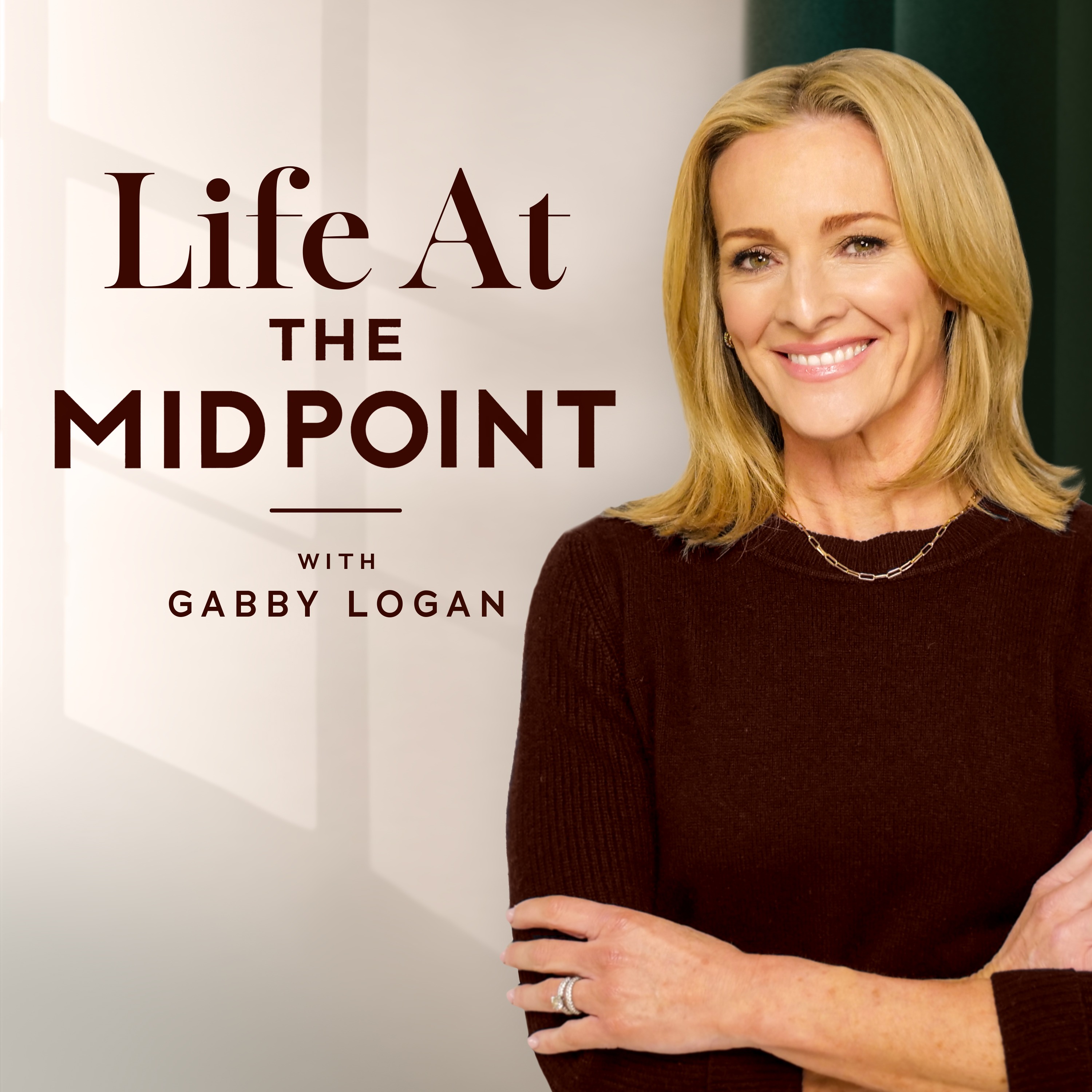
In this episode of Life At The Midpoint, Gabby Logan speaks with Dr Federica Amati about her new book, The Appetite Reset, which explores how GLP-1 medications work, what happens before, during and after taking them, and why diet quality remains essential. They discuss the science of appetite regulation, food noise, the role of fibre and whole foods, and how public health policy could better support access to nutritious food.
Topics GLP-1 medications, appetite regulation, food noise, fibre and satiety, whole foods nutrition, weight loss and diet, public health food policy
Mentioned in this episode Dr Federica Amati, Henry Dimbleby
Chapters
- 0:01:36 Why Dr Amati wrote The Appetite Reset
- 0:05:20 Understanding food noise
- 0:09:58 Homeostatic versus hedonic hunger
- 0:13:52 The four stages of appetite and satiety
- 0:19:42 Whole fruits, whole grains and fibre
- 0:24:45 Collagen, on-the-go eating and meal timing
- 0:33:24 Public health policy and food access
Partner with Life At The Midpoint
Life At The Midpoint is produced by Audio Always. We work with brands on sponsorship, advertising and partnerships across our network of podcasts, reaching engaged listeners and viewers.
Advertising categories Healthy Cooking And Eating, Nutrition, Weight Loss, Food & Drink, Food Movements
Show notes
Weight and weight loss is something that we have struggled to understand properly for decades. Whether its a fad diet, a new theory or an alternative approach, it’s something we have been discussing and often misunderstanding, for many years.
With the introduction of GLP1s, this has only increased.
GLP-1 medications have changed the conversation around weight, appetite and health in a way few of us could have predicted. But what happens before you start, while you’re on them, and after?
Dr Fede Amati, who has joined us on The Midpoint before, is a Medical Scientist and Registered Public Health Nutritionist who has been at the forefront of the research into how food and our bodies interact — and her brilliant new book tackles one of the most talked about topics in health right now.
In this episode of Midpoint, Gabby sits down with Dr Amati for a conversation about what these medications actually do, why what you eat alongside them matters more than you might think, and how to build a relationship with food that serves you at every stage of life. No judgement, no fads — just really good science explained clearly.
Dr Fede Amati’s new book, The Appetite Reset: How to Eat, Drink and Thrive Before, During and After GLP-1s, is published by Penguin Michael Joseph and is out now, priced £25.
Hosted on Acast. See acast.com/privacy for more information.
Full transcript
Gabby Logan 0:00:36 Hello and welcome to The Midpoint, and it is a very warm welcome back to the wonderful medical scientist and clinical nutritionist Dr. Federica Amati. She's back with a timely new book, The Appetite Reset, and the core of the book is the idea that hunger is not a test of willpower. It is indeed a biological function. And this, of course, comes out as the use of GLP-1s are ever more mainstream, ever more popular, and the conversation around their long-term use and how to get off them without piling on the weight is also getting louder. She looks at why jabs alone are not enough and why you should be preparing before you even start using them.
Gabby Logan 0:01:11 And of course, if you don't want to use a GLP-1, the book is for you because it aims to help you reduce food noise, something people talk about when they find it really difficult to lose weight, and how you can improve that idea of being fully sated. There is lots to talk about. You've also sent in a load of brilliant questions, so I'm going to put those to her too. So let's go meet Dr. Federica Amati. Federica Amati, it's so great to have you back on The Midpoint.
Gabby Logan 0:01:36 And you have this new book, The Appetite Reset, and I'm intrigued to know when you realised this book was necessary with the, the conversation and the noise around GLP-1s.
Dr Federica Amati 0:01:47 Yeah, I think it was around sort of autumn last year, actually. So quite recently. But the conversation had really picked up. I was asked to contribute to a documentary for the BBC sort of 2, 3 years ago when it first started.
Dr Federica Amati 0:02:02 And a lot of the predictions we made then started coming true about how people were going to come off it and potentially be in worse shape than when they started. And all of these stories started to come up with, you know, lean mass loss and side effects. And I just thought, actually, I have quite a lot of patients that I've looked after with my clinical team, Well-Founded Health. They're a group of doctors and we work together, and it's exactly how you should take these drugs, right? So with all the care, and even then it's complicated and each patient's very different.
Dr Federica Amati 0:02:32 And so I just thought, actually, this is a— you know, I always try to make my books useful, Gabby, so that people can actually take something from them and improve their lives. And I thought this would be quite useful because we know The stat that did it for me was that 99% of people are accessing these drugs outside of a healthcare setting.
Gabby Logan 0:02:49 99%? Yeah.
Dr Federica Amati 0:02:52 Depending on which estimates, some say over 95%, but it's definitely sort of in the 90s.
Gabby Logan 0:02:56 So they're not getting any support before they go on them, during their usage, maybe ticking a box on a website or something, and then coming off, which is obviously hugely important.
Dr Federica Amati 0:03:08 Yes. And so we— and now we know that, you know, 50 to 60% of people come off within a year. And this is for people whose prescriptions are due to obesity or type 2 diabetes. So this is for the people who are taking the drugs as intended.
Dr Federica Amati 0:03:21 Even they're coming— sort of stopping within a year. So there's a real need to help support people through this time. And as I started writing the book, which was really designed to be a companion to anyone who is thinking about taking the drugs or on them or coming off them, I started to realise actually the science of appetite is fascinating and it's not always explained or taught even at medical school. So I, as you know, I teach medical students about nutrition and I was like, we don't actually teach that much about how appetite regulation works, the hormones involved, how, you know, how it all functions. So in the end, the first half of the book is actually just the physiology of hunger and appetite.
Gabby Logan 0:03:59 Which is why it's relevant to somebody who isn't going on GLP-1s or thinking of going on them because
Dr Federica Amati 0:04:04 Yeah.
Gabby Logan 0:04:04 They can almost— if they understand what appetite is and how it works, you're hoping that they then can control that with their diet.
Dr Federica Amati 0:04:12 Yes. The hope is that if we have a better understanding and appreciation of how the system is set up, and it is actually set up for us to succeed, like biology is trying to help us out here, then we can appreciate it better, realise that we are in a situation where the environment we live in is stacked against us.
Dr Federica Amati 0:04:30 But there's things we can do to help ourselves out of that. And then also, if you're somebody who actually biologically needs more support, and so when you start to understand that in some people the brain responds differently to the same signals, then the medication becomes a really good option. But we still need the support, the lifestyle medicine intervention alongside the medication. Otherwise, you're just getting half a prescription. And it really isn't setting anyone up for success.
Dr Federica Amati 0:04:59 So I'm hoping that the book will help more of us appreciate how amazing our appetite system is, how brilliant the biology inside us already is, and then also make sure we take these medicines seriously. Don't treat them as a silver bullet that works for everybody. They really don't, right? That like every other medicine, there's side effects and there's potential that it won't work.
Gabby Logan 0:05:20 If our body and our brain are set up to understand that appetite is something that you sate and then later in the day when you need to eat something, your brain, your body tells you. What happens to people who talk of food noise, who just don't seem to be able to control their appetite?
Dr Federica Amati 0:05:39 So food noise is super interesting because it's essentially something that's a result of these medications is suddenly so many patients have described food noise quietening, switching off food noise, that there is now medical consensus as to what food noise is. Before these medications, it wasn't a thing, which I find fascinating. So now there's the— for the first time, like literally last year, a group has published what's considered to be the first description of it and the first way that we can categorise food noise. So it's a really important point to say that food noise isn't just thinking about food or being a foodie.
Dr Federica Amati 0:06:15 Food noise is disruptive. It gets in the way of your normal daily function. It's unwanted, obtrusive thoughts about food, food planning. Is it healthy? Is it not healthy?
Dr Federica Amati 0:06:25 How many calories? So it's something that now we know is present in a lot of people who have obesity. And with these drugs, it just quietens. And it's very— it has very strong parallels with eating disorders. So people who have eating disorders also have this rumination about food.
Dr Federica Amati 0:06:43 Mm-hmm. And so this has given us a whole new window into human psychology and how it works. And the question you asked is like, how did we get to a point where so many people suffer with food noise?
Gabby Logan 0:06:52 If we're naturally supposed to not have it?
Dr Federica Amati 0:06:55 Exactly.
Dr Federica Amati 0:06:55 And it's this imbalance, this mismatch between our biology and the food environment we live in, the obesogenic environment, which is often called. So we live in an environment which constantly stimulates us to seek food. And actually, we have an abundance of food. So it's really odd because our body is like constantly receiving information to snack, eat, buy this, purchase that, try this, eat this, prepare this. But we have an abundance of food all the time.
Dr Federica Amati 0:07:23 Every corner store, petrol stations, places where you didn't used to have food. Do you know what I mean? And now it's available everywhere. And the food we have available to us most commonly is nutrient-lacking. Mm-hmm.
Dr Federica Amati 0:07:34 So it's energy-dense, plenty of calories in it. often plenty of sugar, but there's no nutrients. And so this— our biology is like, hang on a minute. So we've got all this stimulus, this cue, external cues to purchase and buy and eat food. Then we have loads of food available.
Dr Federica Amati 0:07:50 We eat it and we're getting energy, but we're not actually getting the nutrients that help our biology to switch on and say, oh, look, we've got nutrients here. You can, you can feel satiated. And that's because, again, we now know this a lot more thanks to these drugs and the research that's gone on around them. That there are specific cells in our gut that are nutrient sensing. So they only switch on when they actually have nutrients touching them, if you will.
Dr Federica Amati 0:08:17 And those nutrients are complex carbohydrates. So the kind of carbohydrates actually reach further down in your tract, not just get absorbed in the stomach or the mouth or very high up in the small intestine, healthy fats and proteins. We actually need these nutrients to reach these some of them are called L-cells. There's these nutrient-sensing enteroendocrine— like, lots of words— cells that essentially when they sense the nutrients, they then release GLP-1, PYY, GIP, all these satiety signals. And so the answer is like we have this environment where our internal biology is looking for this food that we keep seeing everywhere.
Dr Federica Amati 0:08:56 The nutrients aren't really there. to send the signals to signal our brain that we're satiated. And at the same time, we've got this constant preoccupation. Also, thanks to diet culture, there's also sort of a cultural preoccupation with food. And so then we now have a sort of pathological psychological state where people are so preoccupied with food and it is so obtrusive in their mind that it actually stops them from performing at their best in the rest of their lives.
Dr Federica Amati 0:09:26 Which is fascinating, but also super sad. And these drugs actually switch off this noise.
Gabby Logan 0:09:32 So you can be born without this noise. And the noise can develop through, obviously, eating the food that you described, which is not nutrient-rich. Maybe it's high calorie, maybe it's high sugar. But over a period of time, your appetite will effectively be dictated to.
Dr Federica Amati 0:09:52 Yes, it's like a real mismatch.
Gabby Logan 0:09:53 It's like a reverse of hacking in a positive way, isn't it? You've kind of hacked your genes in a negative way.
Dr Federica Amati 0:09:57 Anti-hacking.
Dr Federica Amati 0:09:58 Yeah. And so what you've just touched on is like, I always think about newborns as the ultimate simple hunger signals. So newborn babies and babies just have homeostatic hunger, as we call it. So they just cry and scream when their energy levels are dipping and their internal hunger cues are saying, hey, we need more energy because we're running out. Babies don't care about food advertising.
Dr Federica Amati 0:10:24 They don't respond to you saying, oh my goodness, can you— do you recognise this dessert or this cookie? They don't have any emotional relationship to food yet. And so when you think of babies, that is pure homeostatic hunger. They are eating in response to a decline in nutrient availability. That's how we're born.
Dr Federica Amati 0:10:42 And then through life, we start to pick up hedonic hunger signals, which are things like The yellow arches. Oh my gosh, does that mean you might get a Happy Meal? Or, you know, on a Friday at home we have ice cream. And so therefore, so you start to have these emotional connections and cue response based on brands often and based on things that we learn. So learnt behaviours.
Dr Federica Amati 0:11:05 And the hedonic hunger is often what external cues, adverts play on. So they, advertisers know this. They know that we respond to these things. And so that's a lot of the time you might, you might not be hungry at all. You've just had lunch.
Dr Federica Amati 0:11:19 Mm-hmm. But you then see an advert or a sign on the street for— I'll give you an example that happened to me the other day. I walked past a shop and it said like tiramisu ice cream. And I was like, yes, that's a bit of me. So I literally, I had just had lunch, walked into the shop and I was like, I'll have some of that.
Dr Federica Amati 0:11:33 And that's hedonic hunger. That's got nothing to do with your biological needs.
Gabby Logan 0:11:36 It goes back to childhood somewhere, does it? That tiramisu is your go-to dessert. I would be, if I saw coffee ice cream, I love coffee ice cream. So I would be, I can avoid all ice cream forevermore. I'm not that bothered about it. If I see coffee ice cream, there's something, it must go back to some period of my life where I loved coffee ice cream. And it sucks me in.
Dr Federica Amati 0:11:53 And so then you're like, I need— I'm going to have it. And you're not at all hungry.
Gabby Logan 0:11:55 I'm going to go have some coffee ice cream.
Dr Federica Amati 0:11:57 Yeah, exactly. And so there's these— there's this differentiation in the types of hunger. But the food noise is really this mismatch between the way our biology is set up.
Dr Federica Amati 0:12:06 You know, we obviously evolved over thousands of years to actually survive on fairly scarce food resources. But the resources we had were incredibly fibre-rich and very rich in nutrients and bioactive compounds in the foods we ate. So tubers and roots and berries and leaves and all these things. And so the way that our— when you look at our appetite regulation system, it's really set up to succeed with those kinds of nutrients because there's a delayed signalling from each part of the gut. But the food that we often eat doesn't actually activate the entire way down because it doesn't reach the colon.
Dr Federica Amati 0:12:42 So if you take an example of a meal that's, I don't know, something like a A white bread sandwich with very minimal amounts of, say, chicken in it and nothing else, like sort of chicken mayo sandwich, right? When you eat that, you might activate, you might see the sandwich, you might interact with it for a minute before eating it. A lot of people just wolf food down straight away. So there's—
Gabby Logan 0:13:05 Okay, let's do the interaction then. So is that an important thing? Because I think we might have discussed this before. I've definitely mentioned it on the podcast that I was trying to explain to my husband that even if he hangs around me while I'm cooking, That helps his enzymes get ready to eat. Exactly. So he's like, what do you mean? I said, well, it's just the smells and the sensations and feeling the food and everything. So the interaction with the food, if we're on the go food and you haven't cooked it yourself or made it yourself, it's still important to have that relationship.
Dr Federica Amati 0:13:31 It would be helpful. Let's do it. Let's flip it to a—
Gabby Logan 0:13:35 Hello, sandwich.
Dr Federica Amati 0:13:36 How are you? Let's flip it to a healthy way because then you'll see the gaps with modern food environment, right? The best possible thing would be that you, you get your groceries, you get them all out and you chop them. So you've got the peppers, the sweet potatoes, the onions, you start chopping them up.
Dr Federica Amati 0:13:52 So visually you're seeing the colours, you're seeing the foods, you start chopping, you start getting some smells, right? The act of preparing your meal is actually the first step in satiety signalling. So your brain is thinking, right, there is food coming. We're going to be eating some food. And it starts to tell your stomach to increase its gastric juices.
Dr Federica Amati 0:14:12 Start getting ready for that salivation in the mouth, right? You'll start, you'll get a little bit, what's the word? It's not drooling. I think it's drooling. It's when you're like—
Gabby Logan 0:14:22 Well, you're just releasing your saliva.
Dr Federica Amati 0:14:24 Yeah, but there's a word, there's a phrase for it. It'll come to me later. And so that starts like increasing and your pancreas gets primed to releasing insulin because we want to absorb the nutrients as efficiently as possible, right? So that all happens before you've taken your first bite. Now, if you cut that out entirely and you're somebody who's drinking your lunch at your desk, you've just, you've just given yourself— you've just shortcut one of the main things that are part of access.
Gabby Logan 0:14:50 So what's happening then? Say you are drinking your lunch at your desk.
Dr Federica Amati 0:14:52 If you're drinking your lunch at your desk, you don't have any of that priming.
Gabby Logan 0:14:54 So what's happening to the nutrients?
Dr Federica Amati 0:14:56 So the stomach hasn't increased its gastric juices, for example. So you're a bit less efficient at breaking the food down in your stomach.
Gabby Logan 0:15:04 So some of it will just leave you without leaving the goodness.
Dr Federica Amati 0:15:07 It just won't. Yeah, it just won't.
Dr Federica Amati 0:15:08 You won't have the same amount of breakdown and the insulin priming won't have happened as well. So you won't start absorbing nutrients as quickly. You know, it's all things that when you look at population-level data, the populations who spend time preparing their foods and sharing it at a table have better health outcomes. They're associated with overall improvements in markers of health. The Mediterranean diet, one of the key components of the Mediterranean diet is conviviality, which is this idea of preparing your meals and sharing them.
Dr Federica Amati 0:15:34 It's literally a part of the diet because we know it's so important.
Dr Federica Amati 0:15:37 So that's the— it's called the cephalic stage of appetite regulation. It's this interaction with food, seeing, smelling, and thinking about preparation. Then you get to eating it. And when it reaches your stomach, our stomach is like a balloon. And as it stretches, there are stretch receptors.
Dr Federica Amati 0:15:55 And those stretch receptors are nerves that literally travel through the vagus nerve to your brain. And they tell your brain, hey, there's food in the stomach. We've got something here. And that's what I would describe as fullness. So when your stretch receptors are activated to a certain point, your stomach is full and you get that.
Dr Federica Amati 0:16:12 It's temporary, but it means you've got enough food in your stomach, but it's temporary. Then as your stomach empties into your small intestine, you have some of these nutrient-sensing cells are there and they're really important for telling the pancreas, get the insulin out. There's things coming. They're very sensitive to the protein, the fat, the carbohydrates. And they're the first time that you see this GRP-1, PYY, GIP, these peptides that are satiating.
Dr Federica Amati 0:16:39 They suppress your hunger. So they compete with ghrelin, which is like a hunger hormone, to say, actually, look at this, we've got some food. We can tone down the hunger. We can stop seeking food. It's great.
Dr Federica Amati 0:16:50 So this all happens within 40 to 60 minutes of eating. So if you have a meal that at least reaches your top of your small intestine, that could be your sandwich with your chicken, then you will feel like you've eaten something in the first hour. However, if the food is really highly processed, very low in fibre, and lacking in nutrients, then it kind of ends there. Most of the nutrients have been absorbed very high up in the tract. Your small intestine is actually not that small.
Dr Federica Amati 0:17:17 It's really long. And a really large number of these nutrient-sensing satiety cells live at the end of the small intestine. And so we really want to eat foods that can carry nutrients all the way through the small intestine right towards the end. The foods that do this are foods that have really good structure and they have high fibre because fibre traps some of these nutrients in and they don't get sort of to reach the nutrient-sensing cells until later in the tract. So fibre is very important for satiety.
Dr Federica Amati 0:17:49 And as we get to the end of the small intestine, into the colon. We get to the colonic phase. And this is where, you know, some people say, oh, I had this meal and I'm full 3 hours later. Because if you've eaten a meal that's really high in fibre, has really good quality fats in it, and you're, you're like 3 to 4 hours later, it's making its way through your colon. There's nutrient-sensing cells there.
Gabby Logan 0:18:10 Right.
Dr Federica Amati 0:18:11 And they are responding to the nutrients in the food, but they're crucially responding to the breakdown products of the fibre fermentation from your gut microbiome. So the microbes break down the fibre and they produce short-chain fatty acids. So the nutrient-sensing cells are also sensitive to these fatty acids. So the more short-chain fatty acids your gut produces, the more these nutrient-sensing cells are then activated in the colon 3 to 4 hours later to say, hey, we've still got some nutrients here. This is great. Okay. And so you can see how if you have a very nourishing meal that's nutrient-dense and high in fibre, Actually, you're going to feel pretty satiated for hours. Yeah, not just—
Gabby Logan 0:18:48 and we've talked fibre on the podcast before, how important it is, because it seemed to have been the forgotten entity for a while, didn't it? People focusing so heavily on protein. If you want to add some extra fibre into a meal very quickly, are we talking beans, pulses?
Dr Federica Amati 0:19:03 Yeah, beans, pulses, nuts and seeds. Whole grains are the unsung heroes.
Gabby Logan 0:19:09 How would you add whole grain to your evening meal?
Dr Federica Amati 0:19:12 So you might buy some barley and cook it exactly the same way as rice. Or nowadays you can get the pouches of spelt, you know, the microwavable pouches. So if you're someone who doesn't really want to try cooking something new, you can get microwavable pouches of spelt, of quinoa, which is a whole grain. It's actually a pseudo-grain, but it works the same. And you can also introduce oats again. So oats are a really good whole grain. We just want to go for the jumbo rolled ones or the ones that are actually steel-cut. So that's the whole grain. It hasn't been rolled out.
Gabby Logan 0:19:42 And are they— is barley gluten-free?
Dr Federica Amati 0:19:45 Barley isn't gluten-free. Buckwheat is. Quinoa is. Freekeh, I believe, is also gluten-free. So there are gluten-free grains you can get. Okay.
Gabby Logan 0:19:54 So you can just use those like you would use rice effectively? And oats as well.
Dr Federica Amati 0:19:58 Yes. You can use the same as— you can add them to stews, to soups.
Dr Federica Amati 0:20:02 them in stir-fries or— so it's the same way as you would rice. I would say that for texture reasons, like quinoa is a hard swap for me because it's very different texture. But barley and buckwheat for the gluten-free option work well. You can make a buckwheat risotto, for example. And it's just, you know, I'm passionate about the whole grains.
Dr Federica Amati 0:20:22 The other group of foods is whole fruits. Both whole grains and whole fruits have been quite demonised with the kind of fear of sugars, glucoses. But actually, but they have so much more to them than their starch, right? And we know from population-level data that the dietary factors that are driving most deaths— that's a strong statement, but it's what it shows, what the data shows— is a diet low in whole grains by a country mile is the biggest one. And a diet low in whole fruits is— so diet low in whole grains, diet low in whole fruits, diet low in nuts and seeds is up there at the top.
Gabby Logan 0:20:57 So fruits are controversial, aren't they? And actually, One of the questions that came through to you was about smoothies. And so when you say whole fruits, you mean eating the apple rather than juicing the apple?
Dr Federica Amati 0:21:10 Yes. So eating the apple, eating the banana, eating the kiwi, keep the skin on it to as many things, obviously not bananas, but like kiwis and apples and pears, keep the skin on. Whole fruits.
Gabby Logan 0:21:22 Do you eat kiwi skin?
Dr Federica Amati 0:21:22 Oh, I do. Yeah. But you know, the golden kiwis, the skin's a bit less fluffy, so it's a bit less of an aggressive way to do it.
Gabby Logan 0:21:30 Like you're eating a brush. Yeah. Okay. So obviously bananas, you can't keep the skin on, but any fruit that you can.
Dr Federica Amati 0:21:36 Yes. Where you can keep it on and eating whole fruit, like it's so good for you. I'll give you a really cool, very new study came out last year. I think it was in Denmark. They took a group of patients that had early, like prediabetes, so type 2 diabetes, but not so serious that it needed to be medicalized yet. And they put them on a Mediterranean dietary intervention where 50% of the calories came from whole fruit. That's a lot. And 9 out of 10 patients improved their glycemic control. So their blood glucose improved. 6 out of 8 of the patients in that trial could stop their medication.
Gabby Logan 0:22:14 Wow.
Dr Federica Amati 0:22:14 So whenever anyone's like, I'm so scared of fruit—
Gabby Logan 0:22:17 That's incredible.
Dr Federica Amati 0:22:18 Whole fruit. When you think about whole fruit, you mustn't just think about the sugars. There's vitamins, there's fibres, there's these bioactive plant chemicals in them. There is so much more to fruit than the sugar it comes in. Sugar is like a side product.
Gabby Logan 0:22:32 Are there any fruits that perhaps they'd be the last ones that you would incorporate if you were looking at the sugars or looking at the nutritional breakdown?
Dr Federica Amati 0:22:40 Well, it's actually even more complex than that. So because it's not so straightforward as saying, oh, this one's bad, this one's good.
Dr Federica Amati 0:22:46 I mean, it's true berries have the most research as being super helpful. They're very rich in these bioactive compounds. molecules that are antioxidant polyphenols and things like this, and they're higher in fibre. So berries, maybe they're like the most efficient fruit choice. But actually, we know that a variety of fruit is the best way to go because each fruit has different fibres and different compounds in them.
Dr Federica Amati 0:23:10 And so the combination feeds different populations in your gut and they have different micronutrients. So you're best off just getting a variety. And you listen, in the UK, apples, pears, kiwis, bananas, grapes and berries are like a nice thing roster to have.
Gabby Logan 0:23:24 Fruits are coming back.
Dr Federica Amati 0:23:26 They need to, honestly.
Dr Federica Amati 0:23:27 We've suffered from cutting them out. And the effects, you know, what I'm always fascinated by is the effect that fruit has on blood pressure. So we know blood pressure is a real problem. Hypertension, high blood pressure is the number one risk factor for cardiovascular disease. And, you know, cardiovascular disease, heart disease is still the number one killer.
Dr Federica Amati 0:23:46 And introducing whole fruit, adding whole fruit to the diet, measurably lowers your blood pressure. So I have a lot of patients and a lot of friends actually who have worried about fruit. They're like, oh, I only eat one portion of fruit a day. I'm really careful. I'm scared of the sugar.
Dr Federica Amati 0:24:01 And I'm like, you are literally doing yourself a disservice. Please eat more fruit, 2 to 3 servings a day. I mean, and if you look at this latest trial— Well,
Gabby Logan 0:24:10 I have a lot of berries, but I've been, I suppose, subliminally drawn away from the fruit bowl. And the other day I had an apple and I was like, This is lovely. Delicious. I haven't had an apple for ages. And then immediately thought, oh, but all that sugar. Have I just taken on loads of sugar that I shouldn't have?
Dr Federica Amati 0:24:24 No, you're taking on so many beneficial compounds that are literally going to help you live longer.
Gabby Logan 0:24:28 Okay. Eat the fruit. An apple a day. I mean, the old— yeah, yeah, exactly. Um, should we get into some of the questions that you've answered quite a lot actually already with your brilliant answers? Um, but some from our lovely listeners, uh, pertain to things like, um, Collagen. Yes.
Dr Federica Amati 0:24:45 Oh yes.
Gabby Logan 0:24:45 Is that something that can be absorbed externally? Do we need to take it? This is quite, um, I mean, it's not that trendy, but it is, you know, it is something that is at the moment— I get asked about it a lot still.
Dr Federica Amati 0:24:57 Yeah. So I feel like I've been asked about this one for at least 3 years, but it still comes up a lot. And another thing that comes up a lot is women will say to me, I am targeted. I get the adverts for it all the time.
Dr Federica Amati 0:25:09 So the evidence is really clear. Topical collagen does nothing. It's a huge molecule. It doesn't cross the skin barrier, as it shouldn't, because your skin's supposed to protect you from things crossing it. So a collagen cream is just an expensive moisturiser.
Dr Federica Amati 0:25:21 The things that are actually doing the work are the other ingredients in the cream. So probably not a good way to spend your money. Hydrolyzed collagen in some trials has shown benefits, but they're quite marginal. And the problem with the collagen trials— and there's a lot of debate about this— but the problem with the collagen trials is that a lot of the collagen preparations have other ingredients in them. Mm-hmm.
Dr Federica Amati 0:25:40 So it's usually collagen and vitamin C. C, or like collagen and creatine and vitamin C. There's something in there. And so it's hard to untangle what's the collagen and what's the rest of the mixture.
Gabby Logan 0:25:52 So you've
Dr Federica Amati 0:25:53 got
Gabby Logan 0:25:53 to look at pure collagen then to get some kind of result?
Dr Federica Amati 0:25:55 Yes. And the pure collagen, honestly, the evidence is stronger for joint pain than it is for skin health. If we're talking about skin here, what I always say to People I work with is, listen, if you've noticed a difference in your skin and buying the collagen isn't impairing you from buying more whole fruits, more fresh vegetables, then it's okay. Like, go for it. But that I, you know, mostly the evidence is telling us it's not going to be that measurable an effect on your skin.
Gabby Logan 0:26:24 You mentioned joint pain. That's quite significant.
Dr Federica Amati 0:26:26 The joint pain results, I think, are more compelling than the skin results. Okay. So, but you're best off eating more fruits and veg. And looking after your skin as opposed to just buying very expensive collagen supplements.
Gabby Logan 0:26:39 Quite a lot of questions about eating on the go. What would you recommend to eat well on the go? What would you recommend to buy from a mini supermarket for lunch? You talked before about garages who sell food. I'm saying it in inverted commas because there's not much of it that I would like to put in my mouth. No, it's true. What can you do if it's unavoidable that you're going to be on the go?
Dr Federica Amati 0:27:00 2 things when I'm out all day: have a really good breakfast, so like really hit all that satiety signalling potential you can. Um, that just helps set you up for the day and you're less likely to feel really hungry.
Dr Federica Amati 0:27:11 And bring snacks with you. So like bringing a healthy snack is such a flex. If you've got some nuts, you've got some fresh fruit— bananas and apples travel very well, so do satsumas. Um, and if you can plan where you might eat, so if you have some sort of idea where you'll be, that's great. If you end up stuck in like a Tesco Express or Sainsbury's Local, then actually kind of ignore the meal deal.
Dr Federica Amati 0:27:32 You can get a decent combination of ingredients usually for under £10. And normally the way I think about this is get yourself a tin of fish, ideally like an oily fish if you can, if you like it, say mackerel or sardines, then get yourself like a bag of leafy vegetables, some sort of salad, or if not, a punnet of cherry tomatoes. So some veggies, get some mixed seeds or some mixed nuts as well. And then if you want to, and if you can, one of those pouches of the quinoa or some just oat crackers, some good complex carbohydrates. And then you can add things like olives or some sauerkraut.
Dr Federica Amati 0:28:09 So like just for flavour and topping. And then as long as you have somewhere where you can put them in a bowl.
Gabby Logan 0:28:14 If you've got an office, you can put them in a bowl.
Dr Federica Amati 0:28:15 Then actually you can make a fairly balanced meal with some basic ingredients. And for a good price.
Gabby Logan 0:28:21 Everything you've described there, and I'm not saying that, you know, we're kind of going to offer advice about how you share your lunch, but you could easily— 2 people could kind of share that, couldn't they?
Dr Federica Amati 0:28:29 Or you could make it and then keep the rest for tomorrow in a fridge. A lot of offices have fridges now. Yeah. So you could package it away for the next day. And so you have it. And it's honestly more affordable, much more nutritious, and will keep you satiated for longer than a meal deal.
Gabby Logan 0:28:43 Are there any high street Cafe— I'm not— the brands I'm talking about. Yeah, I don't want to name any names and put them in your head, but are there any that are better than the others?
Dr Federica Amati 0:28:54 There are, but they come with a price tag. Right. So the ones I like— Attis, beautiful. They do a really good job. There's also— what's the one that makes the salad project? You know, but these are really quite expensive. You're looking— I have to say the portions are generous, but you're not going to get a lunch for much less than £20. So it really depends on your budget. And this is a big problem with our food environment in general. It's quite— it's— you have to put in an extra bit of work to access healthy food on a, like, a more tighter budget.
Gabby Logan 0:29:23 A lot of people then think, oh, well, I'll go and get my lunch, as you say, in liquid form. And they go to one of those high street places where there's lots of different drinks available. You can add lots of different things into it. Oh, are they— I kind of know they're a no.
Dr Federica Amati 0:29:36 They're a no. So like we talked about the 4 stages of appetite.
Dr Federica Amati 0:29:40 If you're drinking your lunch, listen, occasionally getting a smoothie might be like the best option. Okay. But if you're buying like a bottled lunch situation from a garage, from a petrol station or supermarket, you're bypassing cephalic region. You're not activating stretch receptors in your stomach because there's not enough volume in there. You are activating the top part of your small intestine where the carbohydrates, sugars, and proteins will be absorbed straight away because they're already blended and hydrolyzed.
Dr Federica Amati 0:30:06 your lower part of the small intestine might get some dregs, the colon's getting nothing. So it's really not working with your biology. And I worry about— there's no evidence for this, so I might be wrong, but I do worry about the speed of absorption from your small intestine to your liver when everything is in liquid form. Like, that's not how we are supposed to be absorbing our nutrients. So I'm really not a fan of drinking your lunch at your desk.
Dr Federica Amati 0:30:31 There are— I was just thinking, actually, there's also like the Farmer Jay They're really good.
Gabby Logan 0:30:35 Yeah, they are excellent. But I think they're pretty much London-based.
Dr Federica Amati 0:30:38 Yeah, these are all, these are all expensive London brands.
Gabby Logan 0:30:41 Yeah, yeah, they're amazing. They are. Farmages are amazing, but they are expensive and they are, you know.
Dr Federica Amati 0:30:46 And that's why I think you have to plan a bit, bring things with you if you can, and if not, go to the supermarket and think ingredients instead of ready meal.
Gabby Logan 0:30:54 Yeah, I think that's good advice. Um, is it better to have 2 meals a day if you're aiming for weight loss? This is the fasting kind of question.
Dr Federica Amati 0:31:02 Yes. The short answer is not really so. And actually for women, especially perimenopause, menopause, where we need to be much more conscious of nutrient density and really working with our bodies to make sure it gets everything it needs, reducing meal times makes it harder to get enough nutrient density. So I would say it's less about the number of meals you have.
Dr Federica Amati 0:31:23 It's more about the time window within which you eat them. So if you're eating your 3 meals a day within a good 10-hour window, So you're giving your body a 12 to 14-hour overnight fast if your goal is weight loss, by the way. Otherwise, if your goal isn't weight loss, 12 hours overnight fast is perfect. It seems to work well. It seems to also improve your sort of metabolic function, but it's all marginal.
Dr Federica Amati 0:31:48 Dietary quality is the big factor. So making sure you're eating the best possible dietary pattern is going to move the needle the most. But if you're trying to structure your eating, which is a really good idea with weight loss, then it's less about the number of meals you have and more about keeping them at regular timings.
Gabby Logan 0:32:03 Right. Even if you've had a different sleep pattern that night, you'd still say if you're having breakfast at 8 o'clock, have breakfast at 8 o'clock.
Dr Federica Amati 0:32:12 Yeah, try to keep things constant.
Gabby Logan 0:32:13 Yeah.
Dr Federica Amati 0:32:13 Sleep, ideally you keep your sleep window constant as
Gabby Logan 0:32:16 well. Yeah. But the best sleep expert we've had on the podcast over the last few years, the thing that she said you should focus on is your wake-up time as opposed to worrying about your going-to-bed time.
Dr Federica Amati 0:32:24 Yes.
Gabby Logan 0:32:25 And that helps to regulate sleep. So that would Yeah. Also buy into that holistic view of your body and its metabolic functions.
Dr Federica Amati 0:32:31 Its circadian clocks. It's all rhythm-based. And the more we respect the rhythm, the more the rhythm can sustain itself as being predictable and efficient. You see this flattening of circadian rhythms over time with age. And a lot of the sleep dysfunctions and metabolic dysfunctions pair up with this flattening. So we really—
Gabby Logan 0:32:50 I should have said the best advice rather than the best, as if I was grading them all. I'm not grading them all. I just remember coming away thinking that seems like— It's a
Dr Federica Amati 0:32:57 good piece of advice, isn't it? Because you then don't beat yourself up if you go to bed a bit later. But actually, if you— and don't you find anyway that if you go to bed late, you still wake up around the same time? And I say that about my kids. If my mum puts them to bed, she's like, well, I put them to bed a bit later. I was like, well, it'll do nothing to their wake-up time. They'll just be tired.
Gabby Logan 0:33:13 Well done, you. I want to talk to you a little bit, it's slightly off topic, but about education. And, you know, what you do is educate. You educate students, but you also educate us.
Gabby Logan 0:33:24 What more do you think public health policy and the government should be doing to make the kinds of things you're talking about now More accessible and easy for people? Because as you're talking, I'm just thinking of, I mean, my walk from here to the place I come from when I work on these podcasts is another studio. And I pass, I'd say, 25 eateries, none of which I want to go into. Right? So how can we make good, healthy food more accessible for people?
Dr Federica Amati 0:33:50 Yeah. So I think here I always like to point to countries that are doing a better job because actually there are countries that are doing a better job than us. So we can look at what they've done and the policies they have in place. And it spans quite a lot of things. So like there's different touchpoints. There's licensing, the number of licences you give out for fast food outlets on streets. Pretty simple.
Gabby Logan 0:34:07 Who does that well?
Dr Federica Amati 0:34:08 So Japan and sort of Singapore and Brazil. So a lot of countries do that quite well. I think France also has a policy in place where you have a limit on the number of fast food outlets, basically, that you're allowed to have.
Gabby Logan 0:34:20 Anecdotally, it feels like that in France.
Dr Federica Amati 0:34:22 Yeah, you do not see— There's also— so there's the kind of actual urban planning. How many of these outlets are allowed? Are they allowed to advertise?
Dr Federica Amati 0:34:31 So interestingly, Singapore, you're not allowed to put like a big billboard unless you're selling healthy food. So the healthy food outlets are the ones that are allowed to advertise. The unhealthy food outlets can't. So it's a bit like putting cigarettes behind the counter type thing, right? Then there's education system.
Dr Federica Amati 0:34:47 So there's— if you think about institutions, if you start with institutions, you usually have a big impact. So that means improving the food in schools, improving food education in schools. I mean, Japan has zero foods prepared offsite. All food is prepared in schools, right? Italy, France, Spain have massively protective laws around what's served to children, especially in early life.
Dr Federica Amati 0:35:07 And then what's actually taught in school. So bring back teaching kids how to prep food, how to grow food, what it is. I love teaching children in schools. I just do it when I can, like in my free time I give lectures. And they are so open to it.
Dr Federica Amati 0:35:20 Kids are amazing. They love it. So there's schools, there's hospitals. So actually improving hospital food massively improves outcomes for the patients. Now, at the moment in the UK, if you go into the hospital, you're likely to— you're more likely to come out with more malnutrition than when you came in.
Dr Federica Amati 0:35:39 So you're getting worse. Yeah. This is why we try to dismiss patients. So literally like institutions, schools, hospitals, prisons. If you start with big institutions and changing what food is served to them, you could massively improve outcomes with a long-term effect, right?
Dr Federica Amati 0:35:54 So that's like institutional. Then there's a policy level. How accessible is food and supporting farmers? So supporting the way that food is grown and distributed in the country so that vegetables are accessible, fruit. So you're taking out the middleman a bit.
Dr Federica Amati 0:36:06 You have to sort of reduce the monopoly that supermarkets have in how they're allowed to price and distribute. Fresh produce.
Gabby Logan 0:36:13 Are you worried about what's happened with the price of fertiliser, for example, and oil, obviously, with farmers? They're talking about just not even bothering this autumn with crops because they can't afford to grow them. Yeah. Are you worried that there's been a lack of, it would seem, policy kind of to help the farmers in this country?
Dr Federica Amati 0:36:33 There's a huge lack of foresight with these things. And actually, Henry Dimbleby did an amazing job with his plan, which set out a lot of changes for the farmers to become more self-sufficient and be able to thrive, not just literally scrape by. So there have been really good policy options built by people who are experts. I'm definitely not a farming policy expert, but there are really good full systems solutions that haven't been taken in.
Dr Federica Amati 0:36:55 So now we're looking at even more increases in food prices. I mean, food prices have increased drastically since the pandemic. Mm-hmm. And we're looking at another big increase this winter. And we know that access to food, healthy food, is a big block for the majority of the households that suffer the most metabolic dysfunction.
Dr Federica Amati 0:37:14 So these diet-related chronic conditions are disproportionately found in populations that have less access, that have reduced excess income. And it's going to be an even bigger divide if food prices continue to grow. So we need to really— like, what I really— it's hard because not working at policy level, it's about giving people the incentive to be like, hang on a minute, this is not okay with me. I'm going to use my power to vote, to write to my MP, to do whatever it is that's in your power. Fill out the forms online where you can complain, basically.
Dr Federica Amati 0:37:50 And also find ways where you can support your local farmers, where you can buy produce from them. Start to look outside and see what's available. Support perhaps, or if you're trying to support families that have less access, how can you support food banks, for example? donating fresh produce. There's lots of things that we can do as individuals.
Dr Federica Amati 0:38:06 And if we all come together and push for the same change, actually, it does then force change. But certainly top-down has been pretty slow with these changes, which is why so much of my time is spent hopefully educating, giving tools that everyone can use in their daily lives. Because yeah, otherwise it's a waiting game.
Gabby Logan 0:38:27 It's a great time to remind, isn't it, as food prices are going to increase, that vegetables in cans, you know, beans and legumes in cans and frozen vegetables are a good way of getting those nutrients at a lower cost.
Dr Federica Amati 0:38:39 Absolutely.
Dr Federica Amati 0:38:39 So frozen veg, tinned, canned. Also, if you buy dried legumes, they're like incredibly cheap, dried whole grains. It takes a bit longer to prep, but it's really soaking them overnight in water. It's not too much more than that. But, you know, it's really Trying to buy bulk as well of a lot of these products will make them a lot cheaper.
Dr Federica Amati 0:38:57 So nuts and seeds are super nutritious. The price can go quite high for those. So if you buy like mixed nuts and mixed seeds in bulk, the price is drastically reduced. And so it's just also to your point, knowing that it doesn't have to be a fancy brand. It doesn't have to be sort of super fresh from the shelf.
Dr Federica Amati 0:39:15 You can actually— frozen vegetables, especially in berries, can often be more nutritious. than the ones on the shelves because they're frozen on the field immediately.
Gabby Logan 0:39:23 Yeah.
Dr Federica Amati 0:39:24 And so all the nutrients are preserved. So there's lots of things like that which make it a bit more accessible and hopefully take some of the stress away. It doesn't have to be like you have to pick it from your own field or anything. Yeah.
Gabby Logan 0:39:35 It's always wonderful to chat to you and, and we covered such a wide range of topics there. But I think the start of our conversation really did focus on your new book, The Appetite Reset, and it was so informative. Thank you for that. And thoroughly recommend any of your books. They should all be on everyone's shelves. So good luck with this one, and I'll probably see you next year.
Dr Federica Amati 0:39:54 Yeah, I hope so. Thank you so much.
Gabby Logan 0:39:56 Thank you.
This transcript was generated automatically and may contain errors.