
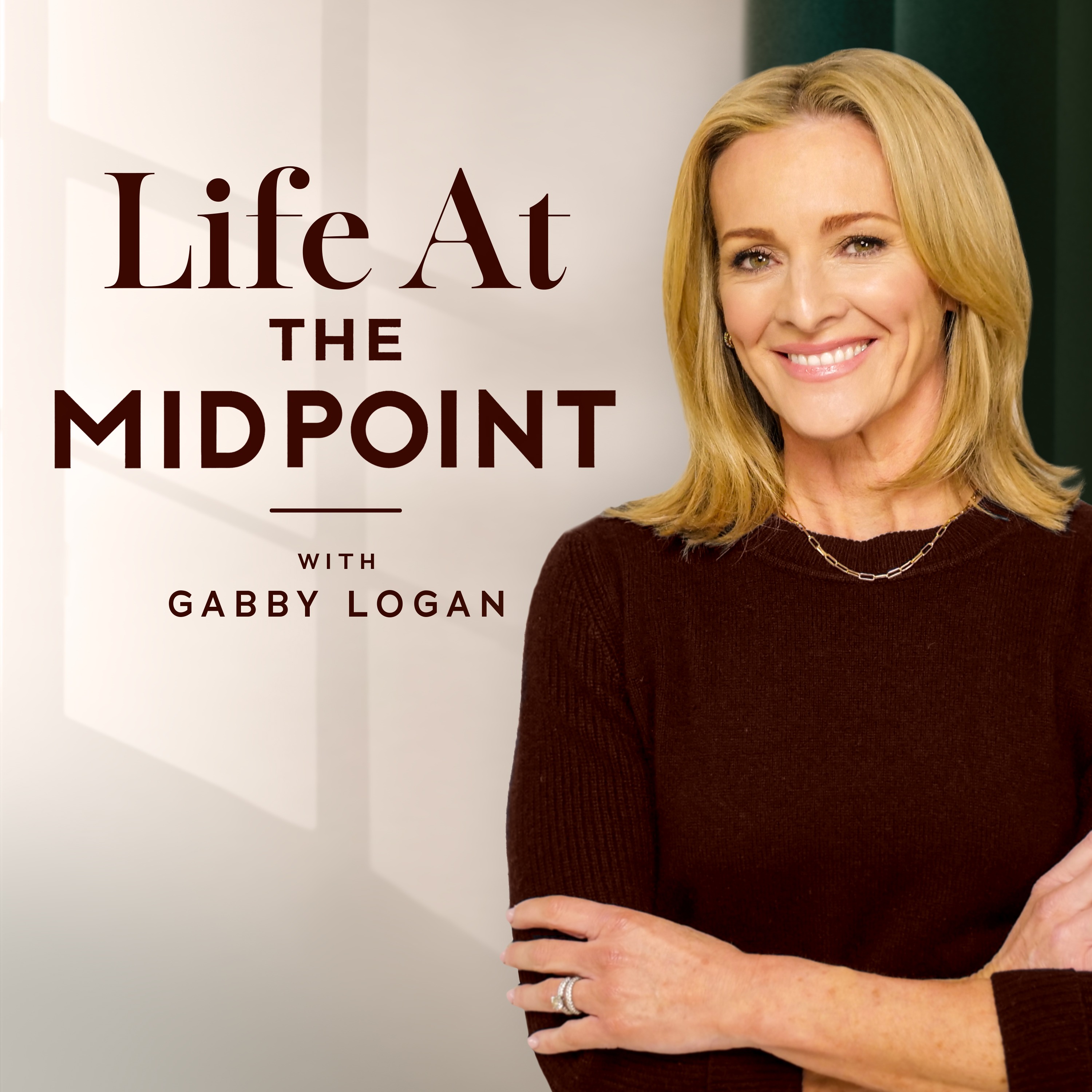
In this episode of Life At The Midpoint, Gabby Logan talks to journalist Cathy Newman about her two decades at Channel 4 News and her move to host a new daily politics show on Sky News. They discuss resilience, online abuse, women's visibility in broadcasting, the changing political landscape, competitiveness, and finding balance in a demanding career.
Topics career change at 50, women in broadcasting, online abuse and resilience, political journalism, menopause and work, work-life balance, women supporting women
Mentioned in this episode Cathy Newman, Kate Adie, Jon Snow, Gordon Brown, Theresa May, Donald Trump, Connor Burns, Boris Johnson, Emily Maitlis, Susanna Reid, Beth Rigby, Armando Iannucci
Chapters
- 0:02:42 Cathy Newman joins the show
- 0:03:15 Women's visibility on screen over 50
- 0:06:12 Leaving Channel 4 and moving to Sky
- 0:13:47 Interviewing liars and building resilience
- 0:25:41 Energy, sleep and switching off
- 0:30:02 Sexism, politics and women in society
- 0:38:57 Male allies and female networks
- 0:44:53 Finding joy amid a grim news landscape
Partner with Life At The Midpoint
Life At The Midpoint is produced by Audio Always. We work with brands on sponsorship, advertising and partnerships across our network of podcasts, reaching engaged listeners and viewers.
Advertising categories National News, News And Politics, Celebrity Scandal, Social Networking, Political Issues
Show notes
My guest this week is one of Britain’s most respected and fearless journalists.
Cathy Newman spent twenty years at Channel 4 News, interviewed eight Prime Ministers, and broke some of the biggest stories of the last decade — including the investigation that led to the Archbishop of Canterbury resigning for the first time in history. She’s just been named Journalist of the Year and Interviewer of the Year, and she’s now embarking on an exciting new chapter at Sky News fronting her own show.
But away from the headlines and the political interviews, who is Cathy Newman? What drives her, what has she sacrificed, and what does it feel like to be at this particular midpoint — leaving somewhere you’ve called home for two decades and stepping into something completely new? This is a really honest and fascinating conversation and I think you’re going to enjoy it.
Hosted on Acast. See acast.com/privacy for more information.
Full transcript
Gabby Logan 0:01:11 Hello and welcome to The Midpoint. My guest today is a serious news broadcaster, but I met her for the first time on Have I Got News for You last year, so I know she's also got a very healthy funny bone too. A teenage Cathy Newman was on her way to becoming a violinist or a lawyer. Until she was inspired by the incredible broadcaster Kate Adie, synonymous with war zones and disaster reporting in the '80s and '90s. And then Cathy decided she too wanted to become a journalist.
Gabby Logan 0:01:37 She graduated from Oxford University and worked her way up through newspapers at first— The Guardian, The Independent, and then The FT— and at just 23 years old, she was a political correspondent. She began her TV career in 2000, and in 2006 joined Channel 4, where she's been for the last 2 decades. At the heart of many important campaigns, showing her skills as an investigative journalist time and time again on stories about political impropriety, sexism in the corridors of power, and paedophilia, to name a few. She shone a light on so many important topics and has carried on writing as well. Her book Bloody Brilliant Women was highly acclaimed and is well worth a read.
Gabby Logan 0:02:15 In January, it was announced she's leaving Channel 4 and heading to Sky to be the host of their 7 o'clock daily politics show. Taking on new podcasts and leading more special investigations for them. And I'm really excited about chatting to Cathy. There are so many things I want to talk about, but particularly taking on a huge challenge like this and a big career change in the period of life that only a couple of decades ago we'd got used to seeing women disappear completely from our screens. Let's meet Cathy.
Gabby Logan 0:02:42 Cathy, welcome to The Midpoint.
Cathy Newman 0:02:44 Thank you. Great to be here.
Gabby Logan 0:02:45 Well, you've got a lot going on at the moment. You're a very busy woman, and in your introduction I talked about the fact that actually a couple of generations ago, this move, this huge career move that you're making right now in this week— um, I know you've already left Channel 4 and you're about to start your show on Sky. In fact, this might be going out just after you've started. Yeah, might not have happened because you probably would have been off the screen. Um, the visibility of women over the age of 50 has increased dramatically in the last couple of years.
Cathy Newman 0:03:15 No, it's really heartening actually, because when I first started as a TV presenter, everybody was sort of like, oh, do you think you'll be able to carry on broadcasting into your 50s? And I was like, well, yeah, why not? You know, all the men do. Um, but yeah, funnily enough, in the last few years, no one asks that question anymore, which is great. You know, that is something to celebrate, isn't it?
Gabby Logan 0:03:32 It is. And it still feels lovely that, you know, we are lucky enough to be in the generation that are here.
Cathy Newman 0:03:38 Yeah. And I suppose you're always pinching yourself thinking, well, maybe, maybe this is my last gig and then I'll get shuffled off. But no, I mean, I feel now— and also I always think that I feel like I'm in my 20s still.
Cathy Newman 0:03:50 You know, mentally or whatever. It was Jon Snow, my presenting colleague at Channel 4 News for many years, always used to say, you know, that he felt like a teenager and behaved like one. He didn't quite, but, you know. I sort of always feel mentally that I'm still young and, you know, running around. I've got loads of energy and everything.
Cathy Newman 0:04:08 And I feel that now, when you look at women in their 50s, you know, several decades ago, our mother's generation, they kind of behaved older at 50, 51. I am, you know, and I feel now that there is this expectation that 51, you're just beginning to get into your stride and, you know, you're having all this fun and you've got all this experience and you care less about things. And it's, it's very energising.
Gabby Logan 0:04:32 And your kids are older. So the responsibility of that day-to-day parenting, which tends to still fall on women's shoulders, even if you do split it completely evenly, somebody's got to be the kind of orchestrator or the boss. The choreography of the family diary in the house as well seems to matter less and less, doesn't it? So you've got a freedom. But you should have been equipped for this period of life because in looking at various things to do with your kind of family life and past, your husband wrote the manual, literally.
Cathy Newman 0:04:59 The midlife manual? Yeah. Oh, I had forgotten about that. 2010. I'd forgotten about that. He wrote it when he was nowhere near midlife.
Gabby Logan 0:05:05 That's what I was gonna ask you. I mean, this is a guy who was preparing for the future because he was— he must have been in his 30s when he wrote this. So was that kind of something that was concerning you quite a lot in your 30s as well? midlife was gonna go.
Cathy Newman 0:05:16 He also wrote a book about hypochondria as well. And I remember the Daily Mail trying to interview us as a couple about what was it like to live with someone with hypochondria. And I was like, well, he's not really that bad. I really killed the interview, to be honest. But, um, so, you know, I— it's funny because he's never been a kind of like old fogey or young fogey or whatever. So I think he just got a bit confused that midlife— he thought, oh, well, I must be in my 30s. And I'm like, no, you know, now we're in our prime now anyway. Yeah. But, um, well, midlife means different things to different people.
Gabby Logan 0:05:48 And I think, you know, there's an official— I think it's 38, the Economic and Social Research Council say 38 to about 58, but it's shifting all the time because it's not actually to do with lifespan necessarily. It's this age of potentially reaching a period that you think you should have contentment and you're not quite sure what that means. And there's a lot of kind of philosophical questions going around your mind. Does that resonate at all? And did that come into your thinking about your shift?
Cathy Newman 0:06:12 When you think you have contentment, Contentment. That's— I always think sometimes, because sometimes I say to my husband, oh God, I wish I just did 20% less and then I'd be much happier. Because I'm always busy, I'm always late. And, you know, I was late here today and that was probably my fault, though I did blame the tube strike. But yes, I always think, oh, I'll be happier if I just go a bit slower.
Cathy Newman 0:06:36 And my husband says, you really don't know yourself because you will only be happy if you're manically busy. So what is contentment? And I suppose I did think, you know, when I'd been on Channel 4 News 20 years, I suppose for the last few years of that, I did begin to think, right, what do I do next? What does the next chapter of my life look like? You know, how do I take control of that?
Cathy Newman 0:06:57 And, and I suppose, how do I— how am I the author of my own destiny? Because otherwise you can just sort of almost— especially I think as a woman, you sort of— get shoehorned into a way of life that perhaps you haven't really decided whether you want that. You might want something different. So I did take a few years just to think about, well, what do I do next? Mm-hmm.
Cathy Newman 0:07:17 And what would make me happy? Um, and, you know, I do think the thing about the Sky News show that I'm launching is that it's gonna feel really different. It's gonna feel really— there's gonna be a lot of personality in there. Um, you know, there's going to be a sort of energy and informality. It's gonna be— it's built very much for YouTube as, as well as the, the Sky News channel.
Cathy Newman 0:07:39 So there's that feeling of doing something different which is very bracing, very energising, and I think that makes me happy.
Gabby Logan 0:07:48 A bit scary?
Cathy Newman 0:07:48 Oh God, yeah. I mean, yeah, and there have been times when I wake up in the middle of the night and think, what the hell am I doing? You know, I've, I had this very stable, very contented professional life and I've just thrown it up in the air, but You need to live a bit. You need to go, let's do something. Does make me a bit fearful. I'm mostly excited. I'm just a tiny percentage fearful.
Gabby Logan 0:08:11 Do you think you sent out the kind of message subliminally that you needed this opportunity, or did you pick the phone up or somebody else pick the phone up and say, we've had a call?
Cathy Newman 0:08:20 You're getting down to the nitty-gritty now. I think I had— I knew the team at Sky over many years. You know what it's like in the industry. You sort of get to know people, don't you? So I'd had a sort of initial contact, initial breakfast meeting, and then things sort of picked up over the summer. Last summer, my agent got a call, and then we sort of—
Gabby Logan 0:08:43 Things don't work quickly in TV, do they? I quite like that. Yeah, I, I knew that Match of the Day was going to change a long time before it was announced and everything, and it feels sometimes like you kind of go, oh, come on, why does this have to take so long? And but it does take time to make big decisions, and this is a big show. So,
Cathy Newman 0:09:00 well, I think I also needed time to get my head around a big shift. And, you know, I kept on sort of trying it out in my head. You know, what would this feel like having my own show? You know, doing it in a very different way. Your own name on the top of the show.
Cathy Newman 0:09:13 Yeah, my name on the— yeah. Success or failure, my name's on the tin. And I just had to sort of roll that around a bit and see what that would feel like. But, you know, in the end, the offer from Sky of this, my own programme, 7 PM, so, you know, the same time slot as my my old show, so not too much change all at once. Um, politics— I love politics.
Cathy Newman 0:09:34 I've always loved politics. It's returning to Westminster for me 15 years after I left it as a correspondent. Um, and so all of that, plus the investigations that I'll be doing, which I love doing at Channel 4, and, you know, I'll be doing the same sort of hard-hitting investigations at Sky. They've got this brand new documentaries team which is absolutely fantastic, actually run by someone from Channel 4. Um, and I'll be doing a podcast which I'll launch in the autumn.
Cathy Newman 0:09:59 So all of that put together— it was kind of impossible to say no, really.
Gabby Logan 0:10:03 And you had that wealth of experience, that wisdom, and that sense of confidence that comes, I think, with turning 50 and getting into, you know, that decade. I think brings with it, uh, it's now or never, really, in professional terms. And that's for men as well, I think, isn't it? In our industry, I think, in the sense that you're not going to necessarily get those opportunities when you turn 70.
Cathy Newman 0:10:23 But I wonder, in some ways, if women get more confident as they age and maybe Well, I suppose it is hard to generalise, isn't it? Maybe some men lose a bit of confidence. Maybe some men get more and more confident as well. So maybe it's hard to generalise, but I do think—
Gabby Logan 0:10:38 I think if you're still there as a woman—
Cathy Newman 0:10:39 Yeah, that's true. God bless you.
Gabby Logan 0:10:41 You probably do feel more confident.
Cathy Newman 0:10:43 Yeah, I do.
Gabby Logan 0:10:44 Because you've had to ride through a few storms to get there.
Cathy Newman 0:10:46 Well, and storms, I mean, you know, in my— must have been my 30s, I guess, was when I really— I remember I'd just come back from— now let me get this right. Yeah, I'd just come back from my first maternity leave. And Twitter had just hit. And I remember the first, like, Twitter storm I was involved in and the sort of horrendous abuse and very misogynistic abuse aimed at me. And I remember just feeling completely, you know, decent— it's sort of like I was a piece of meat being kicked around in the street, like I wasn't a human being.
Cathy Newman 0:11:18 Yeah. And I remember the shock of that. Like, I really felt like I was in shock. There were moments when I didn't I couldn't remember what I was doing because I was so, you know, it was, it just swamped me. And then now I just think, I don't even look at it anymore.
Cathy Newman 0:11:33 I don't look at all that stuff coming my way. I, and I don't care. Um, and I said that to one of my male presenting colleagues not so long ago, and they said, oh, but you do really care, don't you? I was like, do you know what? I really don't care what someone with an egg on their head, you know, with, you know what I mean?
Cathy Newman 0:11:49 An egg for their identity. Yeah. On their handle on Twitter. Or probably a bot. I don't care what they're saying.
Cathy Newman 0:11:55 I care what I, what I care about doing journalistically, the stories I'm bringing to the screen, the people that I'm platforming who wouldn't otherwise get heard. Those are the things that matter.
Gabby Logan 0:12:07 Absolutely. I mean, I completely agree with you. And it takes time.
Gabby Logan 0:12:11 It's easy to, to say it to somebody who's a lot younger, actually younger colleagues, female colleagues of mine who've received some horrible abuse online. And you've been there, and you know how, you know, that first time you open the Pandora's box almost, and you read stuff, you— it can feel awful. But actually, through your longevity of career, and also the people who really matter, I think, in your world, whether it's an editor you trust the opinion of, or, you know, your husband who you might seek counsel with, who, you know— yeah, those people are the ones who are going to tell you the truth, aren't they?
Cathy Newman 0:12:42 Yeah. And people who you've Obviously your family, you know, you've known for a long time, um, some of them forever. Um, but, um, you know, it is the people that you've worked with for many years, the old colleagues, like old colleagues from newspapers who I consulted about this big shift privately, um, you know, old colleagues at work who I've worked with for 20 years at Channel 4, um, you know, my agent who I've worked with for many, many years. You know, there's all these people who build up a kind of team, a network, a supportive group around you. And I think, yeah, listening to what they say is really important.
Gabby Logan 0:13:16 Going back to abuse online and things that have been thrown at you, you have taken on some really tough subjects, some tough interviewees who sat in front of you and, and have given you a hard time. Um, and I know what it can be like when somebody throws something back at you that you weren't expecting. How have you built the resilience to, to deal with that professionally? I'm not talking about people you don't know, kind of in the Twittersphere, but when somebody's sitting in front of you and they tell a blatant lie, or they come back at you with a falsehood?
Cathy Newman 0:13:47 Well, I think, you know, I always find it very frustrating, um, interviewing, for example, um, you know, Russian politicians, because you know that they're lying about the war or some particular casualties that they're, they're saying is, you know, fake news or whatever. And the best— how do you deal with someone who really doesn't care about lying? That's the first thing, who hasn't got any kind of moral compass about lying.
Cathy Newman 0:14:10 So it's very frustrating. And I feel that we've all, in our different ways, tried different things, haven't we? You know, whether you show them the pictures of casualties that you're seeing, or whether you just calmly set out the facts as you understand and know them. I mean, it's the same with people— I haven't ever been able to interview Donald Trump, but I'd love to. But it's how do you do that when there's, you know, people now— and we've done it on Sky— you know, he picks up the phone and you get a sort of impromptu interview.
Cathy Newman 0:14:41 That wasn't actually the answer to your question, though, was it? But how do you deal with these things?
Gabby Logan 0:14:44 But when you're in that moment and, you know, your heart starts beating a bit faster, or you feel a slight kind of physical shift in your body because the person has just said something that's so outrageous, or he's he or she has accused you of manipulating the truth. Because modern journalism, especially television journalism where you can see the whites of somebody's eyes, we sit there night after night. I can hear my husband now going, how can they get away with that? It is so hard for credible interviewers to come out of that situation feeling, I put them to the sword. I gave them everything I had there.
Cathy Newman 0:15:21 I feel always, and this is quite a sort of female response, I think, is that I will feel happy if I know I've prepared as hard as I can and that I've done my homework and I've got all the ammunition. I'll feel happy about that, as long as I've deployed that ammunition in the interview, of course. But yeah, but the thing is, not all interviews go according to plan. And, you know, that's the other thing about longevity is that, you know, that you do hundreds of interviews a year. They're not all going to be the ones that you want to be in your—
Gabby Logan 0:15:52 And you're about to show it.
Cathy Newman 0:15:53 Yeah, exactly. And you just— I think you, you just have to sort of deal with that. And that is all. I mean, I don't want to be too pretentious, but, you know, I sometimes think of— I love— one of my favourite texts in English is The Wife of Bath by Chaucer. And, you know, she starts off about experience. And I think that is— you, over a period of your whole professional lifespan, there will be things that go well and there'll be things that don't. And you just have to look at it in the round and feel whether you're happy doing what you've done and you've done what you set out to do.
Gabby Logan 0:16:22 Does it feel, though, this current kind of political landscape that we're in over the last few years, it feels almost post-COVID actually, that things have changed in the way that politicians and leaders and people that we trust are delivering in a way that we've never seen before? We don't know who to trust. We don't know. And yet we've got more visibility than ever before because of social media.
Cathy Newman 0:16:47 Well, it's one of the things I've been reflecting on a lot because it It's 15 years since I last worked in Westminster, and the whole political landscape has been turned upside down.
Cathy Newman 0:16:56 You know, the two-party system of old that, you know, we grew up with, really, that's all gone. Mm-hmm. Um, and so it has been, and, and it's got much shoutier. And I think we have to, we broadcasters have to adjust to that. So the whole kind of 4-minute interview round where, you know, they try and get their points across, you try and interrupt them because you haven't got time.
Cathy Newman 0:17:16 You've only got 4 minutes and you want to get across a lot of subjects. That just feels increasingly pointless to me. You don't learn anything. The audience doesn't learn anything. The politicians get cross because they haven't got across what they wanted to say.
Cathy Newman 0:17:28 I get cross because I haven't got everything asked that I wanted to ask. So we're trying as much as possible in this new show to give more time to the interviews that matter, to do fewer bigger interviews, and to let things breathe and unfold and to sort of also show our own homework. How do people come into the studio? What's that initial exchange of— how do people look when they come in after a heavy day and they sink onto the sofa, my new velvet sofa, which is very comfortable.
Gabby Logan 0:18:00 Have you had anything to do with the tension of the springs?
Cathy Newman 0:18:03 Well, I mean, I did right from the start. I said the problem with a lot of TV furniture is that it's made for men and it's too big. The chairs are too big and you're just sort of like you can't reach the floor on some of them. I'm very small. So I sort of let my views be known.
Cathy Newman 0:18:20 And the team has done an amazing job picking a chair that I can reach the floor. And it's very comfortable and very relaxed. And that's the point, to have a sort of slightly more informal, chattier, and therefore more revealing conversation. Yeah. So people coming into the studio, we've got this gimbal camera, you know, which is very nimble.
Cathy Newman 0:18:40 And we'll film those initial exchanges. You know, if it's been a particularly heavy day in Westminster, and, you know, a minister sinks into the sofa and is looking sort of sweaty and shattered, that's important to know. Equally, if it's someone who's looking emotional— I mean, one of my first interviewees, we had to send out for a box of tissues. You know, it's like those are human moments that everybody relates to. You know, everybody has a bad day occasionally, and we need to know what that feels like.
Cathy Newman 0:19:11 Mm-hmm. I suppose the other thing about the political scene at the moment is that—
Cathy Newman 0:20:30 you know, a lot of people increasingly don't see politicians as sort of human beings like any other, and they are. And, you know, they get horrendous abuse themselves. And that social media shoutiness and division is very corrosive, um, to democracy, really.
Gabby Logan 0:20:51 It is. And I, I think— always think back to when Gordon Brown left Number 10, and he had not shown us much of his personality really in that short period of time he was Prime Minister. And suddenly he was walking out with his boys who we'd not really seen before, and his, his wife obviously, who we had. And it was very emotional. I was quite surprised how emotional I was about that and how I wished he'd given people a bit more of himself. And you don't want it to be inauthentic. You don't want people to kind of do a schmaltzy, you know, this is my family.
Cathy Newman 0:21:24 That's genuine, isn't it? Yeah. You know what, I always think that when you see prime ministers leaving, you know, we've seen quite a few of them leaving Downing Street recently. And, you know, I've had the privilege of being there in the street, you know, metres away from them when that— at that most, you know, vulnerable moment in their lives, really. And I think you do— I find it very emotional
Gabby Logan 0:21:44 watching Theresa May's voice breaking, telling us how this was the honour of her life. Yeah. It doesn't matter what your political persuasion, when you see the vulnerability and the human— do you know, there's one person I can't imagine ever, Donald Trump, delivering a moment like that where I feel remotely connected to him as a human being. Maybe, maybe he'll surprise us all. But even people you've not necessarily admired as politicians or you've not particularly warmed to.
Cathy Newman 0:22:07 Yeah, I feel emotional whatever party it is, by the way. You know, I'm not making a party political point.
Gabby Logan 0:22:11 No, I've just given you 2 different, you know, ends of the spectrum then. Yeah, they both gave me a different insight into, into them as people.
Cathy Newman 0:22:18 And I think that's what we want to get across in, in my new show, is the sort of humanity of it, the kind of what's really going on there, you know. Let's not do the lines to take and the sort of, you know, the— it's just cutting through that cacophony and getting to the heart of it.
Gabby Logan 0:22:35 Do you feel like they need to like you to come on?
Cathy Newman 0:22:40 I think personally, I don't think it's about liking. It's a really good question. I think it's— you've got to have a rapport with people.
Cathy Newman 0:22:48 You know, you've got to be interested in people as human beings, as I am. And I'm fascinated by politics anyway. So, But if it was someone from business coming, because we're going to be ranging beyond Westminster in this new show, you've got to be interested in what people are doing and what they want to talk about. That's decent and polite. And I am interested in people and what they do.
Cathy Newman 0:23:09 And so I think that's what matters is that people know that. And they also know that you're going to be fair. You're not going to— the gotcha questioning, that's had its day. If you're trying to get, you know, the Education Minister to do the times tables or whatever, I mean, you know, I, I'd struggle under pressure to do my times tables, I'm afraid. Um, I own up to that.
Cathy Newman 0:23:31 And it, you know, let's not, let's not make them performing seals. You know, these are human beings and you want to establish that rapport. So I think establishing a rapport is important rather than a friendship.
Gabby Logan 0:23:42 It's funny because I agree, the gotcha thing is, is tired. But there's still this clickbait thing that drives a lot of— Moments. Yeah, a lot of TV. You know that something is being kind of engineered towards a click and digital and, you know, kind of moments that are— you referred to it earlier on— just so fleeting, really quick, and they don't tell you anything about the bigger picture. Do you resist and push back on that kind of narrative?
Cathy Newman 0:24:11 I suppose one of the things that I'm really impressed with at Sky is just how impactful they are across multiple different social media platforms. And that needs to happen because that is how people are consuming their news.
Cathy Newman 0:24:22 You know, you need to— you know, Sky's got 11 million followers on TikTok, for example. You know, I don't get my news by TikTok, but our kids, they do. Yeah. And so you've got to lean into that. That, that's the first thing.
Cathy Newman 0:24:35 But, you know, it's— there are moments and there are moments. You know, for example, one of the interviews I did with Connor Burns, who was one of the staunch loyalists of Boris Johnson when the whole Partygate thing was going on. And he was trying to explain how this birthday party against COVID rules happened. And he said to me, I suppose in a sense, you know, he was ambushed with a cake. And I was like, but that's ridiculous.
Cathy Newman 0:24:58 And the whole thing went viral because it spoke volumes about the contortions that everyone around Boris Johnson were making to try and explain away his behaviour. So yeah, you could say, was that clickbait? Was that a, you know, a viral moment? It was a viral moment, but it also told you something bigger. And I think that's where those kind of social media moments are really important, is if they speak to a sort of higher truth.
Gabby Logan 0:25:22 So you've talked about your energy and your desire to be— well, you think you want to be less busy, but you patently don't because you've just taken on this enormous challenge and you are very good at being busy and spinning lots of plates. Where does the energy come from? Do you make time for kind of exercise or lifestyle kind of hacks that give you?
Cathy Newman 0:25:41 Yeah, I think actually it probably comes to the point that I've never been very good at sleeping. So, so it's actually not necessarily a good thing. I think, I know, even right from being a baby, I was never, you know, my kids always— What
Gabby Logan 0:25:56 are we talking about? How many hours?
Cathy Newman 0:25:57 Well, you know, if it's an election night, I don't feel tired when I've done an election night. I don't feel like— You push on through. Yeah, I could just push on through. But that's not a good thing, I don't think. So for me—
Gabby Logan 0:26:08 I have to say, Cathy, it goes against most of the experts we have on the podcast who talk about sleep and being this very important tenet of your health and wellbeing. So—
Cathy Newman 0:26:18 Well, except I've just read a book about sleep because I was worrying.
Gabby Logan 0:26:21 You found your sleep guru who says you don't need sleep.
Cathy Newman 0:26:24 Well, no, the good thing about this book, and I can't remember, so I can't name-check it, it probably would be product placement anyway, but it's very good because She just says you've got to worry less about sleep, which was really refreshing to hear because I'd be lying there awake at 3 in the morning thinking, oh my God, I've only got, you know— 2 hours. 3 hours more to sleep. I've only had— yeah, I've only had 2 hours sleep.
Cathy Newman 0:26:45 And that really stressed me out. And then of course you don't go back to sleep. So the good thing about this book is it says you'll trust your body to know when it will take the sleep. You know, empty your mind, which is hard for me to do because there's always stuff spinning around my mind.
Gabby Logan 0:26:58 Is that stuff you've just taken out of an interview, or is it something that you—
Cathy Newman 0:27:01 I think, well, at the moment, you know, there's a lot going on with launching the new show. So, you know, that's, that's always in my mind. I am not too bad at switching off after— my husband will probably— I'm hearing him go, yeah, you're terrible at switching off after a busy day. But I'm not too bad at the sort of separating work and home. Like when I put the key in the front door, I'm like, okay, here I'm home.
Cathy Newman 0:27:24 This is a different space. That's great. here's my family, you know, and I feel relaxed and that's all brilliant. But I think I'm quite bad at if it's been a particularly busy, adrenalised day, you know, where everything's so exciting in politics at the moment. I think I'm— it's hard to empty my mind of like, oh, I need to get this, that, and the other guest or interview on, or I must chase that story.
Gabby Logan 0:27:48 So do you— would you go for a run?
Cathy Newman 0:27:50 I do. I I did run actually quite a lot in my old job because I used to run along the canal in Leeds. I'd more do exercise bike twice a week. I walk everywhere. I mean, we got a cab here, which is literally because my colleague here insisted we get a cab. I would otherwise have walked. So I like walking because it gives me thinking time and it does help me sort of cleanse my brain and process. Process. Yeah. But in terms— I think the key thing for me is like relaxing with a nice meal with my husband, my family, watching— I've been watching some old Bond films to just try and switch off.
Gabby Logan 0:28:30 Who's your favourite? What's your favourite Bond?
Cathy Newman 0:28:31 Well, I'm in the middle of Skyfall at the moment, and that's going well.
Gabby Logan 0:28:35 Yeah, Daniel Craig is hard to beat, I think. I mean, it's been a long time since we've had a Bond.
Cathy Newman 0:28:39 Yes, we were saying we need another Bond.
Gabby Logan 0:28:41 Yeah, you might— your show might actually get to interview whoever the next Bond is.
Cathy Newman 0:28:45 Well, I have bid for some of the candidates.
Gabby Logan 0:28:48 Will you be going that kind of, uh, the breadth of the show be going that wide?
Cathy Newman 0:28:51 Yeah, absolutely. I mean, so it's going to be British politics at its heart, but also American politics, European politics. But then beyond that, my own original journalism. So, you know, I've done a lot on church abuse, for example. There'll be other stories that come to me or that I come to them, and we'll work them up in investigations.
Cathy Newman 0:29:10 We've got a few things on the go at the moment, um, but then we'll also do key cultural figures and you know, for example, Armando Iannucci, um, people like that, Ian Hislop, you know, people who have something to say about contemporary Britain and politics. Um, we'll have the odd film star on, I hope. Um, writers, um, actors.
Gabby Logan 0:29:33 Yeah, pretty much anyone you find interesting.
Cathy Newman 0:29:36 Anyone who's interested. And by the way, most people have a story to tell.
Gabby Logan 0:29:40 They certainly do. And you, you've experienced and written and talked about sexism in the early part of your career and the kind of bear pit of being in kind of Parliament, working around those corridors of power. And you said at the very beginning, going back in that environment, it's almost got worse in the sense of kind of how noisy and shouty the whole thing is. Has it got better, though, for women in that environment?
Cathy Newman 0:30:02 I mean, I've only been back down there for a few days, so I'll have to come back to you on that one. But, but I— my sense is that it has. But I'm not sure that society as a whole is necessarily treating women better. And it the polarisation, you know, particularly if you look at what's happening in America, you look at birth control across the world, you know, those rights that we perhaps took for granted are sort of being peeled back. And that's quite shocking that you think things that you took for granted as you were growing up, you know, the whole tradwife movement, I find quite interesting.
Cathy Newman 0:30:36 Mm-hmm. Um, you know, everybody's got a choice with what they do with their life. That's great. But I feel as if, um, Yes, some of the things that when I was in my 20s and 30s, some of the things we argued for and, and felt that we'd won, that's going backwards. So for example, as we've touched on before, in the online space, I think all women are asking for is to feel as safe in the online space as they are in the real world.
Cathy Newman 0:31:00 And that currently is not the case. And that, that, that astonishes me.
Gabby Logan 0:31:03 Not that safe in the real world, is it? It doesn't feel that women are at a place where now where It's not— walking down the street from a night out is no better than it was 40 or 50 years ago.
Cathy Newman 0:31:15 And, you know, if you look at the rape figures, you know, there are some improvements being made in certain police forces, but, you know, there are parts of the country where people, MPs, have said, and I think it's true, that rape is effectively decriminalised. And that is shocking in this day and age. And, you know, I've had my own experience of dealing with offences, going to the police, and the the sort of length of time and the effort you have to put in as a victim of abuse to— it's astonishing how long it takes and how many hoops you have to jump through.
Gabby Logan 0:31:47 I can't believe I even had to ask you that question in 2026, because it was a question at the very beginning of my career when I started at Sky 30 years ago. I, for the first 10 years, kept thinking, oh, this question will stop being asked, you know. And in some ways it has stopped being asked about this particular job that I do and the area I work in because there's much more visibility of women.
Gabby Logan 0:32:06 But it is the overall kind of position of women in society which feels to have perversely got worse. And the possibilities for women, as you point to America, if those trends kind of come across here, are insidious and worrying for our daughters and their futures.
Cathy Newman 0:32:23 Exactly. And I do think that, you know, we're in a position of immense privilege. And, you know, if, if you're a woman from a less well-off background, you're struggling to make ends meet, particularly at the moment in a cost of living crisis. You know, you've got this economic crisis that has been sort of inflicted on everyone. I think that's where you see the kind of real inequalities. So yeah, it's important to sort of recognise that, yeah, great battles have been won in the field of TV, you know, presenting. Yeah. But there are many more issues that, you know, affecting women from all sorts of different fields.
Gabby Logan 0:32:59 Yeah, I mean, I always talk about the, the importance of seeing women playing sport at top level is because then it gives young girls and young boys the idea that women can actually do anything they like, and they can, they can enter spheres that they previously thought weren't for them, whether that is top careers in science or the arts. And we saw with the, the astronauts, obviously, how many women were kind of working in top positions recently for Artemis II. And, and those things, I think, are really powerful, those visible
Cathy Newman 0:33:24 Well, hard-hitting TV journalism, because, you know, I didn't get a TV until I was 16. And when I did, I saw Kate Adie standing in a flak jacket reporting from a war zone. And I genuinely didn't realise that those kind of jobs were open to women. So, you know, those kind of really tough TV jobs. So yeah, you've got to see the change, haven't you?
Gabby Logan 0:33:44 Yeah, I said that in your introduction, actually, because I'd read that you were on your way to becoming either a violinist or something in the law.
Cathy Newman 0:33:50 Yeah, yeah, I thought about— I loved playing the violin. And so I thought about being a violin teacher, both my parents were teachers, and I remember one of, one of their friends who was also a teacher said to me, oh, it's a dog's life being a teacher. I was like, all right then. So anyway, then I thought about being a lawyer, um, and then I just— I, I— it was seeing Kate Adie that sort of changed my mind.
Gabby Logan 0:34:12 Have you had the opportunity in your career to tell her?
Cathy Newman 0:34:14 Yes, she interviewed me about my book Bloody Brilliant Women, so that was a real pinch-me moment.
Gabby Logan 0:34:19 Of which she is one.
Cathy Newman 0:34:20 Yes, exactly. She certainly is, you know, a real trailblazer.
Gabby Logan 0:34:23 Yeah.
Cathy Newman 0:34:23 And she's fought some battles over her time in journalism.
Gabby Logan 0:34:26 Yeah. So it feels like it's, it's a, it's better at the moment. It feels like the, the kind of corridors of power anyway, the attitudes there, because they're not tolerated, but not necessarily overall for women. Are these stories that—
Cathy Newman 0:34:38 And when you look at female MPs as well, the abuse they get, and, you know, particularly, you know, women of colour, it's off the scale. Um, but I think MPs of all genders and all parties suffer from that too.
Gabby Logan 0:34:53 And then you think, why would I do that? Why would I put myself in, in the line of fire like that? When you hear those stories being reported, it feels—
Cathy Newman 0:34:59 Yeah, I thought about being an MP once, and then, yeah, and to be honest, it was exactly that, that I just thought, you know, in the job that we do, we can, you know, get change in the way that many very diligent backbench MPs try to and, and achieve. Um, and yeah, I just think with the amount of vitriol you get, you've got to be a very, very resilient person. I feel I'm resilient, but— I
Gabby Logan 0:35:24 was going to ask you about resilience, because to get to where you are in your career and to have this platform you're going to have now is, is grit, it's determination, it's, it's hours and hours of work doing the shifts at times that you didn't want to do that might have kind of taken you away from your family, and, and you have to keep doing. And in so many careers, that is the way you get to the top. Um, is it something that is innate in you, do you think, or did you learn by looking around, think is the only way I'm gonna—
Cathy Newman 0:35:50 I think there's a difference between determination and resilience. And I think I've always been very determined. I've always been quite stubborn. I've always been an incredibly hard worker. You know, that's— I think that is innate, probably. You know, both my parents were very hard workers, and I think you see that. I've been— I've always been very competitive. My older sister—
Gabby Logan 0:36:11 How does that manifest itself?
Cathy Newman 0:36:12 I just always want to win. It's really— it's not necessarily a nice quality, but yeah, I'm just very— Do you think it's an
Gabby Logan 0:36:20 an insult to women. I, I, I get accused of being competitive. Oh, you're so competitive, you're so competitive. And it always comes out as an insult, never a compliment.
Cathy Newman 0:36:30 Well, also, and you, you know, you've spent a lot of time in the sporting world, I feel that to be competitive as a man is seen as a, a bonus attribute. Yeah. But if you're a competitive woman, then it shades into that, oh, she's very ambitious, you know, and that's seen as an insult. I think it can be, even now in
Gabby Logan 0:36:43 2026.
Cathy Newman 0:36:44 Yeah, I think a little bit. But I, I feel You know, I feel proud to be competitive, but sometimes I suppose it comes back to that thing about contentment, doesn't it? Sometimes I wish I wasn't quite so competitive. You know, that phrase, don't let the best be the enemy of the good. Sometimes I wish I could just be happy with good. You know, that would make me happier.
Gabby Logan 0:37:02 Are you competitive with Cathy? Are they, you know, internal— Yeah, all of that. Or do you go for, I'm gonna have that job and that person, or I'm gonna do that and that? Is it more about how far you can push yourself?
Cathy Newman 0:37:15 Weirdly, you know, unlike Michael Heseltine, although he always disputes this story, you know, that he had his career mapped out on the back of the envelope, culminating in Prime Minister. I don't feel I've ever planned my career like that. But what I— where I am competitive with myself is that I always want to get the best story or the best exclusive or the best interview. You know, that is— so it's not, you know, oh, I want that job. Mm-hmm. It's like, I want to do this job to the best of my ability. so that I feel happy with myself.
Gabby Logan 0:37:46 And are there— is there a kind of group of you in those top jobs, women who are kind of—
Cathy Newman 0:37:51 do support each other? I mean, that's what has changed dramatically in the 15 years since I was last in Westminster.
Gabby Logan 0:37:57 Did you get a well done message from Maitlis?
Cathy Newman 0:37:59 Yeah, well, yeah, all of that. And Susanna Reid. And, you know, there's a lovely group. And Beth Rigby, our own Beth from Sky. I mean, you know, that— and you— sorry, I need to name-check everyone.
Gabby Logan 0:38:11 Yeah, yeah, we'll put a ticker across the bottom of the screen here.
Cathy Newman 0:38:16 Exactly. Let's just make sure we've missed no one off. But what is lovely is that there is now that network of women who support each other. When I was first on newspapers, there was one female newspaper editor who shall remain nameless who was not known for sending the elevator back down, as the saying goes. Right.
Cathy Newman 0:38:35 And now I just feel that, you know, the Women in Journalism is such a great charity that really supports other women and applauds them. And we're there for each other. And I think that makes the whole thing a very different proposition. You know, men always had those networks and they, you know, there was the whole old school tie of like the public schools and the clubs and all of that. And they looked out for each other and they did.
Cathy Newman 0:38:57 It was a sort of unspoken code. Now I think that exists for women and that's brilliant.
Gabby Logan 0:39:01 But alongside that, those male allies, I'm sure that you've had along the way through your career have been, have been vital because those men, and they're often unheralded, I think. And I always try and kind of name check and give those people credit because Because I, you know, if they hadn't supported at the very beginning, then those doors wouldn't have been opened.
Cathy Newman 0:39:17 Well, there is a chapter in my third book, The Ladder, on male allies.
Cathy Newman 0:39:22 Um, and I think that is really important to recognise because, you know, I had a mentor at The Independent, a guy called Matthew Horseman, who was an incredible scoop-getter. Um, and he gave me brilliant advice, which was, you know, never take a, never take a lunch break just to have lunch. You know, always take someone out for lunch and get the story. He also said, go— if you get a good story at lunch, go into the loo, write it down in your hand so you know that you're gonna remember it. Because in those days, people used to expect to have a drink over lunch.
Cathy Newman 0:39:53 You know, your contacts would expect to be bought a drink. So, you know, you would sip a little bit, but— Not as much as them. You'd have to check yourself. Exactly. Not as much as them.
Cathy Newman 0:40:03 But so he was brilliant at telling me showing me the ropes when I was first on newspapers at The Independent. And just, you know, right the way from Jim Grey, my old boss at Channel 4 News, who's now at the BBC. You know, they— people who, yeah, show you how it's done, I suppose, and show you the ropes. Matt Fry, my old colleague from Channel 4 News, was always a great friend and supporter. Yeah.
Cathy Newman 0:40:30 Oh God, now I'm gonna have to name-check all the men.
Gabby Logan 0:40:32 We'll be here all night. So would you— Would you say that you, through, through your kind of industry, through your industrial kind of journey and, and this career that you've had, it's been kind of never— it's never been about being a woman per se? Because you've written, you know, bloody brilliant women.
Cathy Newman 0:40:50 You mean I haven't got where I've got because I'm a woman?
Gabby Logan 0:40:52 Yeah, it's never— it's never— you've never felt, oh, this is fortuitous that I'm here right now?
Cathy Newman 0:40:56 Well, I have felt that occasionally right at the start because, for example, I was a media correspondent on the FT And I always remember in, um, a press conference, I would quite often be the only woman. And someone like Sam Chisholm, who actually ironically used to run Sky, and Rupert Murdoch, you know, they used to pick me out because they— I stood out because I was the only woman. And that was quite helpful. Um, but yeah, have I ever got anywhere because of being a woman?
Cathy Newman 0:41:24 I don't really feel that, no. Right. You know, the diversity hire thing is maddening, really, because I think very few women have got where they've got because they just ticked a box. You know, most women have got to the top of their fields because they work incredibly hard. And they, you know, they do, they do well.
Cathy Newman 0:41:42 I don't want to sound arrogant or boastful. But, you know, that, that's— you work and you succeed. And that's good.
Gabby Logan 0:41:49 I started the chat talking about the visibility of women in their 50s on screen, how important that is. And the conversation around menopause has become so much louder over the last few years, and, and people understand the challenges that that brings. And for a lot of women, um, it's, it's brain fog, and it's all those kinds of the mental kind of, um, challenges that, that they face, as well as the physical ones. Have you ever had those doubts about a name that you're about to say, or a— um, people always ask me this question about being on air, going, yeah, struggling.
Cathy Newman 0:42:20 Oh God, yeah. I've definitely had that. I mean, it's why I usually have notes there just to reassure myself. But I've never really— I've always been bad at names. So I've kind of always had that. It's okay. So glad you reminded me. You know, so I've always had the sort of safety net of my notes because that's my kind of, you know, knowing that I've done my prep and I've got it all there just makes me feel more relaxed.
Gabby Logan 0:42:45 Even if you never look at them, it's the safety net, isn't it? It's like carrying an umbrella around London on a sunny day.
Cathy Newman 0:42:49 I've got an umbrella in my bag. Doing it for everybody else.
Gabby Logan 0:42:52 So those, those things, uh, don't worry you so much? You're not—
Cathy Newman 0:42:56 No, I mean, I don't feel like, you know, we— I never talked about menopause with my mum. No, I had— I mean, I, I went on HRT just because all my friends were doing it, and I thought, well, I don't want to miss out, you know. Maybe I'll end up getting sort of older and wrinklier and more forgetful, and I won't even know. I don't even know whether I've had menopause symptoms. Um, you know, you're riding through it.
Gabby Logan 0:43:18 Maybe your mum didn't talk to you about it because she didn't really have— yeah, because my mum maintains that She said I had extra Bacardi and Cokes and dark chocolate. She said that's what her recipe was.
Cathy Newman 0:43:29 I love that! The new HRT!
Gabby Logan 0:43:30 Well, the old HRT. That was her. She had this conversation at my 50th birthday party with Denise Lewis, and she said, I don't know why she's going on about the menopause all the time. I just had an extra Bacardi and Coke and a square of dark chocolate. And she won't mind me saying that because she's quite proud of it.
Cathy Newman 0:43:46 That's what my kids would say. Queen.
Gabby Logan 0:43:49 Or sleigh. Yeah, she's from Leeds, which you might realise the accent because you've lived in Leeds.
Cathy Newman 0:43:55 So, well, yeah, I didn't actually live there, but, you know, the family was all in London.
Gabby Logan 0:44:00 I was gonna say, you must have spent a bit of time in Leeds.
Cathy Newman 0:44:02 Yeah, yeah, absolutely. Yeah, love the city, you know, but don't love the LNER. Sorry.
Gabby Logan 0:44:06 No, it doesn't always work. But is your show— you don't want to be London-centric, you're based in the South. How are you going to represent the whole nation?
Cathy Newman 0:44:14 Well, I mean, it is It's at its heart, it's Westminster, but obviously Westminster affects everybody's lives. So yeah, of course we'll be, you know, we won't always be broadcasting from my velvet sofa, which I was calling an orange velvet sofa, and then we realised it's more sort of dusty pink. Oh, okay.
Cathy Newman 0:44:30 So, you know, we will be getting out and about. We will be doing OBs, outside broadcasts, you know, as the news justifies. So, you know, if something big happens elsewhere in the UK, which it frequently does, you know, and it's got a political angle to it, or it's an investigation I've been doing. And there are various investigations I've got potentially which could take me overseas. So, yeah, you know, the world is your oyster.
Gabby Logan 0:44:53 And finally, in a world of chaos and, you know, we lurch from one disaster and one war to the next, and every time, you know, we kind of wake up in the morning and what's happened overnight now? For a lot of people, it's turning the news off. Yeah. So they don't want to hear any more bad news. I think most of us want to feel informed and we want to feel that we, we have an idea of what's going on. But it's still, even if you try and be kind of resilient and put a coat of armour there, it can get to you. How does it?
Cathy Newman 0:45:20 Yeah, you're so right. I mean, so many people say that to me, oh, I don't watch the news anymore, it's too depressing. And I really feel that and I really understand that. So, you know, the new show is energetic and uplifting and it's finding humour in, in where you can. Uh, we're— every day we will have some sort of uplift in the programme. Absolutely. And I've got a new podcast launching which lean into this very theme as well. That won't launch till the autumn. But it's just the idea of finding the joy and the inspiration and the uplift in life, because it's there, but we've just got to excavate it.
Gabby Logan 0:45:52 It's just walking around town today, because I did some other podcasts for a sports podcast I do, walking through, there were some lovely scenes in the street, you know, and it's so easy to ignore those things, isn't it? Or to not, to not see them anymore, because we're told to look out for somebody nicking our phone, or we're told to look out for somebody coming up behind us and, you know, grabbing our bag. And, you know, my kids don't live in London, and they've got this terrible impression of what life is like in London when they see all these stories on TikTok and things.
Cathy Newman 0:46:19 It's so much fake news. I must say, I'm always walking around with my phone and I'll go, I shouldn't have advertised that.
Gabby Logan 0:46:23 Yeah, you probably should. I was going to say, she's got very curly blonde hair, she'll probably be wearing a lovely suit.
Cathy Newman 0:46:29 Totally Target. Yeah.
Cathy Newman 0:46:31 Um, I mean, the thing we do every week on Times Radio, because I've got a show on Times Radio, we have an animal story every week, and that's at my instigation. And it's not just something about a fluffy cat or a dog or whatever, Sometimes it's about, you know, how seahorses copulate, or— How? It's an interesting story. It's very interesting. You should look it up.
Cathy Newman 0:46:51 Okay, we'll do. Or, you know, maybe it's about some dinosaur that's just been rediscovered after however many centuries. See, slightly brain-fucking that one. Missing Years. Oh yeah, that one.
Cathy Newman 0:47:03 You know, so we'll have some sort of fascinating, funny, uplifting, intriguing story. And that— you've got to have that. You've got to leaven the load of this grim time that we're living through.
Gabby Logan 0:47:14 I can't wait to watch the show and hear the podcast and, uh, see you again at some point, because, Cathy, you're a ray of hope and light in the darkness that is our current news landscape, I think.
Cathy Newman 0:47:26 And you must come on the show.
Gabby Logan 0:47:26 Oh, I'd love to. I'd love to. Um, but yeah, um, I don't know what I'm going to be able to talk about at the moment, but I'm— something, something will come up.
Cathy Newman 0:47:33 We'll find something.
Gabby Logan 0:47:33 Yeah, yeah. Thank you so much for coming on.
Cathy Newman 0:47:36 Thank you for having me.
This transcript was generated automatically and may contain errors.