
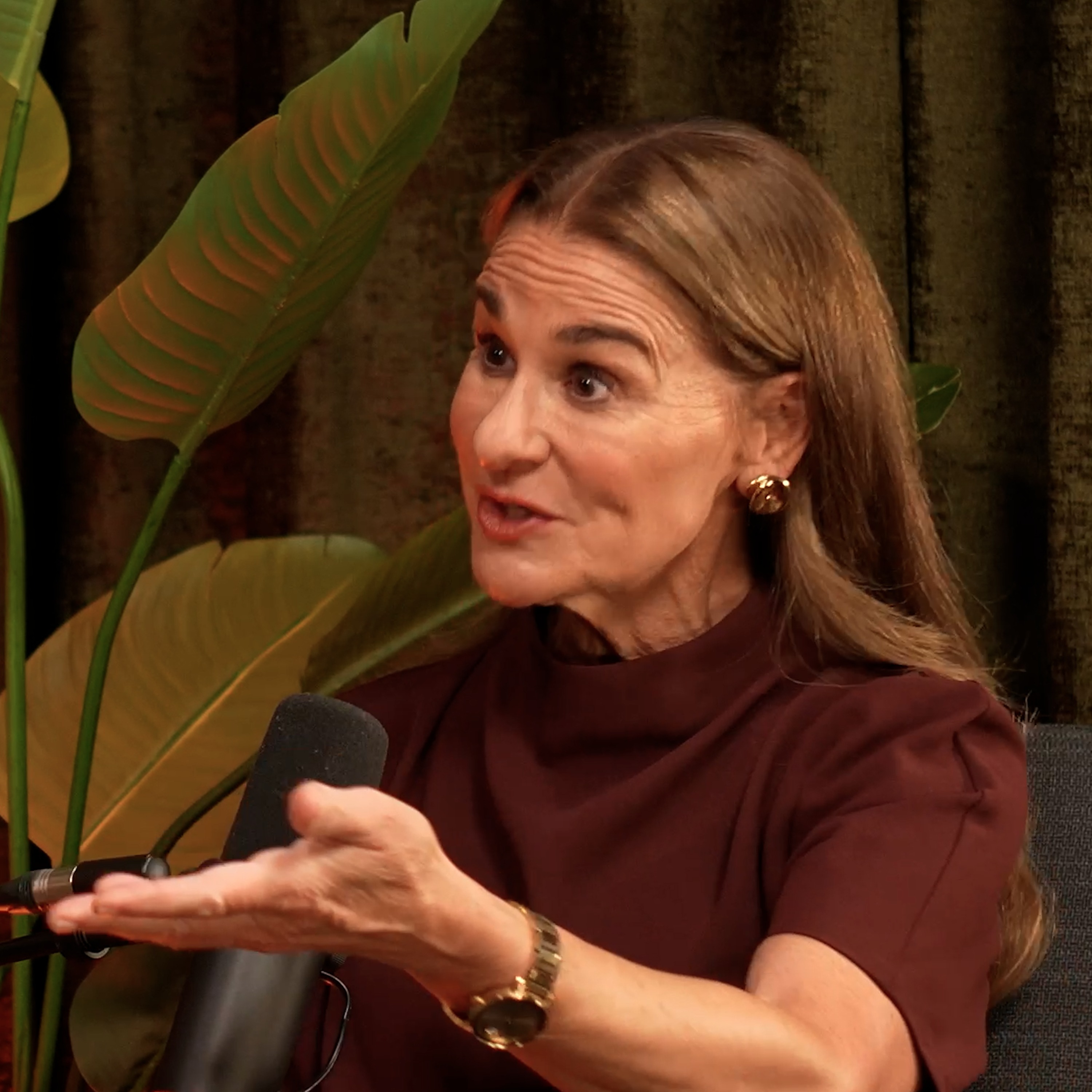
In this episode of Life At The Midpoint, Gabby Logan speaks with philanthropist Melinda French Gates about the lack of research and medical support surrounding perimenopause and menopause, and the work her organisation Pivotal is doing to address it. They also discuss women's power and agency, the ethics of extreme wealth, parenting, dating after divorce, and finding joy in later life.
Topics perimenopause and menopause, women's health research, philanthropy and wealth, AI regulation, parenting with wealth, dating after divorce, female friendship, women's power and agency
Mentioned in this episode Melinda French Gates, Bill Gates, Mackenzie Scott, Gayle King
Chapters
- 0:02:13 Melinda's Most Dramatic Life Change
- 0:05:42 Health Tech and Tracking Your Body
- 0:07:23 Investing in Women's Menopause Health
- 0:19:52 Violence Against Women and Social Progress
- 0:30:29 What Makes a Good Leader
- 0:41:37 Raising Children Amid Extreme Wealth
- 0:47:36 Therapy, Trust and Dating Again
- 0:54:13 Finding Joy Beyond Material Things
Partner with Life At The Midpoint
Life At The Midpoint is produced by Audio Always. We work with brands on sponsorship, advertising and partnerships across our network of podcasts, reaching engaged listeners and viewers.
Advertising categories Women's Health, Men's Health, Menopause, Sexual Health, Reproductive Health
Show notes
How do we unlock the lack of research into women’s health and menopause? Gabby is joined by philanthropist Melinda French Gates. In 2015 Melinda founded Pivotal, an a group of organisations working to accelerate the pace of social progress for women and young people in the U.S. and around the world. Melinda is frequently listed as one of the world's most powerful women by Forbes magazine, and is worth over $30 billion.
She talked to Gabby about her new project exploring care during the menopause, which revealed that women were too often navigating perimenopause without adequate information, care or support.
Melinda also revealed what it’s like parenting as a billionaire, the importance of female friendship and what it was like to start dating again.
If you have any questions, dilemmas or things you’d like to discuss, please get in touch email hello@midpointlife.com or you can find us on social media @midpointlife.
Hosted on Acast. See acast.com/privacy for more information.
Full transcript
Gabby Logan 0:01:07 Hello and welcome to Life at the Midpoint with me, Gabby Logan. My guest today is one of the most influential women of her generation. Melinda French Gates has spent decades at the intersection of technology, philanthropy, and global change, from her early career at Microsoft to more than 20 years helping lead one of the world's largest philanthropic organisations. But in recent years, she's made some changes of her own. After her divorce from Microsoft founder Bill Gates, she built a new chapter through Pivotal and increasingly put women's power, women's health, and women's economic independence at the heart of her work.
Gabby Logan 0:01:41 Today, she's using her extraordinary platform to challenge some very big assumptions about women's health, menopause, wealth, technology, and who gets to hold power. We're going to talk about what has really changed for women since she wrote The Moment of Lift, the opportunities and the risks AI could bring, and the ethics of an enormous wealth. We're also gonna talk about her own life, becoming a mother and a grandmother, rebuilding trust, and what she's learned about herself through those changes.
Gabby Logan 0:02:13 Melinda, thank you so much for coming on to chat to us today. I'd like to know when in your life you've experienced the most dramatic change.
Melinda French Gates 0:02:22 Well, first of all, thanks for having me, Gabby. I think the most dramatic change maybe was when I launched my third and last child, who's now an adult, to college. I was in my mid-50s and she was the last of the 3 to go.
Melinda French Gates 0:02:39 And I suddenly realised I have more time on my hands. Like, it had been years since I had more time on my hands. And so then the question becomes, what do you do with that time? And I just found it to be this beautiful opening in life. I mean, even though I was sad that she was going, but of course it was the right thing for her and I'd done my job, I felt.
Melinda French Gates 0:03:03 But I had this opening in life and it was just so wonderful.
Gabby Logan 0:03:06 You've always been somebody, and certainly from the kind of public perspective, who's given back and wanted to make change and to help to create that. So when you had that extra time, was the thought that you could put more energy into that, or was this about you and what Melinda needed from life.
Melinda French Gates 0:03:24 This was about me and what did I need and how much did I want to work. Nothing changed about my beliefs in furthering society and what I thought the role of philanthropy could be, but I said to myself, be careful what you do with this time.
Melinda French Gates 0:03:42 Otherwise, I could easily eke it away into work. And I thought, no, I want to make sure I do still the same amount of work in terms of time, but put more time into my extended family, some of my friendships, more into my own health. And I thought, this is an opening for me in life. Like, I've been giving in so many ways, you know, as a mom to my 3 kids, to my work. And so preserve some of this time for me.
Gabby Logan 0:04:09 So what did you do?
Melinda French Gates 0:04:09 I started immediately spending more time with my female friends that I felt like I wasn't getting as much time as I would like in Seattle. I started building more of a network of business friends, quite frankly, beyond Seattle. Started spending more time with my extended family who, you know, I just, we've spent time, but I wanted to invest more in those relationships. And then I started to realise I wanted to put exercise back in my life. I had it in my life, but I wanted to prioritise it more than I had been. And so I'm doing that.
Gabby Logan 0:04:43 What do you do?
Melinda French Gates 0:04:44 For exercise? So I walk with friends. In the summer in Seattle, I'm lucky enough to live near a lake, and so I kayak and do a little bit of paddleboarding. But I love to be in the gym. I love to be on my Peloton bike. I really like to lift weights. I work out with friends. We do crazy workouts. I sometimes work out with a trainer. So I like to mix it up.
Gabby Logan 0:05:05 And in terms of your overall health, have you noticed a big difference as you've prioritised your body and your physical strength?
Melinda French Gates 0:05:12 Definitely. It took a little bit of time. I'm somebody who has my blood work done pretty regularly so that I can measure and my doctor can measure how I'm doing on certain metrics. And it took some time, but literally the last report I got back from my doctor, she said, this is the best I've ever seen your blood work in the last 10 years.
Gabby Logan 0:05:33 Biological age of 23?
Melinda French Gates 0:05:35 I wish it was that, not quite that, but I think it was, you know, in my early 40s, which feels great 'cause I'm now in my early 60s.
Gabby Logan 0:05:42 And that is actually an interesting area, isn't it? The tech of health. You know, as someone who's immersed in tech and has been their life, how those things can help, but also sometimes hinder people. I think they can get a little bit caught up on certain, you know, technological devices that monitor. How are you on that? How much do you kind of put store by those things?
Melinda French Gates 0:06:02 I would say I'm middle of the road. So I've definitely had times in my life where I put too much emphasis on it.
Melinda French Gates 0:06:10 And so I've said to myself, do it when it's helpful. I absolutely measure my heart rate when I'm working out because that helps me know, okay, have I Gotten up to certain levels. So I really am pushing my heart, right? But on my sleep data, I've long measured my sleep, but sometimes having that number in the morning isn't actually helpful. So I'll just put my ring aside for, you know, a couple of months.
Melinda French Gates 0:06:32 And here I am in the UK right now. I choose not to take it with me on international trips. I know my body's more depleted and I've done a lot of international trips, so I know kind of what to do. So having that number is actually— Interesting. counterproductive for me on international trips.
Gabby Logan 0:06:47 We'll get into the kind of bigger picture of philanthropy and the responsibility that brings. But I want to talk specifically about what you're focused on right now with Pivotal, which is, of course, women's health has been for you huge. And that's the area you want to focus on and relevant to, to everybody listening to this. In fact, everybody in society really, because I think that's the point we're going to come to, is what goes on with women in midlife, in perimenopause and menopause. And I know that is an area specifically that you have been researching and looking into? Why did you decide that that was an area you wanted to invest in?
Melinda French Gates 0:07:23 Because we have not focused enough on women's health writ large, and that is just true across every society and over time. But specifically, the amount of investment we've made in perimenopause and menopause is tiny. And yet half the population goes through this. So, you know, women lead full lives, just like a man leads a full life, but she goes through even more transitions with her body, her reproductive years, if she chooses to have children or not.
Melinda French Gates 0:07:57 But then, you know, our hormones completely change. And so we were expecting as society for women to go through it and to kind of keep it invisible and not talk about it. But as I started to look more and more at women's power and where women are getting in society, in their communities, in their workplace, just as As they're reaching the peak of their career, often they're hitting perimenopause. And what we're starting to learn is they are stepping back from work, stepping back from career options, needing to take more time off to go to 4 and 5 doctor's appointments to get their symptoms looked at and treated. And I just thought, this shouldn't be.
Melinda French Gates 0:08:39 This should not be an invisible issue. Let's make it visible and let's make sure we start to do the right things in society to support women so they can stay where they want.
Gabby Logan 0:08:51 Did your own experience in perimenopause kind of inform that in the first place? Did you go into that period of life with more knowledge than the average person that you found in your studies, do you think?
Melinda French Gates 0:09:03 I would say I think I did, but not because of my doctor at the time, because of my friends.
Melinda French Gates 0:09:12 I was lucky enough that most of my friends at that time were older than me. And so, and we would talk about intimate details about our family life, about our health, health, etc. And they warned me because one of them in particular is really on top of her health and she just really experienced perimenopause in a very harsh way. And then the more of my friends I started talking to who were my age, they were also experiencing it. So she warned me so I was more equipped to go start asking my doctor.
Melinda French Gates 0:09:44 And so in some ways I felt just unbelievably fortunate for that.
Gabby Logan 0:09:48 Because I think a lot of the study has found, you know, that the statistics show that women go into this period of life unarmed. You know, they don't really know the depth of the experiences they might be going through, the symptoms they might be going through. And then they don't know necessarily kind of what to take to the doctor. And doctors, as we know in this country, have traditionally not been educated in menopause.
Gabby Logan 0:10:10 The majority of them, only 40% of medical schools had the menopause on the curriculum. So you might be going to your GP, as we have here, and they might not have done anything on the menopause at all. So you might present with a symptom that they don't even recognise as perimenopause. Exactly.
Melinda French Gates 0:10:26 That's exactly right. And we're finding that in the UK, we're finding that in the US, and even some of the ones who have been trained on menopause are getting 1 hour of training in medical school. 1 hour. And yet this is something a woman starts to experience often in her early 40s.
Gabby Logan 0:10:45 Mm-hmm.
Melinda French Gates 0:10:45 And so we're living these longer lives, and so it might be half our lives we are through that period and on the other side.
Melinda French Gates 0:10:54 So it's just time. And this is part of the reason my organisation, Pivotal, and I have done this research with Gallup is to understand from what we're hearing anecdotally is, does the data back that up? Mm-hmm. And in fact, it does. As you said, women in the UK are saying, you know, about slightly over 40% say they understand the symptoms.
Melinda French Gates 0:11:16 They don't, just like in my country, they don't necessarily recognise that the symptoms are happening to them. But then once they do and they go into the health system, 22% of UK women are saying, I still don't know what my treatment options are.
Gabby Logan 0:11:30 Hmm.
Melinda French Gates 0:11:30 22%, right? And so we need to educate not just OB-GYNs and your first-line primary care doctors, but even our mental health providers so that if a woman comes in and says, look, I'm, I'm feeling depressive or I'm, I'm having chronic sleep issues, immediately the person says, hey, it could be this. Let's make sure you get these things measured. Let's make sure we go to the doctor. Present these things, right, to your doctor.
Gabby Logan 0:12:01 It's interesting when this conversation started to get amplified, probably around the time of COVID actually, there seemed to be a generation of women, and I certainly have had guests on this podcast who are very much at the forefront of those conversations, who started talking more openly. And then there was a kind of backlash from older women almost saying, you don't need to talk about that.
Gabby Logan 0:12:19 You don't need to talk about that. We don't wanna air that in public. And it was almost like, we've managed to get to where we are without discussing it. We don't want, you know, the rest of society to kind of know. Men, I think they were talking about.
Gabby Logan 0:12:30 And I remember there was one phone-in I did on a show and this woman came on and said, you really need to be quiet about all this stuff. And I kind of understand why that mentality might have prevailed because there was a sense of we worked so hard to get into these positions and now we don't want that to be an excuse for us to be there then sidelined by, you know, for promotion, or we don't want to feel like we're being, you know, kind of cast aside as no longer being useful because this is so synonymous with fertility, right? Mm-hmm. Which has this huge kind of other kind of backstory almost around society about what women's purposes are. So there's something a lot deeper, isn't there, I think, in terms of why those conversations haven't happened in the past with mothers and female elders in the family.
Gabby Logan 0:13:12 But I've come to the conclusion, I don't know about you, that actually it's much bigger and much more important because of women's roles in families, not just running companies, but how you relate to your children, how you relate to your husband or your partner, how you, you know, how you, how your life is going to pan out for the next 30 or 40 years. So I think we've, we've got to get over all of that kind of stigma, don't we?
Melinda French Gates 0:13:33 We do. And, you know, my hat is off to women who are older than me and climb these career ladders without any discussion about that. I mean, look, We have to, you know, they took a lot of knocks for a lot of us that have come behind.
Melinda French Gates 0:13:51 But I look to the younger generation than me. They are talking about real issues about their mental health. They're talking about their emotions even more than my generation did. I think that's beneficial for society. And I think as women are stepping into their full power, you know, whether it's in their family, whether it's in their community, whether it's in the workplace, Why would we want them to step back?
Gabby Logan 0:14:18 Hmm.
Melinda French Gates 0:14:18 Like, you know, women are saying, I am struggling. You know, if you have chronic sleep issues, you cannot show up for your kids or your spouse the way you would like to, or you can't go out and volunteer in the community as readily, right? And what we're learning is that many of these issues women are facing in perimenopause and menopause affect their cardiovascular system. They are affecting their mental health. We're even starting to think it's affecting dementia. So why wouldn't we fix these issues now for women so that they can live a vibrant life all the way through?
Gabby Logan 0:14:58 So what does your research now— what do you do with that research now? How does that kind of move forwards in terms of pivotal?
Melinda French Gates 0:15:06 So in terms of What many of us can do, because these issues take all of us.
Melinda French Gates 0:15:13 I go back and I, first of all, I look for examples in women's health. We are still behind in women's health writ large, but if you look at one area that has changed, such as breast cancer, when I graduated high school, it wasn't talked about very much, but all of a sudden, and it was because of some women whose sisters got breast cancer and they started Working on this issue, we now do, you know, people know about breast cancer. We talk about it. We do walkathons and marathons for it. But guess what?
Melinda French Gates 0:15:46 Billions of dollars poured into medical research on breast cancer. So now we prevent breast cancer much earlier for women. Okay. So I look at these issues and I say, how do we— thank goodness, as you said, people started talking about this around the time of COVID even more in your country, honestly, than mine. You all are further along.
Gabby Logan 0:16:07 I was going to ask you, about that actually, because I have a sister who lives in America and I was just telling one of your team her experience of presenting to the doctor and saying things that I would say as perimenopausal symptoms to the doctor and was told she needed antidepressants. And she rang me just completely kind of at her wit's end. And I said, I don't think that's what it is, you know? And that really surprised me because we think of America, obviously very different medical care system, but having, you know, cutting-edge technology and being at the forefront of development.
Melinda French Gates 0:16:37 And I think sometimes different societies move forward at different rates than others.
Melinda French Gates 0:16:43 And I think this is a place where, thank goodness, the UK has been a bit ahead in the conversation. Now, the investments that need to happen. So when you say, where do we go next? I look at research. How many dollars or pounds are going into women's health research?
Melinda French Gates 0:17:03 It needs to be far, far more than we have today. And so I think getting people to advocate for these issues, we talk about them. I think we need to invest money, which is one thing I'm doing with through pivotal, at least in the U.S., making sure more OB-GYNs and primary care doctors get trained in menopause. But then we need to pour far more money into research. We have one, one.
Melinda French Gates 0:17:28 women's health longitudinal study that read women's hormones. One. So it's why— I mean, I say to myself at this day and age, why aren't there 30, right?
Gabby Logan 0:17:39 Mm-hmm.
Melinda French Gates 0:17:40 But it was read one way, which was hormone replacement therapy should be used.
Melinda French Gates 0:17:44 Then it was read another way. No, it shouldn't be used. Now it's been read a third way. It should be used. So there's confusion in the system.
Melinda French Gates 0:17:51 Why don't we have 30 studies? Well, it's because of who was deciding where money would be spent in research. And again, we have a chance now that women are in different positions in society to say the way society views women should change, the way we move money against health should change. We are not just, as we kind of say in the US, a small version of a man's body. We are a completely different biological system.
Melinda French Gates 0:18:20 Yeah. So let's study the biological system and let's pour money into the places that women are having health complications.
Gabby Logan 0:18:27 And I know you know this already, but, you know, obviously so much of the research that has gone into so many different illnesses and diseases has been done on men's bodies, including— I was amazed to find out the first studies here on HRT were actually used on a man, which, you know, tells you everything that's kind of wrong with the system.
Gabby Logan 0:19:23 You said something there about the way society views women, and I'd just be interested to hear your thoughts on a story that has, has really blown up here, which is Jane Doe and Cornell and that story. I know when you were at university, you were in a frat, which is a very alien concept in this country because we don't, we don't have fraternities. in universities. And so I think people have seen American movies and they think they know what that is. But obviously people have very much kind of thought this is an appalling story.
Gabby Logan 0:19:52 Obviously it's a terrible, terrible story and reflects really badly, doesn't it, on that kind of fraternity and that university in many ways in terms of how it's been handled. Does that for you kind of signify— actually, you go back to your book of 2019, in terms of women and agency and influence and power, so little has changed. That feels like such a throwback, the way women are perceived in somewhere which is a seat of learning, where you'd think the people who are in that place would have the most forward-thinking ideas about women.
Melinda French Gates 0:20:28 This is a really tough topic and one that we have to unearth. Um, so first of all, my heart just breaks for Jane Doe. Um, that should never happen to any girl or woman ever, ever, ever, ever, ever. And the truth is, it happens in, in country after country after country around the world. Different forms of violence, I'll say, against women.
Melinda French Gates 0:21:01 This particular form was is particularly horrific. It shouldn't happen anywhere in society. Right. And so, you know, to have her bravery to come forward and for the US now to be looking at this and to be dealing with it, it does take bravery. But we need to unearth this in every society because any form of violence against women holds women down and back.
Melinda French Gates 0:21:29 That's— we are not objects. for other people. We are human beings, right? And so we need to unearth these kinds of things. These cases need to be prosecuted.
Melinda French Gates 0:21:43 They need to go to trial.
Melinda French Gates 0:21:46 You know, the perpetrators need to be fully stopped. And I would say that's true anywhere in the world. Mhm. And so it's horrific to read that this happened to a college girl, woman in this day and age. It just should not be.
Gabby Logan 0:22:04 That's the thing. It feels so— Archaic. Like we've gone back, you know? There was a point where I'm kind of in my 20s, I felt we were kind of moving in the right direction. And this is not just an isolated incident, as you say, you know, this is across the world and across, you know, other seats of learning and universities and businesses.
Gabby Logan 0:22:23 There'll be stories like this, right? So this is not an isolated incident. It just feels, I don't know, so maybe it's since COVID Maybe it's in the last 15, 20 years. Maybe it's the way women are in America being the biggest democracy in the world, the way the president of your country talks about women, you know, which says something to the rest of the country, doesn't it? And says something to the rest of the world.
Gabby Logan 0:22:44 There does seem to have been a step back in terms of women's agency and influence.
Melinda French Gates 0:22:50 And this is why we have to all lean in, lean into the headwinds and say, no, no, no, no, no. This is where women should rightfully be in society. We should be able to do whatever we want, whether it's have a family, whether it's to work, whether it's to work and have a family. We should be wherever we want to be in society.
Melinda French Gates 0:23:13 And so this is why I look at women's power and we need to look at what are the barriers that hold women back. Violence against women. Absolutely. It's one of the ways to keep women in their place. We should say never, never, never again.
Melinda French Gates 0:23:28 Same thing. There are certain biases or workplace policies that we need to open up so we make it easier for women to work if they choose to work. We need to do things to accelerate women's progress. I do think if you look across time, we know that progress for women has been uneven, to say it best. Sometimes it's 2 steps forward, one step back.
Melinda French Gates 0:23:55 My own country, rolled back a decision for women's health that had been on our books for almost 50 years in women's reproductive health. That felt like a step backwards. Right. And so we need to— it's why we need to all keep pushing and say, no, this is what is right for women.
Gabby Logan 0:24:14 Yeah.
Gabby Logan 0:24:15 It doesn't feel like it's a coincidence almost when the legislature of your country then makes that step back, that the way people view women changes, you know, and, and how we educate everybody, but young men in particular, still seems to be so important. It's different if you, if you're in a family where, you know, those conversations are open and women can do what they like and the men respect that, you know, those are, you know, obviously kind of situations where you would say, yeah, that's, that's great that women are progressing in society. But that is not everywhere, is it? And so— No. That's where it feels depressing, actually, as somebody in their 50s, that we haven't got to that stage yet where it's normalised?
Melinda French Gates 0:24:54 I think there are still pockets of it. And this is what you see, things that happen in the dark, that happen in private and don't come out to the light of day or with transparency is where bad things can still happen to girls and women. And it's why it's so important that those kinds of cases come forward and are prosecuted to the full extent. And we we hold them up as, no, this is not right for society.
Gabby Logan 0:25:23 Do you feel, uh, in the, the age you are now and the agency you have now, that you have as much fight in you as ever? Just hearing you talk so passionately there and thinking about our politicians, I know you would probably never want to go inside the circle. You, you're finding your power outside the circle, if you like. Um, do you feel as energised on these issues as ever?
Melinda French Gates 0:25:46 Absolutely. Absolutely.
Melinda French Gates 0:25:48 Because to have anything like that happen in this day and age, or to have women's reproductive rights rolled back, it just says to me all the more we need to gather together, women and men, to say, this is what we want in society. This is what we want for our girls and our boys. Here are our high expectations of our girls. Here are our high expectations of our boys. And so I just feel, you know, if I can use my voice in some way, way or my resources to give back, to stand alongside, then that's what I wanna do to try and make society better, not just for my daughters, but I have 2 granddaughters now who are ages 2 and 3 and a half.
Melinda French Gates 0:26:35 And I think about them and these beautiful little girls, and when they launch into the world, they go off, I hope, to university and ultimately to the workforce. I want them to be anybody or anything they wanna be.
Gabby Logan 0:26:46 Do you feel the 42-year-old version of you would have had this conviction and this energy? I mean, you might have had energy as a younger woman, but in terms of feeling that this is your power and you're in your power?
Melinda French Gates 0:26:59 I think I was just beginning to really discover that and step into it in my early 40s because of things I was seeing all over the world.
Melinda French Gates 0:27:11 I was travelling so much for the foundation, our foundation back then, which I have since left, But what I was seeing for women writ large across the world, I was saying, this isn't right. And I would have to even come back and examine what was going on with women in the US. And that's when I started to say, I actually want to turn eventually this institution, which was then the foundation, to really focus more on women's issues. And it took me a while to step into that position and say, fully into that power. But I would say that transition started for me probably in my early 40s, really because what I was hearing around the world from women in so many places.
Gabby Logan 0:27:53 And you're in an incredibly unique position in that sense, and you used your power and you're using your wealth to, to try and elicit change. For women who are not in that position, you know, and, and obviously I know you know, you've looked into as well the kind of difference that it makes for women obviously who don't have economic power in a relationship and how hard it is to get access to the right medical treatment or to even feel within a relationship that they have a power and a voice. What would you advise those people and how they can be as game-changing or to change the game for themselves?
Melinda French Gates 0:28:33 I would say we all have power inside of us. And you have to hold on to it. And I think for some women, the circumstances they find themselves in, if they are in with a partner who where there's domestic violence, or they cannot get out because they don't have the financial means, it is absolutely harder. And I would say band together with other women. You're not alone.
Melinda French Gates 0:29:00 You're not alone. So find other people in your community who can help you stand up. Find people in your community who maybe. can help you get on the next rung to get the economic opportunity to free yourself from that harmful relationship. And then I would say to other women, use your voice wherever you can on behalf of someone else.
Melinda French Gates 0:29:24 Even if you're in the workplace and you're sitting in a meeting and you see someone talk over the woman sitting next to you, band together and say, wait a second, I want to to hear what she had to say. Oh, you just repeated that point. You don't have to be rude about it, but we all have power inside of ourselves to say, no, this is what I believe. This is what I think is right for society. And so I say to people, find your places of power and think very carefully about when you want to use them, but definitely use them.
Melinda French Gates 0:29:58 You can also use your power to vote. Vote for the elected leaders that you believe in. Who will move more money into, say, women's health or stopping domestic abuse or violence, right? We all have agency. We just have to find it and then use it.
Gabby Logan 0:30:14 You've met so many influential leaders, world leaders, leaders of big corporations, other tech billionaires. What do you see as a kind of characteristic that makes a good leader?
Melinda French Gates 0:30:29 Well, leaders come in lots of different shapes and sizes, right? And my picture of a really strong leader is they have moral integrity and values, and they try to live those values out in the world. So I'd say that is number one.
Melinda French Gates 0:30:49 Number 2 is they're willing to have a growth mindset. They learn something new about a different area in society and they say, hmm, I'm going to have courage to step into that or even to say I was wrong. Number 3, they think about everybody, whether it's in their organisation, how do I make this workplace better for everybody, not just a subset? Or if they're in government, how do I make the world better? Or how do I make things better for everyone in my country, even those who maybe have come in and are disadvantaged for whatever reason?
Melinda French Gates 0:31:23 they're thinking about the community as a whole.
Gabby Logan 0:31:26 So in this country, we don't have quite the kind of history of philanthropy in the same way as— you're a bigger country, a wealthier country. At the moment, we have tech billionaires who have more money than most of the countries' GDPs in the world, you know, and they're using their money in different ways. Are they being responsible, do you think?
Melinda French Gates 0:31:46 I think it's hard to classify them as group and what they're doing so far.
Melinda French Gates 0:31:53 I would just say this, my belief, I can only speak to my belief, and my belief is to whom much is given, much is expected. So if you are of great wealth and let's say you've come into it through the tech sector more recently, you benefited, you benefited from society. So if you lived in the US and you were able to start that company, It's because of certain laws we have. It's because of venture capital in our society. It's because we have good roads.
Melinda French Gates 0:32:22 That would be so much harder to start that company in a country where the electricity only stays on half the time. I've been to a lot of those countries. So you need to give something back and you need to think about how to do that and do that in the right way. And what I would say about philanthropy is it's part of society, but it sits alongside. There's philanthropy, there's private sector, there's government, and there's civil society.
Melinda French Gates 0:32:51 And so you have to get that ecosystem working in the right way if you're going to tackle some of the hard problems that society's left behind.
Gabby Logan 0:32:59 Because of the tech revolution, we seem to have more, and they're often men. There aren't many women in that space. The women that are, You and Mackenzie Scott in particular are 2 women who are really, you know, kind of giving their money to issues and causes that they feel will benefit society. We don't hear— maybe it's just because the stories aren't amplified— we don't hear so many of those stories coming out of, you know, the males in this space.
Gabby Logan 0:33:29 How can society kind of regulate that? It feels that there is a lot of power vested in the hands of few. that isn't regulated, isn't, you know, their own personal kind of passions, which may not benefit society, have so much money being invested into them that may not be good for the world and society.
Melinda French Gates 0:33:50 Well, this has been an issue all along if you look at wealth creation. So even if you go back to the time of Carnegie or Rockefeller, right, when you had the wealth coming from the railroads and the wealth that was created at that time, the banking system.
Melinda French Gates 0:34:11 And then you've got a second sort of what they're calling wave of philanthropy that came kind of early in the tech sector. Now we're seeing a third wave, right? Mhm. So I think it remains to be seen yet what these people will do with their wealth. I will tell you that I think some of them are thinking about it in very large-scale ways.
Melinda French Gates 0:34:34 They're thinking about doing it sooner, which I think would be great for society versus, you know, we've seen in the past some people give some away, but then they sort of hold it and then it's given out over time.
Gabby Logan 0:34:46 Mm-hmm.
Melinda French Gates 0:34:47 We cannot see in a crystal ball the problems that are to come in society 80, 100 years from now. So the fact that they will pour it back into society Sooner, I think, is good. And my hope is that they will talk to previous philanthropists, they will talk to others to find out where are places that that money should be invested. And so I'm holding in reserve my judgement until we see some of them get going. But I know there are a lot of conversations. I've been in some of them behind the scenes where they're saying, my gosh, we need to use this money responsibly. So let's see what they do with it.
Gabby Logan 0:35:24 Yeah.
Gabby Logan 0:35:26 Kind of revolution in particular, and this third wave, as you point to now as well, specifically with AI, which feels like the Wild West more than ever before in terms of unleashing something with no regulation. And, you know, even those heavily vested in it saying, regulate us, because this is potentially going to be out of control. And hearing, you know, that it feels like scaremongering sometimes, but maybe it's not. Maybe it is actually the truth that is coming from those people who are blowing the whistle. It feels like we are letting this happen almost in spite of the world.
Gabby Logan 0:36:01 And you've been so heavily kind of involved with tech your whole life. You know, what's your take on what's going on right now with AI and how it's being regulated?
Melinda French Gates 0:36:11 Well, I'm a computer scientist by training. That was my degree, that and economics when I was in college. And look, we even People back then in the '80s were talking about AI and it kind of being the place we knew the computer revolution would go eventually. And everybody has always been quite excited about this innovation. Well, now it's here. It is happening.
Gabby Logan 0:36:39 Do you use it?
Melinda French Gates 0:36:40 I do use it, definitely. And I use many different models because I don't think there's— I don't want to I don't wanna be beholden to one, and I actually wanna see, you know what's really fun? Is to test the answers you get from different ones. That is quite an interesting thing to do. And, you know, look, I like to see which ones are more, have more sycophancy built into them. I can't stand the sycophancy that's in many of them. But yes, I use them because I wanna be current, right? But I'm also very careful.
Gabby Logan 0:37:08 Mm-hmm.
Melinda French Gates 0:37:08 Because you can get a lot of wrong answers. But to your question about society and AI and where we are in this moment, it absolutely can have some major upsides for society, major, especially when you cross it with research and drug development and new things that can be created.
Melinda French Gates 0:37:33 So there are, I think, massive upsides for human potential. potential. I also think, as we're already hearing, there are downsides, especially if it's unregulated or unleashed in the wrong ways. And so it's always about how do we balance these things in society? And so to me, there does need to be a call for what's the right thing for society.
Melinda French Gates 0:38:00 I always used to say to my kids when I was trying to raise them amongst great wealth, Just because I can doesn't mean I should. Just because I can buy you that thing doesn't mean I should, that it's good for you for me to buy you that high-end thing that your friends don't want. Mhm. Well, same thing with society. Just because we now can unleash AI and it's getting better, supposedly better every week, but okay, the downsides are getting higher every week, Just because we can unleash a new model doesn't mean we should.
Melinda French Gates 0:38:40 We are still in control of this. It's like we have this discussion that we've forgotten we're in control of this thing. So society speaking out and saying there should be a group that really thinks deeply about this, regulates it in the right way so we gain as human beings the upsides and we put the downsides, we put some lid on the downsides.
Gabby Logan 0:39:02 Is that the industry itself? self-regulating, or is that government that has to come in? And if so, does that have to be— you're going to have to have a global consensus, aren't you? Because otherwise you'll have pockets of the world where you'll have regional differences in the way China obviously will develop its own AI and they're not going to be regulated by the US, are they? So where does the regulation come from?
Melinda French Gates 0:39:23 Well, you have to look at other— in my view, you have to that we have dealt with this before. And no, we don't have global regulations on everything, right? We just don't. Okay, so I remember, you probably remember, I was in my mid-30s when Dolly the sheep got cloned, right?
Gabby Logan 0:39:43 Mhm.
Melinda French Gates 0:39:43 And there was this big fear, are we gonna clone human beings? Are we gonna clone babies? Well, not that long after that, the UK government put some regulation on it. The US government put regulation on it. Those regulations are not identical.
Gabby Logan 0:40:02 Hmm.
Melinda French Gates 0:40:03 And what is going on in China is not identical, but there are regulations.
Melinda French Gates 0:40:09 The way your country and some of the other European countries think about genetic engineering of plants and when that will get used or not used, France is quite different than the United States. states, right? In terms of genetically engineering plants. But guess what? We do seem to have come to some middle places that work for the world.
Melinda French Gates 0:40:32 So this can be done. Mhm. And I think, you know, we have to look at people's motivations who say certain things. What were they saying 18 months ago? That's interesting how much that has changed now, right?
Melinda French Gates 0:40:46 So the hard things can be done. by human beings and we can figure this out. It's time to figure it out.
Gabby Logan 0:40:52 You mentioned your children and growing up, how you would try to kind of, I don't know, not let them run away with the wealth that your family had in terms of thinking they could have whatever they wanted. And parenting's tough, right?
Gabby Logan 0:41:06 Whatever, wherever you are on the socioeconomic kind of scale. How did you keep them motivated and, you know, have their own dreams and passions and desire? Because so much of that that comes from kids getting on is about their own journey because they want to do either better than their parents or they want something that their parents couldn't afford for them or they want a better life. They were never going to have a better life than the one that you gave them. So how did you stop them being spoiled brats?
Melinda French Gates 0:41:37 Ah, look, I did not get everything right. And I think, you know, parenting is a journey. I learned a lot along the way. Um, but I did believe that kids do best when they have values, when they have values and morals. And, um, I talked with them about that a lot, about how they treated other kids.
Melinda French Gates 0:42:00 I talked to them a lot about my expectations, that if another child in school was being bullied their job was to step up, to stand up for that kid and to find others. And if not, find an adult. So I'm just using one example. I talked to them a lot about values. They had an allowance, so they didn't just get to buy the new pair of jeans or the new sneakers that were the hottest and greatest thing that some sports person had just put out.
Melinda French Gates 0:42:29 They had to wait. They had an allowance. They could earn money, And they also had the ability to put it on their Christmas list. Maybe their grandparents might give it to them or an aunt or an uncle, or maybe I would, or my former husband would. So I wanted them to learn the value of money.
Melinda French Gates 0:42:50 And then most importantly, as you said, I believed self-esteem was built by learning what you're good at. And as I said to them when they were young, whatever you choose to be, you choose to be a poet, you choose to be a doctor, you choose to do some other career. I want you to find that over time inside yourself because you will feel better about yourself having worked, having worked towards something. And so I— we tried to imbue that as parents by also both working hard, even though there was great means, right? Mm-hmm.
Melinda French Gates 0:43:22 We weren't just resting on our laurels in either case. And so luckily I ended up with 3 kids who are highly motivated.
Gabby Logan 0:43:38 What makes you most proud as a mom when you look at your kids now?
Melinda French Gates 0:43:41 Oh my gosh, so many things with all 3 of them. I will say, I would definitely say the way all 3 are pursuing their passions and they're in different areas. I have my oldest is in her last year of her residency. To be a doctor. My middle one is getting his PhD and just finished a big commission he was working on for one of the senators in Washington, D.C. And my last one has started a business and she's ripping it up, you know, and she's learning what competitors will do to try and stop you and how ugly that can be. But they're all following their dreams, and so I couldn't be more proud of them.
Gabby Logan 0:44:21 Do they come to you for advice still?
Melinda French Gates 0:44:23 At times, depending on what the issue is. And sometimes it's also, you know, you have to remember as a mom that they may be still telling you their emotions or telling you about their frustrating day, but they don't want you to fix it. They just want you to hear them. My job so often is to sit back and listen.
Gabby Logan 0:44:40 That is such an important lesson as a mother, isn't it? Knowing the point where you're supposed to just go, yeah, and not come up with a solution. Yeah, I'm still on that road of working out, is this a moan or is this I need problem solving? I don't know why I do this. Nobody does this for phones anymore, but I still use this symbol as a phone.
Melinda French Gates 0:44:57 Me too. I still do this.
Gabby Logan 0:44:58 It's the age.
Gabby Logan 0:44:59 It's the age. And so they're obviously out there. I mean, as a parent, when you see your kids pursuing passions that they, you know, they have in life and living their lives, it's obviously, as you started this conversation, a time when you get to do all the things you want to do and the passions you have in life. And this last The last 6, 7 years for you has been one of huge transition, hasn't it? I watched an interview you did in 2022 with Gayle King, and then I watched an interview that you did this year.
Gabby Logan 0:45:24 I have to say, Melinda, the difference in your whole demeanour was— honestly, you should have a look at those back to back, and it shows just how far you've come in these last few years.
Melinda French Gates 0:45:33 Thank you.
Gabby Logan 0:45:33 You've ridden through a really tough time, and there are a lot of people listening here who will have difficult things where they've lost faith in people, where their lives have changed dramatically, things that they didn't see coming. What's your biggest takeaway from how you have got yourself into such a strong, resolute, and healthy position?
Melinda French Gates 0:45:55 A couple of things.
Melinda French Gates 0:45:56 I would say surround yourself with great people, like with people who've got your back and who will tell you the truth about things, even things you may not want to hear about yourself, right? So surround yourself with with great people, people who believe in you.
Melinda French Gates 0:46:13 I would also say look for opportunities of growth. Like, you can grow. We can all grow in different ways, in different areas, right? I have friends who are learning whole new languages right now, right? And that's not something I've chosen to do, but I'm choosing to do other things.
Melinda French Gates 0:46:28 So just remember, life is about growing, and you can grow in new ways and new ideas. And then the other thing is, I would say, Just hold out hope because even when you're going through something really tough, there is beauty on the other side. You may not feel it while you're going through the tough moments, but there can be absolute beauty and joy that is to come in life. And so don't forget that that will come even when you're in the middle of the struggle. And I would say some days when I was just really, really having a tough day, I could still find one moment of joy.
Melinda French Gates 0:47:04 I started to look for them during the day. Okay, this is hard, this is hard, this is painful, or I'm grieving. What's one moment of joy? And I started to write down my moments of joy. And guess what?
Melinda French Gates 0:47:14 You know, by the end of the month you got 30 of them. And the next month I might find 2 a day. And then I'm like, I've got 60 of them. And you know, there's a lot of joy in life even amongst the pain and the struggle.
Gabby Logan 0:47:24 Yeah. And sometimes you come to those positions of realising that yourself. Other times people seek help from others. You talked about surrounding yourself with good people. Was therapy something that you felt—
Melinda French Gates 0:47:36 Definitely.
Melinda French Gates 0:47:37 Yes. I wrote a second book after A Moment of Lift, which was about transitions in life. And yes, I was initially resistant to therapy, maybe because I grew up in the South. It wasn't as much talked about there when I was growing up. I live on the West Coast now.
Melinda French Gates 0:47:53 It's much more a thing on the West Coast. And I think it's more prevalent all over now these days, thank goodness. But yes, once I came and realised I needed therapy and it wasn't a quick fix, like I had things to work on in myself, right? Not just, okay, these things have happened to me, but on myself, there are things I need to work on and ways I can grow. I would say therapy benefited me tremendously.
Melinda French Gates 0:48:18 Tremendously. And I recommend it
Gabby Logan 0:48:22 And one of the things you talked about was building trust back and forgiveness, and presumably to get yourself into a situation where you could, after anybody goes through this, the ending of a long-term relationship, to find romance again in your life and love again in your life, you're going to need to have some kind of peace with that, aren't you? And be able to trust.
Melinda French Gates 0:48:41 Sure.
Gabby Logan 0:48:41 Yeah. So has having somebody that you can go out with and have a nice date. Has that just been a wonderful addition to the last few years of your life?
Melinda French Gates 0:48:51 Absolutely. Absolutely. You know, I didn't know if that would ever happen for me again. I definitely dated some different people along the way, and that was lovely too because you learn different people's points of view on things, or you go out and do new activities you wouldn't have done. But then to find your person that you can confide in, And again, to realise that, okay, I can trust myself, I'm robust enough to pick somebody that will be healthy for me, and then to be able to rely on them as well is just a really, really beautiful thing. And so I've been very, very lucky in that regard.
Gabby Logan 0:49:32 Well, I think people in this age group, if you like, you know, find the whole dating game quite quite tricky, don't they? Because I don't think any of us met our partners anything other than in real life and in person, right? So they're suddenly stepping into this whole new landscape and wondering how it's going to be and whether or not they want to do that, whether they want to share the rest of their life with another person or trust another person.
Gabby Logan 0:49:55 So I think stories like yours are very inspiring to women, aren't they? And they probably say, well, you, you meet lots of different people, but that doesn't mean you're going to meet somebody that you want to put your faith in. So it says a lot about your character, I think, that you, you're able to do that, Melinda.
Melinda French Gates 0:50:11 Thank you. I'll just say one tip in case it's helpful to anybody.
Gabby Logan 0:50:14 Oh, they love tips.
Melinda French Gates 0:50:15 Who's in this situation. The first time someone— I was extraordinarily lucky that several friends had people they wanted me to meet.
Gabby Logan 0:50:25 Lined up for you.
Melinda French Gates 0:50:26 Yeah.
Melinda French Gates 0:50:27 And look, I wanted people who'd been vetted, right? You know, so anyway, One of my very good friends had somebody who was available and she wanted me to go out with. She had to call and coach me. She had it all aligned that I had his phone number, he had mine. I knew he wanted to go out on a date.
Melinda French Gates 0:50:46 And she said, well, you told me 10 days ago you were going to reach out. He's waiting for your text. And she says, you haven't done it. And she calls me up and again, I use my phone like this. And she says, Why haven't you done it?
Melinda French Gates 0:50:59 And I said, I'm afraid. And then she said, You're afraid? I said, No, I'm terrified. That was the truth. I had not dated since I was in my 20s.
Melinda French Gates 0:51:10 That's the truth. So you just have to step out there and step into it. And then it was sweet. I went out on maybe 4 or 5 dates with him and he and I laughed looking back at that first date that I was even afraid to go on a date, right? So you just gotta put yourself back out there and step out, and it can be very fun.
Gabby Logan 0:51:29 And what do your kids make of you dating? Are they quite cool with it? Do you have to vet, you know, them? Do they need to kind of go, right, yeah, he's okay?
Melinda French Gates 0:51:37 Oh, I said to them early on, okay, I hope you don't— like, I'm gonna date. And they were like, of course you should date. But I said, you don't need to meet everybody, right? They're like, no, Mom, we don't need to meet everybody. Only when you're serious. about. So.
Gabby Logan 0:51:51 Now, one of the things, Melinda, and it's kind of hard to ask this question without sounding like it's the least kind of deep and meaningful question you'll ever get, right? Not many people get to meet somebody with your wealth, right? And how— and it's so hard to imagine what your life is like. It's so different to most people's lives.
Gabby Logan 0:52:10 And one of the things that people have been fascinated kind of when I've told them I was meeting you today is that, you know, how do you you find joy in something? Because you can have anything, right? So the idea that things make people happy, I think we all come to in life and realise that's not necessarily the case. But, you know, where do you get your kind of buzzes from? Where do you know?
Gabby Logan 0:52:31 Because it's not about going and buying a new handbag, as it might be for somebody who saves up for that, or it might be for somebody who goes on a trip that they've spent a long time saving up for. And so I'm intrigued as to What it is like to live the life you live and find kind of joys in things that maybe other people wouldn't.
Melinda French Gates 0:52:52 Yes, I think I learned that probably in my 30s. You know, it was like, okay, I can buy the next whatever incredible coat that was out, or some piece of whatever, a pair of earrings that I wanted. But you realise after a while, once you have enough of them, you're kind of like, okay, that doesn't doesn't quite bring me as much joy, right?
Melinda French Gates 0:53:15 And luckily, I already knew. I mean, I had my first daughter when I was 31. And oh my God, the joy of just being with her at times, holding this precious baby in my arms. There was a deep sense of joy that I just didn't get out of an object. That was just the truth.
Melinda French Gates 0:53:41 And yes, don't get me wrong, the sleepless nights were so hard, so hard at times. But there were also just times I could find joy in watching what she was watching. And so I learned that in my 30s. I was lucky enough, I wanted to have children, I had 3 children, and I get to experience these childlike moments or just going out on the swings with them or enjoying, you know, a nice day on the edge of the lake. And so I started to realise that I found much more joy and beauty in those kinds of moments, and I started to look for them.
Melinda French Gates 0:54:13 And as I said, I started to gather them up, not just when I was going through my hard transition. I started to gather them up during those times, and I started to see the pattern for me. The pattern was in connection with others who I felt like I could have a deep conversation with, or in connection with someone else that I could play with. with, whether it was a child or whether it was a friend and we were doing something that felt playful, like jumping over waves in the ocean. And then I started to realise I felt it in nature too, being out in the morning sunshine.
Melinda French Gates 0:54:46 And again, I'm so lucky I live in the Pacific Northwest in Seattle. We have eagles that go by in the mornings and the evenings. Yes. And you're like, wow, that is just majestic, right? I learned to find them in those places and then I just kept seeking them out.
Melinda French Gates 0:55:02 And believe me, at some point you do not get very much joy out of objects.
Gabby Logan 0:55:08 Does it take time to kind of come to terms with that? And has there ever been a time where you've thought, I wish I hadn't kind of landed on all of this because life would have been so much more straightforward? Or I don't know, it feels It feels like a transition for some people to get to that stage. I mean, we're talking about the tech billionaires who just buy bigger and bigger yachts, right? And don't seem to have found what you've found. Do you need to be coached almost to deal with it? You had a very humble upbringing by comparison, right? You weren't born into this.
Melinda French Gates 0:55:43 And I think that helped me.
Melinda French Gates 0:55:45 I think it helped enormously. And believe me, don't get me wrong, there were times I bought big things that I was like, ah. But I do think you have to learn it. You can only learn it by experience. I look at some of those people doing that where they're buying thing after thing that's larger and larger and I think, mm, they're really not quite settled or happy inside yet, right?
Melinda French Gates 0:56:09 Mhm. And my wish for them is that they get to that place. And some of us get there in life and some of us never get there, no matter how little or how much money you have. have, right? But I guarantee you don't find deep joy out of objects.
Melinda French Gates 0:56:22 You just do not. So—
Gabby Logan 0:56:25 Well, let's bring it back around as we finish our conversation to what we started, which of course is the incredible work that Pivotal is doing in terms of the women's health space, specifically the study you've done on perimenopause and menopause. What would you like to see in 10 years' time in terms of policy and in terms of experience that women are having in this period of life that has come from your research?
Melinda French Gates 0:56:49 I would like women in 10 years to be able to say, I only had to go to one doctor and they knew how to help me.
Melinda French Gates 0:56:57 They knew how to listen to my symptoms. They knew what I should try. We might not have gotten it right the first time because it is very tailored to different women's hormones, but I was listened to. I didn't have to go to 4 or 5 different doctors to figure out my symptoms and I found a solution. Oh my gosh, if we can get there, which I definitely think we can in 10 years, I just think it'll be so much easier for women when they go through this time of life and it should be, right?
Gabby Logan 0:57:30 And you will see as a result, do you think more female CEOs, more female leaders, more female politicians at the top of their game?
Melinda French Gates 0:57:38 Yeah, and more women just feeling really vibrant in life so that they can do any of those things that they want to do, right? I mean, we have to be honest, most women start into perimenopause in their 40s, right? And so come on, let's just make sure that women can be their full selves. And when they can be their full selves, they can do anything they want to do.
Melinda French Gates 0:58:04 they want in their family, their community, and in their work life. And we're working our way there, but I just want it to happen faster and sooner for everyone. And we can. We can make investments in this to change the course of women's lives, and we should.
Gabby Logan 0:58:21 Thank you so much for what you're doing, but also for your brilliant conversation today. And let's have that conversation in 10 years' time, shall we? And make sure that, that it's all happening.
Melinda French Gates 0:58:31 Thank you, Gabby. Thanks for having me.
Gabby Logan 0:58:33 Thank you so much. Thank you. And that was Melinda French Gates. I absolutely loved chatting to her and wish her all the best in her ambitions to help change women's health. Thank you so much for listening to Life at the Midpoint. If you've got any questions or thoughts about anything we've talked about today, I'd love to hear from you. You can email me at hello@midpointlife.com or find us on social media @midpointlife.
This transcript was generated automatically and may contain errors.