
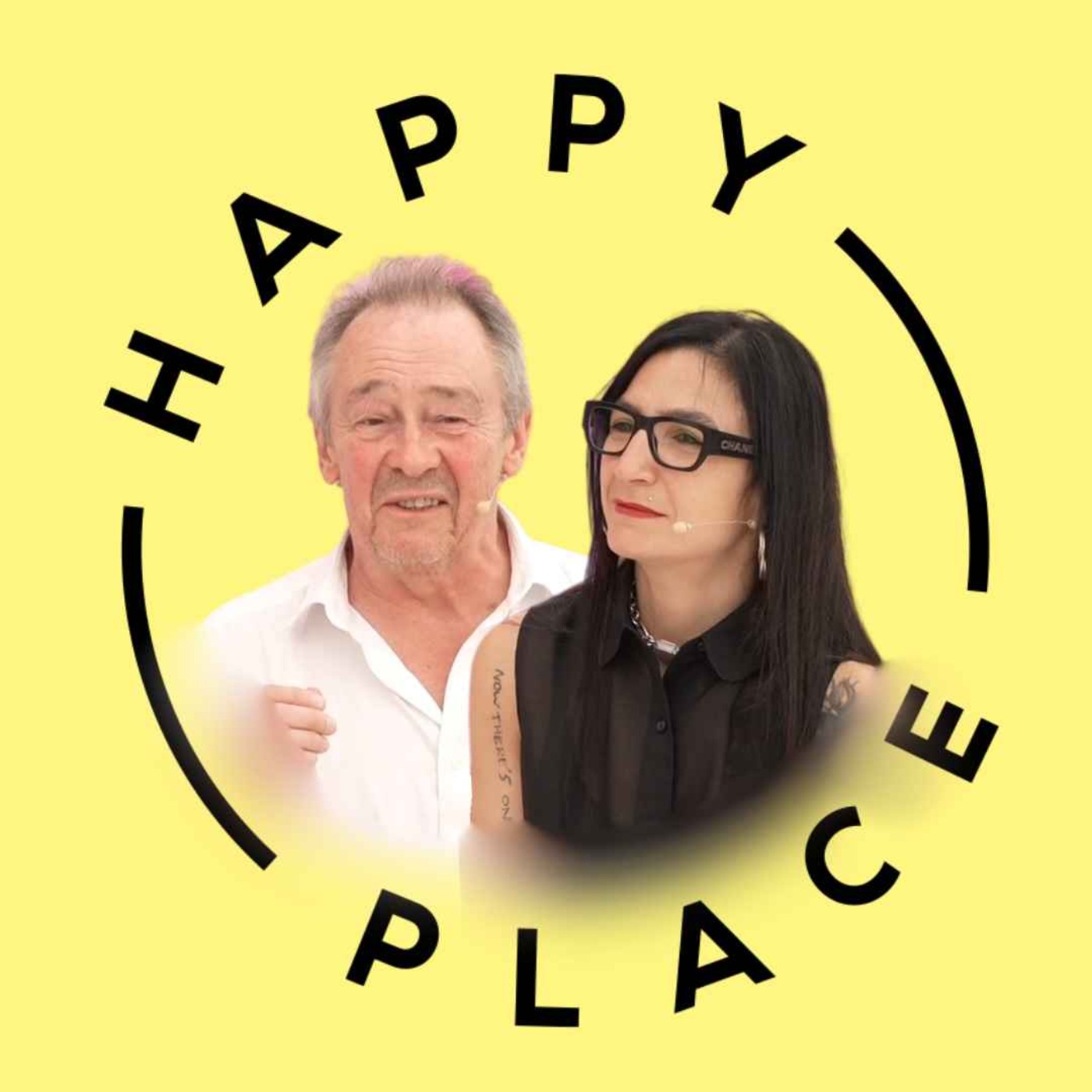
In this episode of Happy Place, Fearne Cotton is joined live at the Happy Place Festival by comedian Paul Whitehouse and his wife Dr Mine Conkbayir MBE, who holds a PhD in neuroscience. They discuss Mine's late ADHD diagnosis, childhood trauma, emotional regulation, and the need for education reform for neurodiverse children. Paul also reflects on his physical health scares and how fishing and exercise support his wellbeing.
Topics late ADHD diagnosis, emotional regulation, childhood trauma, neurodiverse children, education system reform, physical health and wellbeing, rejection sensitive dysphoria
Mentioned in this episode Paul Whitehouse, Mine Conkbayir, Bob Mortimer, Robbie Williams, Roger Taylor, Stephen Fry, Simon Day, Denise Welch, Chris Packham, Angela Rayner, Lucy Beaumont, Shaun Ryder
Chapters
- 0:00:26 Welcome and introductions
- 0:05:55 Mine's late ADHD diagnosis
- 0:11:30 Rethinking education for neurodiverse children
- 0:19:45 Understanding emotional self-regulation
- 0:28:42 Paul's heart health and lifestyle changes
- 0:35:00 Rejection sensitive dysphoria explained
- 0:39:46 Living apart and unconventional choices
- 0:44:29 Mine's campaign against Ofsted's autism guidance
Partner with Happy Place
Happy Place is produced by Audio Always. We work with brands on sponsorship, advertising and partnerships across our network of podcasts, reaching engaged listeners and viewers.
Advertising categories Mental Health, Brain And Nervous System Disorders, Bereavement, Parenting, Early Childhood Education
Show notes
Are you aware of what can trigger big emotions in you? How to do you act on those difficult emotions? Comedian Paul Whitehouse and his wife Dr Mine Conkbayir MBE – who has a PhD in neuroscience – talk about learning to emotionally regulate.
In this chat with Fearne – live from the Happy Place Festival – Mine explains what led to her late ADHD diagnosis, and the childhood trauma that plays into her own behaviour. Meanwhile Paul’s had physical health scares, and explores how his lifestyle has changed as a result.
They all talk about how the education system needs to change for neurodiverse children, why labels might be useful for some and not for others, and how to calm others with your own behaviour.
Plus, why do this married couple choose not to live together?
Listen to Paul and Mine’s podcast I’m ADHD! No You’re Not! wherever you’re listening to this right now!
If you liked this episode of Happy Place, you might also like:
Child on the line is a three-part documentary podcast series celebrating the Volunteer Counsellors of Childline, and the brave children & young people who contact the helpline service.
Listen here: https://www.childonthelinepodcast.com/
Hosted on Acast. See acast.com/privacy for more information.
Full transcript
Fearne Cotton 0:00:26 Hello, I'm Fern Cotton and this is Happy Place. Today, a real treat, not one but two guests live from the Happy Place Festival. I'm chatting to Paul Whitehouse and Dr. Minna Junkbyar, MBE.
Mine Conkbayir 0:00:45 It was my then therapist who suggested I might be ADHD, and the mere thought, you know, shocked me deeply. I was like, moi? know, but I had headphones on, chewing gum, book in one hand, foot bouncing. Well, what gives you that idea, you know? And she, well, look, you know, I'm not interested in the labels, but might be something for you to pursue in the future. And when I was diagnosed, I hit top marks across the board. Top marks? And I cried, you know. I felt quite scared and angry and upset.
Fearne Cotton 0:01:18 I am recording this little intro from home today. And I'm still absolutely bloody knackered slash elated about the weekend. I had such a good time at the Happy Place Festival.
Fearne Cotton 0:01:30 It was just quite dreamlike. I've spent a lot of time like you do after you've been on holiday looking back at all the beautiful photos. It was just so, so special. And I was so happy to meet Paul and Dr. Minna. I think I've met Paul before.
Fearne Cotton 0:01:44 Some of the '90s were a little bit blurry around the edges, but I'm pretty sure I've met him before. But we had such a laugh. They're a wonderful dynamic duo. Mm-hmm. Not only do they host an amazing podcast, but they're husband and wife.
Fearne Cotton 0:01:56 And they've got their own set of rules for life that they really live by that I really love. And they're fascinating, and they're funny, and they bicker, and they're just brilliant. And a little kind of behind-the-scenes look at the day. After we came off stage, we are really good friends with this amazing brand called Electric Eye Apparel. I've got loads of t-shirts.
Fearne Cotton 0:02:17 If you ever see me wearing a t-shirt with like a band lyric on, it's from this brand. Very small brand run by one lady. And she very kindly said that she would make some of our Happy Place Festival guests a gift. So we got their favourite song lyrics and then we had them put onto jumpers and t-shirts and we gave Dr. Minna hers after the podcast and she was so touched that she cried. And it was just such a beautiful moment, like so lovely.
Fearne Cotton 0:02:43 It couldn't have been nicer after like the high of being on stage and we had a big hug. It was just, it was beautiful. And then we gave Paul Whitehouse his, and it was lyrics from the Womble song, which was in vast contrast hilarious. Now, of course, we all know comedian Paul from The Far Show, which was just iconic TV for me growing up in the '90s. I didn't miss an episode.
Fearne Cotton 0:03:06 Me and my dad still quote it now. And of course, Mortimer and Whitehouse Gone Fishing, which is the most gentle show where you get to see Bob Mortimer and Paul Whitehouse obviously fishing, but also chatting about all sorts. It's really beautiful. And also, of course, his wife Minna. She's an absolute powerhouse too.
Fearne Cotton 0:03:25 She's a lecturer and has a PhD in early childhood education and neuroscience. She also has ADHD but was diagnosed later in life. So together they host this award-winning podcast that I adore called I'm ADHD, No You're Not. And that's what we talk about a lot today— why some people find labels really useful and others just don't. Both are fine.
Fearne Cotton 0:03:46 And also the work Minna's doing to change the education system and loads of really useful stuff about how to self-regulate our emotions.
Fearne Cotton 0:05:29 Right, here we go. This is the show.
Paul Whitehouse 0:05:55 Blimey, I was expecting about 3 people.
Fearne Cotton 0:05:58 No, these are your groupies, mate. Millions of you. Look at them. They're very fond of you.
Mine Conkbayir 0:06:03 Um, welcome.
Paul Whitehouse 0:06:04 I'm not Bob Mortimer, you know that, don't you? I'm better than that.
Fearne Cotton 0:06:09 Dr. Minna, look at your shoes.
Mine Conkbayir 0:06:12 I had to. I'm so short, I just wanted to elevate myself.
Paul Whitehouse 0:06:16 She's only about that high. I am.
Fearne Cotton 0:06:18 Please tell me you're going to do yoga in those later.
Mine Conkbayir 0:06:20 I'd love to. I played football in them before and I scored.
Paul Whitehouse 0:06:24 She's done down dog in them as well, but we won't go into that.
Fearne Cotton 0:06:28 No, no, it's a bit early for that, I would say.
Paul Whitehouse 0:06:30 This is the earliest gig I've ever done, by the way. Wake me up in about 10 minutes.
Fearne Cotton 0:06:35 Okay, we will. Welcome, welcome to the festival. I hope you have a really lovely day today. I love what you're doing as a couple, as a dynamic duo. I think your podcast is brilliant. Thank you. I'm ADHD. No, you're not.
Paul Whitehouse 0:06:50 Yeah.
Fearne Cotton 0:06:51 It's absolutely brilliant. You've had some amazing guests on. Robbie Williams, who was so open chatting to you guys.
Mine Conkbayir 0:06:56 Yeah, so generous. Yes.
Fearne Cotton 0:06:57 And I really loved Serena and Roger Taylor, which was a recent one. I thought that was fascinating.
Paul Whitehouse 0:07:01 It was. And we— that means we've been to the houses of 2 of the richest people in the world. What did you nick? Because she always nicked some—
Mine Conkbayir 0:07:11 Bog roll, biros, tea bags.
Fearne Cotton 0:07:16 Right, do they know this?
Paul Whitehouse 0:07:17 They do now.
Fearne Cotton 0:07:19 Yeah, but it's so brilliant. I love the conversations that you're having, but also, as you're a couple, I love that you quite frequently pee each other off during the interviews.
Paul Whitehouse 0:07:30 Surely not.
Fearne Cotton 0:07:31 Just a really fun little domestic to listen to. I like it.
Mine Conkbayir 0:07:35 Yeah, yeah.
Paul Whitehouse 0:07:36 What was it Angela Barnes said? It was like being in the back seat of the car.
Fearne Cotton 0:07:41 Yes.
Paul Whitehouse 0:07:41 And your parents are having the argument that's going to lead to the divorce in the front on your way to your summer holiday.
Fearne Cotton 0:07:48 It's great. It's a really interesting thing to listen to. And obviously you're talking about big topics. You're talking about ADHD formally. Um, Dr. Minna, you were diagnosed at what age of ADHD?
Mine Conkbayir 0:08:00 40. 3.
Paul Whitehouse 0:08:02 Surely not, darling.
Mine Conkbayir 0:08:04 So 3 years ago. How am I doing?
Paul Whitehouse 0:08:06 Shut up.
Fearne Cotton 0:08:07 Very good. I mean, like many of the women that you've interviewed on the podcast, there's misdiagnosis, there's, you know, completely getting it wrong or ignoring it, certainly in childhood. And there are a lot of women, more specifically later on in life, getting these late diagnoses. What, what did that mean to you and what led you to, to going to get that checked out in the first place?
Mine Conkbayir 0:08:29 It was my then therapist who suggested I might be ADHD, and the myth thought, you know, shocked me deeply. I was like, moi?
Mine Conkbayir 0:08:37 You know, but I had headphones on, chewing gum, book in one hand, foot bouncing. Well, what gives you that idea? You know? And she said, well, look, you know, I'm not interested in the labels, but might be something for you to pursue in the future. And when I was diagnosed, I hit top marks across the board and— Top marks?
Mine Conkbayir 0:08:55 I cried. You know, I felt really— I felt quite scared and angry and upset. But I also don't think it's the full picture for me because there is early childhood trauma and the anxiety and the depression. I think that there's a lot of overlap there and it's very difficult to pick up the thread and say, this is because of this, this is because of this. And, you know, you also then have to go, well, the apple doesn't fall far from the tree.
Mine Conkbayir 0:09:21 It's 90% genetic. Hi, Mum, I've just been diagnosed. Ah, best wishes and get well soon, but it's nothing to do with me. I'm like, oh, really? Best wishes.
Mine Conkbayir 0:09:30 Best wishes.
Paul Whitehouse 0:09:32 Kind regards and best wishes.
Mine Conkbayir 0:09:34 In Turkish, she said, get well soon, which means get well soon. Right. And I'm like, it doesn't work like that. No. Um, so it's, you know, difficult conversations were then had, and she softened to it and is now a bit more open. But she's nearly 80. What does ADHD mean to her? And she's survived all her life, let's say, with it. But, you know, life has been very difficult for her, and I'm trying to not make those mistakes as a mum. But that might be another story. I don't know. There's a lot going on there. It's not— I don't think ADHD is my full picture. I think it's more about the complex trauma and—
Paul Whitehouse 0:10:10 I'm trying to interrupt you. Shut up! And mansplain and talk over you here. Oh, I've got the noise coming out. Alan Hansen used to sit like that. He goes, it's all about peace. It's all about peace.
Mine Conkbayir 0:10:21 Well, you've just ruined my pace. I don't know what I was saying.
Paul Whitehouse 0:10:24 And now it begins.
Fearne Cotton 0:10:27 Yay!
Paul Whitehouse 0:10:28 No, what I was going to say, I was just going to pick up on that because The, the title of the podcast is I'm ADHD, No You're Not, because there are so many variables. And with you, I think your sort of very traumatic childhood either sort of masks the fact that you are ADHD or triggers it. And that's something we're still debating really and trying to unpack, people say these days, don't they? Yeah, they do say unpack. You're absolutely right. They do, don't they? Let's unpack that, shall we?
Fearne Cotton 0:10:56 Let's unpack it and circle back to that.
Mine Conkbayir 0:10:59 Um, I'm thinking, yeah, not so.
Fearne Cotton 0:11:01 Um, but it's such an interesting topic because it is quite newly discussed. You know, if we look back 20 years ago, yeah, this wasn't a thing. I, you know, I'm, I'm not diagnosed and we can all sit there and go, oh, some of it resonates, I feel like I could be. But for girls especially in school, when you're a young kid, it could be, you know, looking out the window daydreaming and you were just the kid that was, you know, slightly not in the room. Whereas now we take a bit more time and care to go, oh, is there something going on there? Is that something we need to look into?
Mine Conkbayir 0:11:30 And I think that's why it's so important to be person-focused before seeking a label anyway. because you could be ADHD and not get the support you need anyway. And I can speak to that as a parent and as a teacher and a lecturer.
Mine Conkbayir 0:11:43 I didn't know I was ADHD at the time, let alone all my other flipping diagnoses, and I didn't know that my students were some of them. But I knew that they all came from very traumatic backgrounds, so I met each one where they were. And that did look like chaos in the classroom a lot of the time. You know, there'd be some on the floor, lying on their stomachs, shoes and socks off. Some would be leaning the pads on the wall.
Mine Conkbayir 0:12:07 Some would be just outside. I'd take them to the green space that was local a lot of the time, just so that I could be, you know, present for them as a lecturer and as a caregiver, because a lot of them had defences that were really high. They struggled to stay focused in the classroom. So it is, again, I'm going to say it, it's about meeting that person where they are. And I think there's a lot of resistance to ADHD and autism today.
Mine Conkbayir 0:12:36 And, you know, at one end of the spectrum you've got everyone's a bit ADHD today to it doesn't exist. Well, you know, the wiring is different. That is proven. It doesn't mean it has to be steeped in the narrative of deficits and struggle all the time. But again, I think that comes back to how we make— I don't even like the word accommodations, but how we make space for it meaningfully.
Mine Conkbayir 0:13:01 for that individual, be they a child or an adult, whatever. And I don't think society is good at that. They're not willing to just yet.
Fearne Cotton 0:13:08 No, no. Steps are being made.
Paul Whitehouse 0:13:10 I think it's bizarre that we expect 5-year-old children to sit in a classroom for any length of time. It's just crazy. Yes. It's mad. It is though, isn't it? You know, what 5-year-old do you know, unless they've got a, you know— A device. A device, they're gonna go, oh, I can't wait to sit down for 8 hours. Exactly.
Fearne Cotton 0:13:31 But it's quite Victorian. What sort of schooling system was there?
Mine Conkbayir 0:13:34 This comes back to the education system being too narrow, too bland, too unfit for purpose for anyone that has that spark of interest that wants to learn in a way that is dynamic and it's not forced upon them in this irrelevant curriculum that doesn't cater for their needs or their preoccupations. And, and that, you know, almost every single one of our guests was failed by the education system. They were bullied, they were kicked out, they didn't get the grades. Who didn't, surprisingly? So Stephen Fry flourished after a while. Is he ADHD?
Fearne Cotton 0:14:08 I didn't know that.
Paul Whitehouse 0:14:08 Oh, he's everything.
Fearne Cotton 0:14:09 Oh right. Oh yeah, I did not know that. How interesting.
Mine Conkbayir 0:14:12 I mean, you offer— I mean, I call it the unholy trinity, all of our guests, you know, because one could say, oh, they're all successful, they're all celebs. Yeah, but listen to their stories. Every single one brought with them a story of anxiety, depression, thoughts of suicide. Some attempted suicide. And it's, what are we failing, you know, to grasp with these individuals? You can't just dismiss everyone and say, oh, but they're ADHD and that's why, as if like that's— you're destined for that, you know. It's about how we support these individuals, and I just think that remains lacking.
Paul Whitehouse 0:14:45 I think we, you know, sometimes we— it feels like we're being critical of teachers. Absolutely not. Completely the opposite, you know. I think you know, trying to sort of open up the education system and not make it not so sort of linear and crushing actually will be liberating for teachers. Yeah. Because what they have to do is try and keep 20, 30 kids, you know, under control in a classroom, which we know is, is a, you know, a false kind of hope really.
Fearne Cotton 0:15:13 Yeah.
Paul Whitehouse 0:15:14 So as I say, I mean, I'm very supportive of teachers. My mum ended up being a teacher, so You know, we're very— Min's a teacher, we're very supportive of teachers, but I think the system, you know, we say, can we change the system to adapt to individual needs? It's not going to make it more difficult, weirdly, because you're not asking children to do something that's very unnatural. So hopefully that— I mean, I don't know, everybody wants a share of the pie, don't they? But I mean, our children's education is obviously the most crucial thing.
Paul Whitehouse 0:15:48 It is. You know, I mean, I always— I don't know if it's a mantra that people say a lot, but I've always said half the class size is double teachers' wages and you'll get an extraordinary education system that ultimately can only produce people that are going to be beneficial for everyone. Yeah, exactly.
Mine Conkbayir 0:16:09 Anyway, I'll just say— It's like flipping it upside down. A pipe dream, maybe.
Fearne Cotton 0:16:13 A second round of applause.
Mine Conkbayir 0:16:14 Oh yeah.
Paul Whitehouse 0:16:16 Mortimer would never have thought of that, not in a million years. Or Enfield.
Fearne Cotton 0:16:21 Um, Paul, what have you learned through Minna's diagnosis and learning about ADHD and being with someone with ADHD? What, what, what have you learned about it?
Mine Conkbayir 0:16:34 And the rest of the diagnosis.
Paul Whitehouse 0:16:36 Well, like Minna says, Minna had a very traumatic childhood and a lot of complex trauma, PTSD, that have caused her many problems. So I'm sort of always been conscious of that. She thinks I'm ADHD.
Mine Conkbayir 0:16:52 I'm not sure anymore. You're something.
Paul Whitehouse 0:16:54 I don't know what. I'm something?
Mine Conkbayir 0:16:57 You're something.
Paul Whitehouse 0:16:57 Well, definitely something. Yeah, they haven't thought of a category yet. But no, what I think, what I've really learned is that Amina's approach, which is not to see it as the deficit and disorder, within the acronym ADHD and not to look at it like that.
Paul Whitehouse 0:17:16 Not that I particularly did anyway, you know, some of my best friends are ADHD. So many comedians are. And in fact, that was one of the reasons why Min had said, look, we should try and do something about, you know, ADHD. And we went to see a mate of mine was doing a stand-up slot. It was his first one, uh, an open mic, and he was in— it was couple of the cast of Only Fools and Horses.
Paul Whitehouse 0:17:40 I did a musical of Only Fools and Horses.
Mine Conkbayir 0:17:42 All right.
Paul Whitehouse 0:17:43 We're back again in 2027. All right. Anyway, we did.
Paul Whitehouse 0:17:47 So we went to see him, didn't we? Do an open mic slot. And he was waiting. My— well, 2 of my mates were, but one of them, this was his first time and he was about 6th, 6th on the bill. And every person who came out, came out and went, hi.
Paul Whitehouse 0:18:04 I'm ADHD. And then we were like, what? Every single comedian that came out started with that line, and he's going, oh fuck, that's my set gone. He was gonna do— but it did make us think, my God, this— it's, you know, so prevalent. And, and so I think that's what made us, well, do the podcast and come up with the title.
Mine Conkbayir 0:18:27 Yeah, I do want to stress though by saying I don't buy into the language of medicalization and deficits. I don't mean to minimise any ADHDer's experience at all. No. I really don't. For some, it is debilitating.
Mine Conkbayir 0:18:40 But again, I'm going to come back to society not being set up for our wonderful brains. It's not that you are the problem and you are broken. It really isn't. I just think there's so much to be done. But dialogues, you know, places like this are really helping to push the conversation forward.
Mine Conkbayir 0:18:59 And it is my hope that one day through all of this that all of us are doing, we co-construct something different, and that ADHD doesn't reside in a manual for mental disorders like it does now, the DSM-5 text revisions, because it's not a mental disorder. I, I just find it deeply offensive. That's all I just wanted to say.
Fearne Cotton 0:19:22 It seems to have also really inspired the work that you're doing with young people. When I was looking over your website earlier on in the week, there's a lot of discussion around emotional regulation, which is another thing that gets slightly misconstrued, whether it's on social media or people talking about it. What does that mean to you, and, and what can you see within young people that do have neurodivergence?
Mine Conkbayir 0:19:45 So the ability to self-regulate, in a nutshell, is our ability to manage our own thoughts, our feelings and emotions and responses. And it's grossly underdeveloped in many of us. In me particularly, the irony is my then therapist would say, well, you know, why don't read a page out of your own book, son, you know, 'cause I have another meltdown.
Paul Whitehouse 0:20:08 True, I hold it in front of her like that. Read that, woman.
Mine Conkbayir 0:20:12 Yeah, our 14-year-old also, you know, the irony isn't lost on her. But again, it comes back to how we were co-regulated, how we were held emotionally as infants and children, or in my case, and I'm sure some of us here, we were never contained emotionally. So we now have nervous systems that are wired for stress, and primed for stress and trauma, and it's really difficult to get out of that and to get into healthier habits. Again, I'm not using the language of maladaptive behaviours because those maladaptive behaviours as children kept us bloody alive and safe in, in a sea of chaos.
Mine Conkbayir 0:20:54 So yeah, that's what self-reg is. It's managing how, how we respond to others, how, how we come back to equilibrium in a state of, you know, chaos. But those children, those young adults that I work with weren't able to do that. You know, it's tough, man. But if you create an environment that is trauma-informed and it recognises that these people have come from some tough shit and I'm here to help provide a bit of safety, what happens— what I managed to create was a beautiful scenario where they looked out for each other, my students.
Mine Conkbayir 0:21:31 You know, come on, man, don't do that. You know Miss is looking after us. You know she's got our backs. And it's just beautiful. It's collaborative, it's co-constructive, and that, that's missing today.
Mine Conkbayir 0:21:41 Yes. So when I go back to talking about self-reg, it can't happen without being co-regulated. And those of us that haven't been co-regulated then start to draw on ways that might proved problematic for us. And, and this is why your festival is so bloody gorgeous. I walked in, didn't I?
Mine Conkbayir 0:21:58 And I said I felt peace.
Fearne Cotton 0:22:00 Yeah.
Mine Conkbayir 0:22:01 It felt beautiful and instantly grounding and calming. And I, and I think we need to invest more time in our curricula enabling our children and young adults to self-regulate. So like I was saying earlier on, prioritise well-being over learning you know, in line with how the brain develops. Because if those emotional regions are being bypassed, like the brain's panic button, the amygdala, you're not going to have much hope of tapping into those executive functioning skills.
Paul Whitehouse 0:22:31 Geography ain't going to mean much. Ain't going to mean shit.
Mine Conkbayir 0:22:34 So, you know, make your students feel safe and then the rest will come. If you bypass that critical element, you're not going to achieve much.
Fearne Cotton 0:22:43 What about with parenting? Because I'm sure— Can we get back to geography, please? Let's talk about geography.
Paul Whitehouse 0:22:47 Cows on the lowlands, sheep on the highlands. That's all you need to know, right?
Fearne Cotton 0:22:52 That's your geography lesson for the day done. There'll be people certainly sat here in the tent, and there'll be people listening at home that are parents of kids that might have a diagnosis but also might not, but they can certainly recognise that emotional dysregulation where maybe the reaction to something is disproportionate, or it could be triggered by you're out in a really busy environment, in a restaurant, and your kid just starts flaring up. What, what do you do? What's the best way to help the child? Probably not, probably not that.
Paul Whitehouse 0:23:24 See that? Did you see that?
Mine Conkbayir 0:23:26 Did you see the provocation? No, I was just getting some flies away.
Paul Whitehouse 0:23:31 She hit, she hit me.
Mine Conkbayir 0:23:33 I was getting a fly off of you.
Paul Whitehouse 0:23:36 No flies on me, girl.
Mine Conkbayir 0:23:39 There are, there are. Knowing your child's triggers is crucial. Yeah.
Mine Conkbayir 0:23:44 So when you said they're kind of rightly disproportionate response, but to them it's not. No. So misophonia you're referring to is massive, particularly among our neurodivergent children and adults alike. And it's knowing those triggers and trying to minimise them. It might be, okay, noise defenders, it might be fidget toys, it might be avoiding the place, or, you know, going at a time that when it's quieter or something like that.
Mine Conkbayir 0:24:11 Never ever reaching for first-line treatments, as in medications, as like Oh my God, that's what we need. And I've got a lot of parents saying, oh, you know, my son's just been diagnosed, but you know, what can we do? The diagnostician is pushing for medication. I'm like, but what have you tried? Well, nothing yet.
Mine Conkbayir 0:24:29 But I'm like, well, try some other strategies first. And I just think knowing, knowing your child's triggers, but also giving space for yourself as well and looking after your own mental health, however you know, whatever that might look like, so that you're able to contain your child emotionally.
Fearne Cotton 0:24:47 Well, that is such a good point because I think often we think, how can I get the child to calm down? Because it's easier, and then everyone— you, if your kid's happy, you feel happy. But you're so right that if we're not looking after ourselves, we're already on the back foot. We're depleted, we're stressed out, we're at max capacity. We don't know you know, what to do next because we're not feeling okay. What do you individually do to make yourselves feel alright? Gym, walking. Gym, walking, fishing?
Paul Whitehouse 0:25:20 Yeah, but then I've got the idiot, haven't I? Paula, no, Paula, I didn't, I didn't wind, honestly, Paula, I didn't. Oh, Paula, I've fallen. Oh, oh, oh, me shingles, Paul, man.
Paul Whitehouse 0:25:33 You know, but no, obviously on that, but again, the gym exercise, I know it's a cliché, but it's crucial. Yes. It's crucial for you, obviously for your body. I have to do it for heart rehab stuff. Yeah.
Paul Whitehouse 0:25:45 But mentally, if I miss it now, I really find it, you know, disconcerting. But I don't, I mean, I don't, I didn't have Minna's traumatic upbringing, so I don't, I don't sort of float. I don't know, how can I say this without getting a clump? I don't. I'm fairly sort of balanced really, aren't I?
Paul Whitehouse 0:26:09 I don't— I mean, I don't get upset or angry.
Fearne Cotton 0:28:42 You've been really open about your physical health and your, your heart issues that you've had. So obviously you need to do certain things that keep you just feeling— and like, is there panic or anxiety that comes with that?
Paul Whitehouse 0:29:00 No, well, not really. I mean, I think Bob did. Bob had, yeah, a lot of anxiety.
Paul Whitehouse 0:29:06 I— my heart's sort of disease came about after something else I'd had, which was very life-threatening. threatening. And then I was being monitored afterwards and they saw that my blood pressure was raised, my blood flow wasn't right, and I needed to have some stents. So in a way, for me, that treatment was just— it, it was quite straightforward. And I didn't— I'd already had this thing to deal with that I'd overcome.
Paul Whitehouse 0:29:30 So the stent treatment was quite straightforward, I'd say. So when Bob actually had to have his stents done, I was— I sort of was his stent buddy, if you like, you know. And I got in touch and said, you're going to be fine. And they got him in, and he had to have an emergency triple bypass, you know. Out came the old chainsaw, and I was like, oh, sorry, Bob, I gave you a wrong steer there.
Paul Whitehouse 0:29:54 So for me, it was— it wasn't— but having said that, the exercise for me now is sacrosanct, and I'm not very good at just saying no. I'm, you know, I'm not listening to anyone. That is that's my time and I'm going to do it. But now I've got a very legitimate excuse to do it, I do make that time. And that gives me, as I say, not just physical sort of well-being, but makes— definitely keeps me sane up there.
Paul Whitehouse 0:30:20 But, but Bob did, you know, that's a shock, isn't it? You know, if you said— you go from some idiot like me saying, yeah, you'll be fine, you'll be in and out in a day, to having a triple bypass. Yeah. And there is some— obviously I'm sort of trivialising my experience a bit because it is your heart. And so afterwards you're always conscious if there's any slight, you think, oh God.
Fearne Cotton 0:30:43 Yeah.
Paul Whitehouse 0:30:44 You know, it's not like other illnesses and diseases. It's not a slow burner. If, if you, you know, once your heart is compromised, you do think for a while, is that— oh, I'm, you know. Yeah. But that's, as I say, great that gradually with medication and exercise diminished for me. It was much worse for Bob because it was an emergency for him and he was suddenly incapacitated, whereas I was capacitated, if you like, you know.
Fearne Cotton 0:31:09 And did you have that sort of, I don't know, slightly cliché but rightly so moment going through anything health-wise of, wow, this is all very precious and fragile and I want to really live life to the full even more?
Paul Whitehouse 0:31:21 Yeah, to an extent I did. But as I say, I went from this other quite traumatic experience, which was very emergency, operation, and then the heart thing.
Paul Whitehouse 0:31:30 So it was almost like sort of a, a kind of, you know, I started to go up, you know, like that. And definitely for Bob, when he started to come out of his shell and we started going fishing together— this is in real life, you know— we started something I'd— he'd wanted me to do for ages and I hadn't done. And I thought, I better do it quick just in case. So, you know, that we'd been mates for years, but we'd never actually been out fishing. So we started doing that.
Paul Whitehouse 0:31:57 And, you know, I know fishing is very niche and it doesn't appeal to many people, but, but the idea that you're out in that environment and you're actually— the world is over there then for, you know, it, it doesn't really matter whether you— I know some people just want to catch fish, but it, it's our excuse in a way for getting out into the most beautiful places. And that's what it's always done for me. It's like, even if I'm fishing on the canal with me dad or my mates when I was a kid, but it takes you out of the world. And I've been to some very beautiful places as well. So it's definitely been, you know, that's my escape.
Paul Whitehouse 0:32:36 And then we all know the importance of getting out, out into nature, don't we? And having a chat. Yeah.
Fearne Cotton 0:32:42 Just having a nice chat.
Paul Whitehouse 0:32:43 Oh no, I'm not sure about that. Oh, we're blokes, you know. I keep saying to my mates, okay, Bob, can we just shut up? Just have some silence in the beautiful countryside. Yeah. And every then he go, be looking at our floats, and then suddenly he'll go, what's your favourite powdered drink, Paul?
Fearne Cotton 0:33:05 Your favourite powdered drink? Yeah. What a great question.
Paul Whitehouse 0:33:12 I know.
Fearne Cotton 0:33:12 I've never asked anyone that before. I might have to make a note in my pad. I like that. Um, no, it's, it's so important to have something that's outside of work, outside of the noise, that's just for you.
Paul Whitehouse 0:33:23 It's definitely, for me, it's exercise, isn't it?
Mine Conkbayir 0:33:26 Yeah, it's proven to, you know, boost serotonin, endorphins, you know, clinical studies always showing it could be more potent than even antidepressants in, you know, some regards. So, and it also creates new neurons in our hippocampus, the seat for learning and memory, which is fantastic and most necessary for ADHDers like me.
Fearne Cotton 0:33:48 Yes, there was also— All our guests say exercise.
Paul Whitehouse 0:33:51 Yeah, yeah, yeah, yeah. They all do. It's always, you know, some of them obviously have been like through a lot of substance abuse.
Mine Conkbayir 0:33:57 Yeah, you know. Yeah, yeah, yeah, yeah. Sean. Sean? Who's Sean?
Paul Whitehouse 0:34:01 What's his name?
Mine Conkbayir 0:34:01 Oh, blimey! Yeah, come on. Ryder.
Paul Whitehouse 0:34:04 Yeah.
Mine Conkbayir 0:34:04 Oh yeah.
Paul Whitehouse 0:34:05 Sean Ryder.
Fearne Cotton 0:34:06 Oh right, oh yeah. Okay, yeah, yeah.
Paul Whitehouse 0:34:10 The poster boy.
Fearne Cotton 0:34:12 Exactly.
Paul Whitehouse 0:34:12 But he said that about— He said that about— Get on me bike now, get on me bike now. at 9 o'clock in the morning and come home about 12 hours later.
Mine Conkbayir 0:34:20 Yeah, but does he, or is it not? I thought he meant a stationery.
Paul Whitehouse 0:34:24 No, he means a fucking bike.
Fearne Cotton 0:34:26 He's going out, he's having a big cycle.
Mine Conkbayir 0:34:29 You sure?
Paul Whitehouse 0:34:29 Yeah, yeah, yeah, he does. Yeah, no, he goes like— he does about 10 hours a day, and I think given what he went through, he'd need— you need—
Fearne Cotton 0:34:37 Yeah, it's a better option, cycling. A much better option.
Paul Whitehouse 0:34:40 Yeah.
Fearne Cotton 0:34:41 Another thing that I found very interesting that you've talked about, um, in various guises on the podcast, on your website, is RSD. And this is something which is perhaps— is it a comorbidity, am I right, to ADHD? That is the language of no. No, get rid of that. Okay, so this is something that can come along for the ride with ADHD?
Mine Conkbayir 0:35:00 Yeah, but it's not exclusive to ADHD. And apologies everyone, but again, I find this is ADHD only. It's not. It's It's something that can affect any one of us. Okay, it may be disproportionately those of us who have experienced trauma, trauma in childhood, adulthood, whatever, but it's not exclusive to ADHD, and it does stem from a difficulty in regulating our emotions. So yeah.
Fearne Cotton 0:35:29 So for anyone who's not heard that, that term, RSD, Sensitivity Dysphoria.
Mine Conkbayir 0:35:34 Well, who, who probably experiences RSD here? Quite a few, you know. So we're just—
Paul Whitehouse 0:35:40 Get over it, what's the matter with you?
Mine Conkbayir 0:35:42 Yeah, that. Just being extra sensitive to what we might perceive as criticism or hostility. It might not even be real, it might be in our minds, but the, the pain we experience is quite visceral. And I think you might have been referring to the episode with Denise Welsh.
Fearne Cotton 0:36:02 Yes.
Mine Conkbayir 0:36:02 Where I got upset because I bought 2 portions of chips for my daughter on holiday, but knowing she wouldn't get lunch lunch for another 6, 7 hours, and they all cussed me because I got too many chips. And I had a breakdown, got physically sick.
Paul Whitehouse 0:36:17 Chipgate, we call it.
Mine Conkbayir 0:36:18 Didn't surface for a couple of days.
Paul Whitehouse 0:36:20 We don't want 2 bags of chips here. No, but we don't want them. Not here. Oh, fuck that.
Mine Conkbayir 0:36:26 But yeah, but you know, yeah, yeah, basically.
Paul Whitehouse 0:36:29 You disappeared for a day. I did.
Mine Conkbayir 0:36:31 I got quite ill and my stomach went up the spout and I was in tears and woe is me. But in that moment, I mean, it is because you just think everyone hates you and you're rubbish and useless, and you're sensitive to people's responses and behaviours. And it, and it is tough, it is. But again, that comes from the emotion regulation difficulty. That's to be worked on. It's not every ADHD also has RSD.
Fearne Cotton 0:36:58 Right, Mila, so if you, if you know that you're maybe you're in that or that's happening, again, for anyone that's felt that or has been through it recently, Or, you know, you're in a situation where that could be triggered, what, what would you do? Or what would you advise someone could do to just maybe shift the perspective or get themselves feeling a little bit better about the scenario they're in?
Mine Conkbayir 0:37:20 I, I organised a little family meeting in the airport on the way home, just saying, look, I am very sensitive. I am sorry.
Mine Conkbayir 0:37:29 I might have, you know, looked like I was overreacting to you, but I did get upset. Yeah, and it's only because I care. And just talking about why you are the way you are sometimes, and also maybe, you know, stock responses and things not to do or say, like to have a go at me and shout at me even more, because it's like pouring fuel on the fire in that moment. But everyone is different, they're affected differently, they've got different triggers. So I'm always going to come back to knowing your own triggers, being self-aware and reflective and honest enough to go, okay, this is how I am.
Mine Conkbayir 0:38:01 Yeah. what can I do about it, and how can those around me help me to make some changes that will benefit all of us? Because at the end, if you don't, you are going to be sabotaging and undermining your relationships with these people who are probably very important to you as well. So yeah.
Paul Whitehouse 0:38:18 Only probably.
Mine Conkbayir 0:38:20 You ain't completely innocent, you know. So yeah.
Fearne Cotton 0:38:25 One thing that people are endlessly fascinated about is the fact that you don't live together. Is that— that still stands? Yeah. Yeah. Yeah.
Paul Whitehouse 0:38:32 And when we say that to married people, they all go, oh, innit?
Mine Conkbayir 0:38:38 Yeah, I used to find that— Pure jealousy. Yeah, I used to go, oh babe, I don't even have a t-shirt or a toothbrush in your house.
Mine Conkbayir 0:38:44 And I'm like, fuck. I can't envisage sleeping next to someone.
Mine Conkbayir 0:38:55 Also, this is a very real thing. Like, I, I am a sensory-seeking person. And I mean, only last night, innit, baby, he had the Wimbledon on and I had the music on. He's like, which one do you want to turn off? I went, none.
Mine Conkbayir 0:39:09 So the telly's on, the music's on. See? Or at night, all my lights are on, the radio stays on. I gotta get out of there. I don't even draw the curtains, and he and my daughter, our daughter, are the opposite, so it works well for all of us.
Fearne Cotton 0:39:26 So what, you'll do like a day in someone's house? No, we're always—
Paul Whitehouse 0:39:30 no, it's— in fact, it's very close.
Mine Conkbayir 0:39:32 Like, it's been months and months and months I haven't been in your gaff.
Paul Whitehouse 0:39:35 Well, you, you're welcome anytime.
Mine Conkbayir 0:39:37 No, I'm not. I'm not welcome. I never feel welcome in here, to be honest.
Fearne Cotton 0:39:42 I love it, but why be conventional if it doesn't suit you? Oh God, sod conventional.
Mine Conkbayir 0:39:46 Yeah.
Fearne Cotton 0:39:49 Boring. Boring, yes.
Paul Whitehouse 0:39:50 Um, I'm not trying to change the subject because we'll happily talk about that all day long, but, um, one thing I, I— it has come up quite a lot with on the pod with our guests is, uh, pretty well all of them. I was— only very few who wanted to rid themselves of ADHD.
Mine Conkbayir 0:40:08 Yeah, only 2 chose to get rid, right? Gemma Styles and Simon Day. Lucy Beaumont, that hasn't aired yet.
Paul Whitehouse 0:40:16 And Simon Day.
Mine Conkbayir 0:40:17 And Simon. Yeah.
Fearne Cotton 0:40:18 So, and what were their reasons? 'Cause that's really interesting that a lot of people—
Mine Conkbayir 0:40:22 Life's been too much of a struggle. Right. Really, really, really difficult, especially for Simon. He ended up in—
Paul Whitehouse 0:40:28 Simon ended up in a poor stall, you know? And I think with him, he's, you know, he's brilliant. He's got a brilliant mind and, you know, he's so funny and he functioned great in the fast show because we could contain him a bit. Mm-hmm. But, you know, there was an outlet for his—
Mine Conkbayir 0:40:43 yeah, he was an outlet for his mind.
Paul Whitehouse 0:40:45 But when that's not there, he spins outta control and And he hates himself for it, you know. So he found it very difficult.
Paul Whitehouse 0:40:54 He finds it difficult and he has to deal with a lot, but he's doing, you know, he's doing brilliantly. But, you know, that's when you see the flip side, you know. Some people with ADHD who have been successful, you know, they've found a path and they can flourish in that path. But if you don't find that path, so many people end up— we call it, as I'm sure you all know the phrase, the school-to-prison pipeline. And, you know, unless you find a way out or you, you know, you're helped and contained and understood, you know, it's— and also it's kind of weird, some people really liked having the label because it gave them, made them, helped them understand their behaviour or the trajectory that their life had taken.
Paul Whitehouse 0:41:37 Some people don't want the label. Mm. And again, that's— there's a split. But yeah, I mean, there will be most people who have done well despite a lot of problems and trauma and misery and, you know, difficult times. If they found a path, they, they, you know, they keep it.
Paul Whitehouse 0:41:56 But if you go down a different road, I'm sure you don't want to— yeah, I want to keep it at all.
Fearne Cotton 0:42:01 That's what I think is very interesting with if you do seek a diagnosis. For— I've got, you know, many friends who have done that later in life, women, and there has been a sense of liberation. Like, A, I understand myself, and also I don't have to— actually, it's the self-loathing thing— hate myself because I don't know why. Like, one of my friends had a real issue with keeping time, and there was just no way that she could keep on top of it.
Fearne Cotton 0:42:27 She tried so many different techniques and tactics, and after her diagnosis— After her diagnosis, it's— she stopped hating herself because she was like, I get it, I get myself. So it It might not work for everybody, but for some people it can be a real gateway to getting maybe the right help they need or just understanding themselves.
Mine Conkbayir 0:42:48 I think particularly important for children's diagnosis because of the setup of our education system. It's crushing our neurodivergent children. Yes, there are some pockets of excellent practice, I know that, but I also get the letters pretty much daily from parents begging for help because their child's again been shunted into bloody detention, isolation for forgetting equipment, forgetting homework, daydreaming, and I'm sick of it. It's just so discriminatory. So having that diagnosis can be a gateway, like you said, for greater support, greater understanding, whatever that needs to look like for that particular child. Schools have a legal duty under the Equality Act 2010 to provide those those reasonable adjustments. So yeah.
Fearne Cotton 0:43:34 And it's also a subject that we're still in real time learning about collectively, so it's going to keep changing. And that's why it's important to have podcasts like yours where in real time we're getting the information, you're talking to people that are getting diagnosis and working out different ways and methods to, to deal with it. And, and that's helpful for everybody.
Mine Conkbayir 0:43:54 Yeah, I think it's important we listen to each other and, and we're not into these little groups that have split off and they're really hostile to one another. Well, why'd you call it— why do you have, you know, inverted commas above disorder and the D? Because I don't believe it is. That's just my belief, you know, that's how I view it. I know it's difficult for some. I don't think it's a disease. Some still call— what the fuck is the disease about ADHD? Yes, it's a bloody difference. So take these things on board, formulate your own opinions that are informed, evidence-based, back, then I just hope we're moving on from this spot.
Fearne Cotton 0:44:28 Yeah.
Paul Whitehouse 0:44:29 I have to give Minna a bit of a round of applause because recently she's started a campaign, actually, well, over the last 2 years, but recently came to fruition because Ofsted had included in their Prevent training the phrase that their practitioners should look at.
Mine Conkbayir 0:44:49 Oh, don't open that up.
Paul Whitehouse 0:44:50 No, no, no, you need to talk about it. You need to talk about it because it's come to successful conclusion.
Mine Conkbayir 0:44:56 Okay, in a very tiny quick nutshell, basically Ofsted in its Prevent Safeguarding guidance was quote unquote labelling children and young people with autism as likely extremists because of their propensity to develop special interests and because of their language and, uh, communication difficulties, right? They— again, I'm condensing it because it's been bloody long and painful They denied it, they obfuscated. Um, I organised campaign, got some celebs on board, loads of allies, and we handed in a letter to 10 Downing Street. Angela Rayner was on board, loads of other MPs, Lords, and they did remove the wording.
Mine Conkbayir 0:45:35 They did. But the same day, Martin Oliver said that it's— Sir Martin. And I never do this, sir. Why did you have to point at the sir? Said, you know, ridiculous.
Mine Conkbayir 0:45:46 If only, you know, she reached out to us, uh, it could have all been sorted out. We've never said such a thing. So I went online and said, this is all the correspondence, you know, him to me, you know, saying sorry, it's staying because it is a real threat and we have to acknowledge it for safeguarding purposes. All the parliamentary questions I drafted for these high profilers, all of it, it was all denied. But it, yeah, it got removed basically.
Mine Conkbayir 0:46:14 But then The Guardian reported on it on 5th of July and made it all about Chris Packham, who's just a babe. He's a proper star. But I kicked off saying, look, man, I instigated all of this. I've been, you know, yeah, sort it out. And they did rectify my name in there.
Mine Conkbayir 0:46:32 Good.
Fearne Cotton 0:46:32 So, but yeah, yeah, um, I love that.
Paul Whitehouse 0:46:38 But it was extraordinary. I mean, I know Ofsted are not going to go, yeah, thank you, Minna. Yeah, we were wrong. You know, they said, uh, oh, it was never in the manual. And we've taken it out.
Mine Conkbayir 0:46:50 Oh, how did you manage that? Everything. But you know, we do have to stand up for our neurodivergent children. They're not a threat to anybody. They're grossly misunderstood. And you know, it just breaks my heart. So we have to fight fearlessly for them.
Fearne Cotton 0:47:06 Yeah, well, it's a beautiful thing that you're doing. And also collectively, I absolutely love the podcast. And what a brilliant career pivot for you at this point. I love it. Who thought you'd do an ADHD podcast?
Paul Whitehouse 0:47:16 Yeah, I know. Yeah, so strange twists and turns life takes.
Fearne Cotton 0:47:20 It's brilliant, and it's, it's highly entertaining as well as massively important and educational. Before we wrap up, I would love to ask you both, where is your happy place? Paul, let's start with you.
Paul Whitehouse 0:47:31 Uh, well, I mean, I suppose on the riverbank, you know. I would say, you know, I get, I get lost in that world, you know. It's, uh, I would say, yeah, I would say that. Yeah.
Fearne Cotton 0:47:41 Lovely. What about you, Dr.
Mine Conkbayir 0:47:42 Somewhere in a nice open field with a gym.
Paul Whitehouse 0:47:45 A gin?
Fearne Cotton 0:47:46 No, gym with an M. Yeah, it's a dry festival, no gin, sadly. Um, well, look, thank you so much for being at the Happy Place Festival. I hope you have a lovely time walking around and enjoying the whole thing.
Fearne Cotton 0:47:59 Please give it up for Dr. Minna and Paul Whitehouse.
Fearne Cotton 0:48:06 Oh, Paul and Minna, what pair! Yeah, I love that we all got such an insight into just their relationship and their dynamic. I love the amount of times Dr. Minna was like, oh, shut up. Just so brilliant. What a brilliant duo and so amazingly educational and reflective and funny.
Fearne Cotton 0:48:28 It was everything I love about doing this podcast. So thank you, Paul, and thank you, Minna. We've still got loads more to come from the festival, so keep your eyes on your podcast feed across the next few days, and on Instagram too. We are @happyplaceofficial on Instagram. In the meantime, a huge thanks again to Paul, to Dr. Minna, and to you.
Fearne Cotton 0:48:46 You are the bloody best.
Fearne Cotton 0:48:51 Thank you.
This transcript was generated automatically and may contain errors.